
Why Guests Return: What Consistent Care Looks Like at Malatee
Malatee Thai Massage has welcomed guests in Bangkok since 2000, and our name comes from the Malatee jasmine, the most
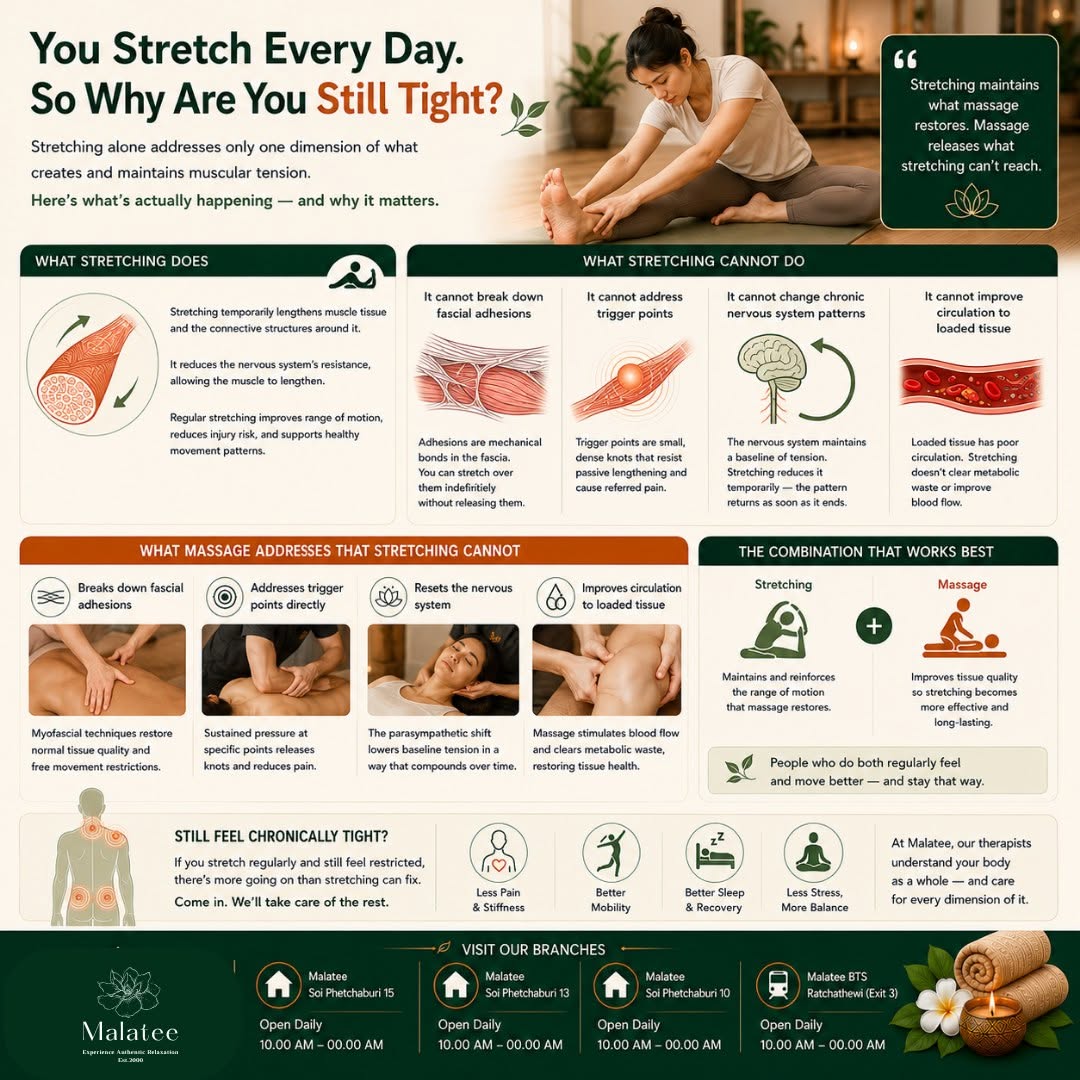
This is one of the most common questions from people who are genuinely trying to take care of their bodies.
They stretch in the morning. They do yoga. They follow a mobility routine. They spend ten minutes after every workout working through their problem areas. And yet — the neck is still stiff. The hips are still restricted. The lower back still aches by Thursday.
The stretching isn’t failing because it’s being done wrong. It’s falling short because stretching alone addresses only one dimension of what creates and maintains muscular tension.
Here’s what’s actually happening — and why it matters.
**What stretching does**
Stretching works by temporarily lengthening muscle tissue and the connective structures around it. When you hold a stretch, the muscle spindles — the sensory receptors that monitor muscle length — gradually reduce their resistance signal. The nervous system relaxes its protective contraction. The muscle lengthens.
This is genuinely useful. Regular stretching improves range of motion over time, reduces injury risk, and supports healthy movement patterns.
But its effects are limited by several factors that stretching alone cannot address.
**What stretching cannot do**
 It cannot break down fascial adhesions
The fascia — the connective tissue web that surrounds every muscle — becomes adhesive when it’s been under sustained load or has been relatively immobile. These adhesions bind muscle fibres together and to adjacent structures, creating restrictions that don’t respond to stretch because they are mechanical bonds in the tissue, not simply muscle contraction. You can stretch over an adhesion indefinitely without releasing it.
It cannot address trigger points
Trigger points are localised areas of contracted muscle fibres — small, dense knots within a muscle that maintain their contraction independently of the overall muscle’s state. They generate referred pain (the sensation in a different area from the knot itself) and resist passive lengthening. Stretching a muscle containing trigger points will lengthen the surrounding fibres but leave the trigger point intact.
It cannot change chronic nervous system patterns
The most significant limitation of stretching is that it works peripherally — on the muscle and connective tissue — but does not directly address the nervous system’s role in maintaining tension. When the nervous system is chronically activated — from sustained stress, poor sleep, or habitual postural patterns — it maintains a baseline of muscular tension that stretching temporarily reduces but does not reset.
As soon as the stretch ends, the nervous system re-establishes the pattern. Which is why the same areas feel tight again the next morning.
It cannot improve circulation to loaded tissue
Muscles that have been under sustained static load — from hours of sitting, screen time, or holding postures — have reduced local circulation. The metabolic waste that accumulates in these tissues doesn’t clear efficiently. Stretching doesn’t significantly improve this circulation. The tissue remains metabolically compromised regardless of how well it has been stretched.
**What massage addresses that stretching cannot**
Traditional Thai Massage works on all four of these dimensions simultaneously.
The myofascial techniques used by skilled Thai massage therapists physically break down adhesions — restoring normal tissue quality and freeing the movement restrictions that stretching passes over. The sustained pressure at specific points addresses trigger points directly. The parasympathetic shift that a good massage produces resets the nervous system’s baseline tension — not temporarily, but in a way that compounds with regular sessions. And the mechanical stimulation of massage significantly improves local circulation, clearing the metabolic waste that loaded tissue accumulates.
This is why people who stretch consistently but also receive regular massage feel genuinely different from people who only stretch. Not because the massage replaces the stretching. But because it addresses the dimensions of tension that stretching, by its nature, cannot reach.
The two work best together. Stretching maintains the range of motion that massage restores. Massage addresses the tissue quality that makes stretching more effective.
At Malatee, our therapists understand this complementary relationship. If you stretch regularly and still feel chronically tight — come in. There’s more going on than stretching can fix.
Walk-ins welcome at all Malatee branches.
คุณยืดกล้ามเนื้อทุกวัน แล้วทำไมยังตึงอยู่?
นี่คือหนึ่งในคำถามที่พบบ่อยที่สุดจากคนที่พยายามดูแลร่างกายอย่างจริงจัง
พวกเขายืดตอนเช้า ทำโยคะ ทำ Mobility Routine ใช้เวลาสิบนาทีหลังออกกำลังกายทุกครั้งในบริเวณที่มีปัญหา และยังคงมีคอที่แข็ง สะโพกที่จำกัด หลังส่วนล่างที่ยังปวดภายในวันพฤหัสบดี
การยืดไม่ได้ล้มเหลวเพราะทำไม่ถูก มันขาดตกบกพร่องเพราะการยืดเพียงอย่างเดียวจัดการแค่มิติเดียวของสิ่งที่สร้างและรักษาความตึงกล้ามเนื้อ
นี่คือสิ่งที่เกิดขึ้นจริงๆ — และทำไมมันถึงสำคัญ
การยืดทำอะไร
การยืดทำงานโดยยืดเนื้อเยื่อกล้ามเนื้อและโครงสร้างเนื้อเยื่อเกี่ยวพันรอบข้างชั่วคราว เมื่อคุณยึดการยืด ตัวรับความรู้สึกในกล้ามเนื้อค่อยๆ ลดสัญญาณต่อต้าน ระบบประสาทผ่อนคลายการหดตัวป้องกัน กล้ามเนื้อยาวขึ้น สิ่งนี้มีประโยชน์จริง การยืดสม่ำเสมอปรับปรุงช่วงการเคลื่อนไหวตามเวลา ลดความเสี่ยงต่อการบาดเจ็บ และสนับสนุนรูปแบบการเคลื่อนไหวที่มีสุขภาพดี แต่ผลของมันถูกจำกัดโดยปัจจัยหลายอย่างที่การยืดเพียงอย่างเดียวไม่สามารถจัดการได้
สิ่งที่การยืดทำไม่ได้
การยืดไม่สามารถสลายการยึดติดของพังผืด — พังผืดกลายเป็นกาวเมื่ออยู่ภายใต้ภาระต่อเนื่องหรืออยู่นิ่ง การยึดติดเหล่านี้ผูกเส้นใยกล้ามเนื้อเข้าด้วยกันและกับโครงสร้างที่อยู่ติดกัน สร้างข้อจำกัดที่ไม่ตอบสนองต่อการยืดเพราะเป็นพันธะทางกลในเนื้อเยื่อ ไม่ใช่แค่การหดตัวของกล้ามเนื้อ
การยืดไม่สามารถจัดการจุดกระตุ้น — จุดกระตุ้นคือบริเวณที่มีเส้นใยกล้ามเนื้อหดตัวเฉพาะจุด — กระจุกเล็กๆ ที่หนาแน่นภายในกล้ามเนื้อที่รักษาการหดตัวโดยอิสระจากสภาวะของกล้ามเนื้อโดยรวม การยืดกล้ามเนื้อที่มีจุดกระตุ้นจะยืดเส้นใยโดยรอบแต่ทิ้งจุดกระตุ้นไว้
การยืดไม่สามารถเปลี่ยนรูปแบบระบบประสาทเรื้อรัง — เมื่อระบบประสาทถูกกระตุ้นเรื้อรัง มันรักษาระดับพื้นฐานของความตึงกล้ามเนื้อที่การยืดลดลงชั่วคราวแต่ไม่รีเซ็ต ทันทีที่การยืดสิ้นสุด ระบบประสาทก็สร้างรูปแบบขึ้นมาใหม่ นั่นคือเหตุผลที่บริเวณเดิมรู้สึกตึงอีกครั้งในเช้าวันถัดไป
การยืดไม่สามารถปรับปรุงการไหลเวียนไปยังเนื้อเยื่อที่โหลด — กล้ามเนื้อที่อยู่ภายใต้ภาระนิ่งต่อเนื่องมีการไหลเวียนในพื้นที่ลดลง การยืดไม่ได้ปรับปรุงการไหลเวียนนี้อย่างมีนัยสำคัญ
สิ่งที่การนวดจัดการได้ที่การยืดไม่ได้
การนวดแผนไทยทำงานในสี่มิติเหล่านี้พร้อมกัน เทคนิคการคลายพังผืดสลายการยึดติด แรงกดต่อเนื่องที่จุดเฉพาะจัดการจุดกระตุ้น การเปลี่ยนแปลงของพาราซิมพาเทติกรีเซ็ตระดับพื้นฐานของระบบประสาท และการกระตุ้นทางกลของการนวดปรับปรุงการไหลเวียนในพื้นที่อย่างมีนัยสำคัญ
ทั้งสองทำงานได้ดีที่สุดร่วมกัน การยืดรักษาช่วงการเคลื่อนไหวที่การนวดคืนมา การนวดจัดการคุณภาพเนื้อเยื่อที่ทำให้การยืดมีประสิทธิภาพมากขึ้น
ไม่ต้องนัด Walk-in ยินดีต้อนรับทุกสาขา
 每天都在拉伸。为什么还是觉得紧绷?
这是真正在认真照顾自己身体的人最常提出的问题之一。
他们每天早晨拉伸,练瑜伽,坚持灵活性训练,每次锻炼后花十分钟专注于问题部位。然而颈部依然僵硬,髋部依然受限,到了周四下背部仍然酸痛。
拉伸没有失效,不是因为做法错误。而是因为单靠拉伸只能解决产生和维持肌肉紧张的其中一个维度。
拉伸能做什么
拉伸通过暂时延长肌肉组织和周围结缔结构来发挥作用。这确实有益,能随时间改善活动范围,降低受伤风险。但它的效果受到几个拉伸单独无法解决的因素的限制。
拉伸做不到的事
拉伸无法分解筋膜粘连——筋膜在持续负荷或相对不动时会产生粘附性,将肌纤维相互粘结并与相邻结构粘连,形成的限制是组织中的机械性连接而非单纯的肌肉收缩,再多拉伸也无法释放。
拉伸无法处理触发点——触发点是肌肉内局部收缩的肌纤维区域,独立于整体肌肉状态维持收缩。拉伸含有触发点的肌肉会延长周围纤维,但触发点依然完好。
拉伸无法改变慢性神经系统模式——当神经系统长期处于激活状态时,它会维持一种基础的肌肉紧张水平,拉伸只能暂时降低而无法重置。一旦拉伸结束,神经系统就重新建立那种模式——这就是为什么同样的部位第二天早上又感到紧绷。
拉伸无法改善受负荷组织的血液循环——长时间静态负荷下的肌肉局部循环减弱,拉伸无法显著改善这一循环。
按摩能做到而拉伸做不到的
泰式传统按摩同时作用于以上四个维度——筋膜松解技法分解粘连,特定点的持续按压处理触发点,好的按摩所产生的副交感神经转换重置神经系统基础张力,而按摩的机械刺激显著改善受负荷组织的局部血液循环。
两者配合效果最佳。拉伸维持按摩所恢复的活动范围,按摩处理让拉伸更有效的组织质量。
欢迎直接前往 Malatee 任意门店,无需预约。
Experience Authentic Relaxation | Est. 2000
Visit Our Branches:
• Malatee Soi Phetchaburi 15
• Malatee Soi Phetchaburi 13
• Malatee Soi Phetchaburi 10
• Malatee BTS Ratchathewi (Exit 3)
#MalateeThaiMassage#มาลาตีนวดไทย#StretchingVsMassage#การยืดกล้ามเนื้อ#ThaiMassageBangkok#นวดแผนไทย#MobilityAndMassage#WellnessBangkok#BangkokMassage#นวดเพื่อสุขภาพ#ถนนเพชรบุรี#FasciaRelease#MuscleRecovery
Lorem Ipsum is simply dummy text of the printing and typesetting industry