
Why Guests Return: What Consistent Care Looks Like at Malatee
Malatee Thai Massage has welcomed guests in Bangkok since 2000, and our name comes from the Malatee jasmine, the most
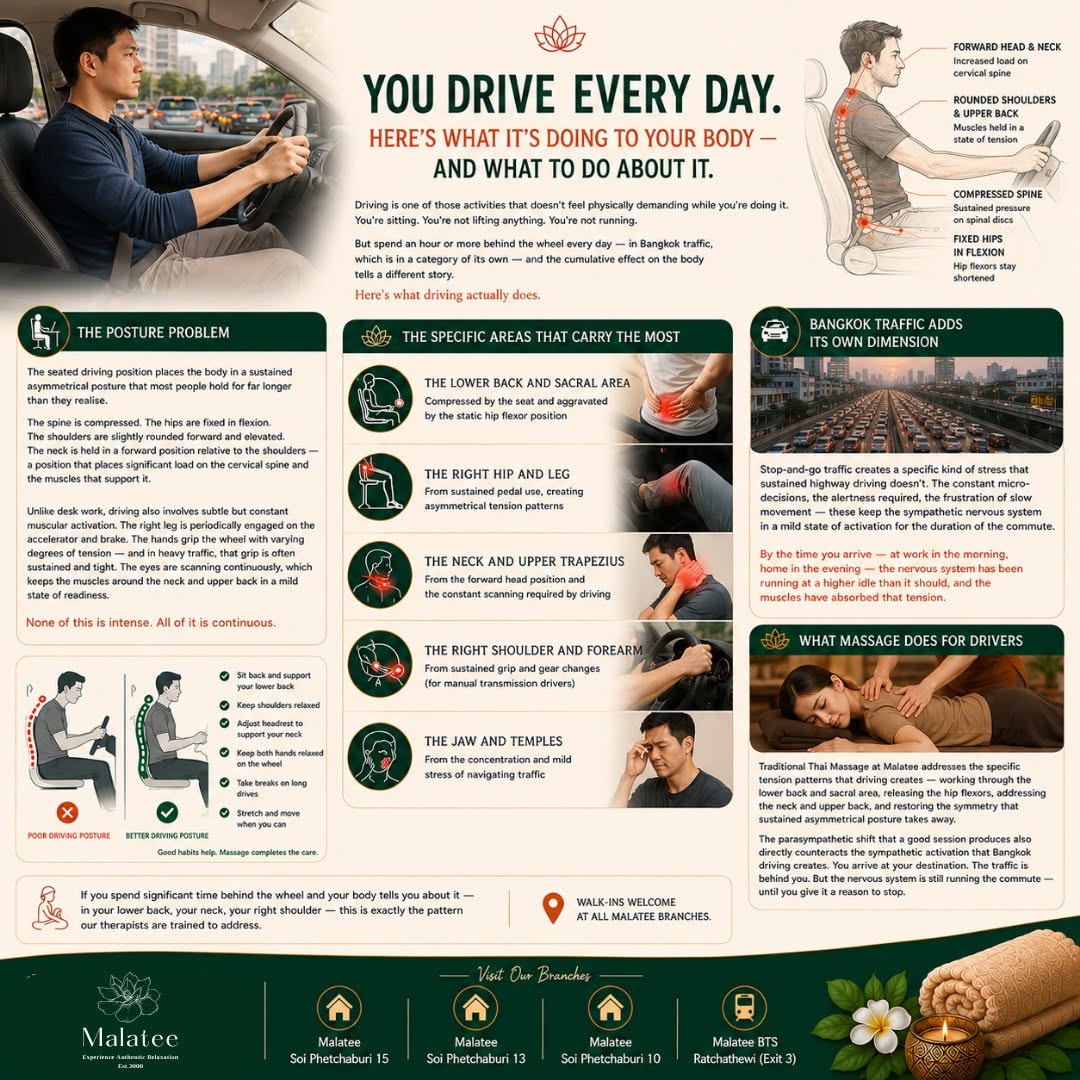
Driving is one of those activities that doesn’t feel physically demanding while you’re doing it. You’re sitting. You’re not lifting anything. You’re not running.
But spend an hour or more behind the wheel every day — in Bangkok traffic, which is in a category of its own — and the cumulative effect on the body tells a different story.
Here’s what driving actually does.
**The posture problem**
The seated driving position places the body in a sustained asymmetrical posture that most people hold for far longer than they realise. The spine is compressed. The hips are fixed in flexion. The shoulders are slightly rounded forward and elevated. The neck is held in a forward position relative to the shoulders — a position that places significant load on the cervical spine and the muscles that support it.
Unlike desk work, driving also involves subtle but constant muscular activation. The right leg is periodically engaged on the accelerator and brake. The hands grip the wheel with varying degrees of tension — and in heavy traffic, that grip is often sustained and tight. The eyes are scanning continuously, which keeps the muscles around the neck and upper back in a mild state of readiness.
None of this is intense. All of it is continuous.
**The specific areas that carry the most**
People who drive regularly — whether for commuting, work, or long distances — consistently develop tension in a predictable set of areas:
 The lower back and sacral area — compressed by the seat and aggravated by the static hip flexor position
The right hip and leg — from sustained pedal use, creating asymmetrical tension patterns
The neck and upper trapezius — from the forward head position and the constant scanning required by driving
The right shoulder and forearm — from sustained grip and gear changes (for manual transmission drivers)
The jaw and temples — from the concentration and mild stress of navigating traffic
**Bangkok traffic adds its own dimension**
Stop-and-go traffic creates a specific kind of stress that sustained highway driving doesn’t. The constant micro-decisions, the alertness required, the frustration of slow movement — these keep the sympathetic nervous system in a mild state of activation for the duration of the commute. By the time you arrive — at work in the morning, home in the evening — the nervous system has been running at a higher idle than it should, and the muscles have absorbed that tension.
**What massage does for drivers**
Traditional Thai Massage at Malatee addresses the specific tension patterns that driving creates — working through the lower back and sacral area, releasing the hip flexors, addressing the neck and upper back, and restoring the symmetry that sustained asymmetrical posture takes away.
The parasympathetic shift that a good session produces also directly counteracts the sympathetic activation that Bangkok driving creates. You arrive at your destination. The traffic is behind you. But the nervous system is still running the commute — until you give it a reason to stop.
If you spend significant time behind the wheel and your body tells you about it — in your lower back, your neck, your right shoulder — this is exactly the pattern our therapists are trained to address.
 Walk-ins welcome at all Malatee branches.
 คุณขับรถทุกวัน นี่คือสิ่งที่มันทำกับร่างกายของคุณ — และจะทำอะไรกับมันได้บ้าง
การขับรถเป็นกิจกรรมหนึ่งที่ไม่รู้สึกว่าต้องออกแรงทางกายในขณะที่ทำ คุณแค่นั่ง ไม่ได้ยกอะไร ไม่ได้วิ่ง
แต่ใช้เวลาหนึ่งชั่วโมงหรือมากกว่านั้นหลังพวงมาลัยทุกวัน — ในการจราจรกรุงเทพฯ ซึ่งอยู่ในหมวดหมู่ของตัวเอง — และผลสะสมต่อร่างกายบอกเล่าเรื่องราวที่ต่างออกไป
นี่คือสิ่งที่การขับรถทำจริงๆ
ปัญหาท่าทาง
ท่านั่งขับรถวางร่างกายในท่าทางที่ไม่สมมาตรอย่างยั่งยืนซึ่งคนส่วนใหญ่ยึดนานกว่าที่พวกเขาตระหนัก กระดูกสันหลังถูกกดทับ สะโพกถูกตรึงในท่างอ บ่าโค้งไปข้างหน้าและยกขึ้นเล็กน้อย คอถูกยึดไว้ในตำแหน่งยื่นไปข้างหน้าเทียบกับบ่า — ท่าทางที่วางภาระอย่างมีนัยสำคัญบนกระดูกสันหลังส่วนคอและกล้ามเนื้อที่รองรับมัน
ต่างจากการทำงานที่โต๊ะ การขับรถยังเกี่ยวข้องกับการกระตุ้นกล้ามเนื้อที่ละเอียดอ่อนแต่ต่อเนื่อง ขาขวาถูกกระตุ้นเป็นระยะบนคันเร่งและเบรก มือจับพวงมาลัยด้วยแรงตึงในระดับที่แตกต่างกัน — และในการจราจรหนาแน่น การจับนั้นมักยั่งยืนและแน่น ดวงตาสแกนอย่างต่อเนื่อง ซึ่งทำให้กล้ามเนื้อรอบคอและหลังส่วนบนอยู่ในสภาวะพร้อมรับเล็กน้อย
ไม่มีสิ่งใดที่เข้มข้น แต่ทั้งหมดต่อเนื่อง
บริเวณเฉพาะที่แบกรับมากที่สุด
คนที่ขับรถสม่ำเสมอ — ไม่ว่าจะเพื่อเดินทาง ทำงาน หรือระยะไกล — มักพัฒนาความตึงในบริเวณที่คาดเดาได้:
หลังส่วนล่างและบริเวณกระเบนเหน็บ — ถูกกดทับโดยเบาะและทำให้แย่ลงจากท่าสะโพกงออยู่นิ่ง
สะโพกขวาและขา — จากการใช้คันเร่งและเบรกอย่างยั่งยืน สร้างรูปแบบความตึงที่ไม่สมมาตร
คอและ Trapezius ส่วนบน — จากท่าศีรษะยื่นและการสแกนต่อเนื่องที่การขับรถต้องการ
บ่าขวาและแขนท่อนล่าง — จากการจับแน่นและเปลี่ยนเกียร์ (สำหรับผู้ขับรถเกียร์ธรรมดา)
กรามและขมับ — จากสมาธิและความเครียดเล็กน้อยจากการนำทางในการจราจร
การจราจรกรุงเทพฯ เพิ่มมิติของตัวเอง
การจราจรหยุดแล้วไปสร้างความเครียดแบบเฉพาะที่การขับรถบนทางหลวงอย่างต่อเนื่องไม่ได้สร้าง การตัดสินใจเล็กๆ อย่างต่อเนื่อง ความตื่นตัวที่ต้องการ ความหงุดหงิดของการเคลื่อนที่ช้า — สิ่งเหล่านี้ทำให้ระบบประสาทซิมพาเทติกอยู่ในสภาวะตื่นตัวเล็กน้อยตลอดการเดินทาง พอถึงเวลาที่คุณมาถึง — ที่ทำงานตอนเช้า บ้านตอนเย็น — ระบบประสาทยังคงทำงานในอัตราที่สูงกว่าที่ควร และกล้ามเนื้อได้ซึมซับความตึงนั้น
การนวดทำอะไรสำหรับผู้ขับรถ
การนวดแผนไทยที่มาลาตีจัดการรูปแบบความตึงเฉพาะที่การขับรถสร้าง — ทำงานผ่านหลังส่วนล่างและบริเวณกระเบนเหน็บ คลายกล้ามเนื้อสะโพกด้านหน้า จัดการคอและหลังส่วนบน และคืนความสมมาตรที่ท่าทางไม่สมมาตรอย่างยั่งยืนนำไปจากมัน
การเปลี่ยนแปลงของพาราซิมพาเทติกที่การนวดที่ดีสร้างยังต่อต้านการกระตุ้นซิมพาเทติกที่การขับรถในกรุงเทพฯ สร้างโดยตรง คุณมาถึงจุดหมายแล้ว การจราจรอยู่เบื้องหลังคุณแล้ว แต่ระบบประสาทยังคงทำการเดินทาง — จนกว่าคุณจะให้เหตุผลที่จะหยุด
ถ้าคุณใช้เวลาอย่างมีนัยสำคัญหลังพวงมาลัยและร่างกายของคุณบอกคุณเกี่ยวกับมัน — ที่หลังส่วนล่าง คอ บ่าขวา — นี่คือรูปแบบที่หมอนวดของเราได้รับการฝึกมาเพื่อจัดการ
ไม่ต้องนัด Walk-in ยินดีต้อนรับทุกสาขา
你每天开车。这是它对身体造成的影响——以及该如何应对。
开车是那种做的时候感觉不费力的活动。你只是坐着,没有搬东西,没有跑步。
但每天在方向盘后面待上一个小时或更长——在曼谷的交通中,这本身就是一个独特的考验——身体的累积效应讲述的是一个截然不同的故事。
这是开车真正在做的事。
姿态问题
驾驶坐姿让身体长时间保持一种不对称的持续姿势,而大多数人持续的时间远超自己意识到的。脊柱受到压迫,髋部固定在屈曲位置,肩膀略微前倾上耸,颈部相对于肩膀保持前伸姿势——这种姿势对颈椎及其支撑肌肉造成显著的负荷。
与伏案工作不同,开车还涉及微妙但持续的肌肉激活。右腿定期在油门和刹车之间交替发力。双手以不同程度的紧张感握住方向盘——在拥堵交通中,这种握持往往持续而用力。眼睛持续扫描,使颈部和上背部周围的肌肉保持轻度备战状态。
没有任何一项是高强度的。但所有这些都是持续进行的。
承受最多的特定部位
经常开车的人——无论是通勤、工作还是长途——会在可预测的一组部位持续积累紧张:
下背部和骶骨区域——被座椅压迫,并因静态髋屈曲姿势而加重
右髋和腿部——因持续踩踏板而形成不对称紧张模式
颈部和上斜方肌——因头部前伸姿势和驾驶所需的持续扫视
右肩和前臂——因持续握力和换挡动作(手动挡驾驶者)
下颌和太阳穴——因在交通中导航所需的专注和轻度压力
曼谷交通增添了它自己的维度
走走停停的交通制造了一种持续高速公路行驶所没有的特定压力。不间断的微决策、所需的高度警觉、缓慢移动带来的沮丧——这些让交感神经系统在整个通勤过程中保持轻度激活状态。当你到达目的地时——早上到公司,晚上到家——神经系统仍在以高于正常水平的”怠速”运转,肌肉也已经吸收了这种紧张。
按摩对开车族的作用
Malatee 的泰式传统按摩专门针对开车所形成的特定紧张模式——处理下背部和骶骨区域,舒缓髋屈肌,调理颈部和上背部,恢复长期不对称姿势所带走的身体对称性。
一次好的按摩所产生的副交感神经转换,也直接抵消了曼谷驾驶所制造的交感神经激活。你已经到达目的地,交通已经在你身后,但神经系统仍在”跑”那段通勤——直到你给它一个停下来的理由。
如果你在方向盘后面花了大量时间,而身体在用下背部、颈部或右肩告诉你——这正是我们的按摩师受过专业训练去处理的模式。
欢迎直接前往 Malatee 任意门店,无需预约。
 Experience Authentic Relaxation | Est. 2000
 Visit Our Branches:
• Malatee Soi Phetchaburi 15
• Malatee Soi Phetchaburi 13
• Malatee Soi Phetchaburi 10
• Malatee BTS Ratchathewi (Exit 3)
#MalateeThaiMassage#มาลาตีนวดไทย#DrivingAndMassage#ขับรถ#ThaiMassageBangkok#นวดแผนไทย#BangkokTraffic#รถติดกรุงเทพ#WellnessBangkok#BangkokMassage#นวดเพื่อสุขภาพ#ถนนเพชรบุรี#LowerBackPain#NeckPain
Lorem Ipsum is simply dummy text of the printing and typesetting industry