
Why Guests Return: What Consistent Care Looks Like at Malatee
Malatee Thai Massage has welcomed guests in Bangkok since 2000, and our name comes from the Malatee jasmine, the most
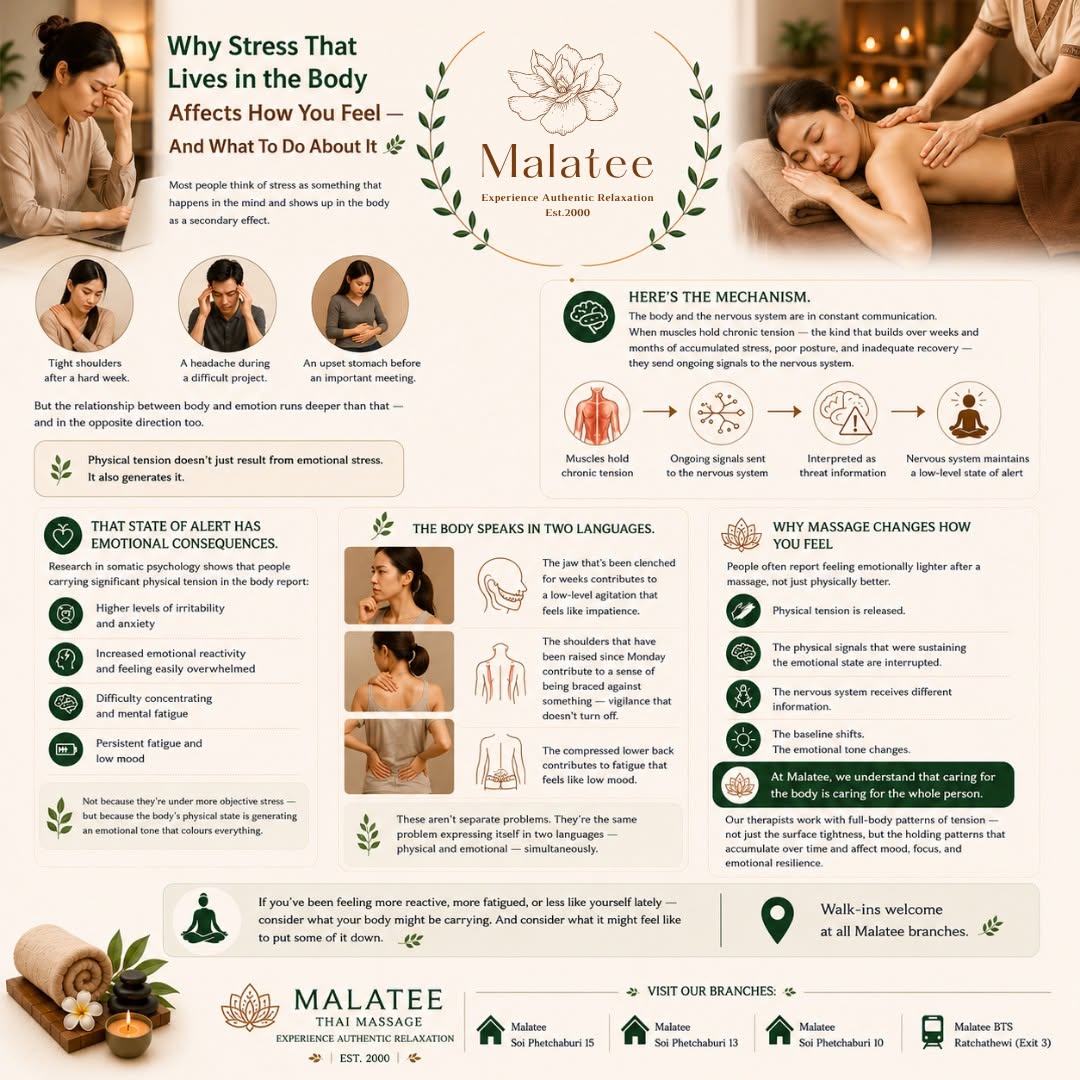
Most people think of stress as something that happens in the mind and shows up in the body as a secondary effect. Tight shoulders after a hard week. A headache during a difficult project. An upset stomach before an important meeting.
But the relationship between body and emotion runs deeper than that — and in the opposite direction too.
Physical tension doesn’t just result from emotional stress. It also generates it.
Here’s the mechanism.
The body and the nervous system are in constant communication. When muscles hold chronic tension — the kind that builds over weeks and months of accumulated stress, poor posture, and inadequate recovery — they send ongoing signals to the nervous system. These signals are interpreted as threat information. The nervous system responds by maintaining a low-level state of alert.
That state of alert has emotional consequences.
Research in the field of somatic psychology has consistently shown that people carrying significant physical tension in the body report higher levels of irritability, anxiety, emotional reactivity, and difficulty concentrating. Not because they’re under more objective stress — but because the body’s physical state is generating an emotional tone that colours everything.
The jaw that’s been clenched for weeks contributes to a low-level agitation that feels like impatience. The shoulders that have been raised since Monday contribute to a sense of being braced against something — vigilance that doesn’t turn off even when there’s nothing immediate to be vigilant about. The compressed lower back contributes to fatigue that feels like low mood.
These aren’t separate problems. They’re the same problem expressing itself in two languages — physical and emotional — simultaneously.
This is why people often report feeling emotionally lighter after a massage, not just physically better. It’s not simply that they’ve relaxed. It’s that the physical signals that were sustaining the emotional state have been interrupted.
The nervous system receives different information. The baseline shifts. The emotional tone changes.
At Malatee, we understand that caring for the body is caring for the whole person. Our therapists work with full-body patterns of tension — not just the surface tightness, but the holding patterns that accumulate over time and affect mood, focus, and emotional resilience.
If you’ve been feeling more reactive, more fatigued, or less like yourself lately — consider what your body might be carrying. And consider what it might feel like to put some of it down.
 Walk-ins welcome at all Malatee branches.
 ทำไมความเครียดที่อยู่ในร่างกายถึงส่งผลต่ออารมณ์ — และจะทำอย่างไรกับมัน
คนส่วนใหญ่คิดว่าความเครียดเป็นสิ่งที่เกิดขึ้นในจิตใจและแสดงออกมาในร่างกายเป็นผลพลอยได้ บ่าตึงหลังสัปดาห์ที่หนัก ปวดหัวระหว่างโปรเจกต์ยาก ปวดท้องก่อนการประชุมสำคัญ
แต่ความสัมพันธ์ระหว่างร่างกายและอารมณ์ลึกกว่านั้น — และไปในทิศทางตรงข้ามด้วย
ความตึงทางกายไม่ได้เป็นแค่ผลจากความเครียดทางอารมณ์ มันยังสร้างความเครียดทางอารมณ์ด้วย
นี่คือกลไก
ร่างกายและระบบประสาทอยู่ในการสื่อสารอย่างต่อเนื่อง เมื่อกล้ามเนื้อเก็บความตึงเรื้อรัง — ชนิดที่สะสมตลอดหลายสัปดาห์และเดือนจากความเครียดสะสม ท่าทางไม่ดี และการฟื้นฟูที่ไม่เพียงพอ — พวกมันส่งสัญญาณอย่างต่อเนื่องไปยังระบบประสาท สัญญาณเหล่านี้ถูกตีความว่าเป็นข้อมูลภัยคุกคาม ระบบประสาทตอบสนองด้วยการรักษาสภาวะตื่นตัวระดับต่ำ
สภาวะตื่นตัวนั้นมีผลกระทบทางอารมณ์
งานวิจัยในสาขาจิตวิทยาโซมาติกแสดงให้เห็นอย่างสม่ำเสมอว่าคนที่แบกรับความตึงทางกายอย่างมีนัยสำคัญรายงานระดับความหงุดหงิด ความวิตกกังวล ปฏิกิริยาทางอารมณ์ที่รุนแรง และความยากในการโฟกัสที่สูงกว่า ไม่ใช่เพราะพวกเขาอยู่ภายใต้ความเครียดที่เป็นวัตถุวิสัยมากกว่า — แต่เพราะสภาวะทางกายของร่างกายกำลังสร้างโทนอารมณ์ที่ระบายสีทุกอย่าง
กรามที่เกร็งมาหลายสัปดาห์มีส่วนทำให้เกิดความรู้สึกหงุดหงิดระดับต่ำที่รู้สึกเหมือนความไม่อดทน บ่าที่ยกขึ้นมาตั้งแต่วันจันทร์มีส่วนทำให้เกิดความรู้สึกว่าต้องเกร็งรับมือกับบางอย่าง — การระวังภัยที่ไม่ดับแม้ไม่มีสิ่งใดในทันทีที่ต้องระวัง หลังส่วนล่างที่ถูกกดทับมีส่วนทำให้เกิดความเหนื่อยล้าที่รู้สึกเหมือนอารมณ์ต่ำ
สิ่งเหล่านี้ไม่ใช่ปัญหาแยกต่างหาก แต่เป็นปัญหาเดียวกันที่แสดงออกในสองภาษา — กายภาพและอารมณ์ — พร้อมกัน
นี่คือเหตุผลที่คนมักรายงานว่ารู้สึกเบาสบายทางอารมณ์หลังการนวด ไม่ใช่แค่รู้สึกดีขึ้นทางกาย ไม่ใช่แค่ว่าพวกเขาผ่อนคลาย แต่สัญญาณทางกายที่คอยหล่อเลี้ยงสภาวะอารมณ์นั้นได้ถูกขัดจังหวะ
ระบบประสาทรับข้อมูลที่ต่างออกไป เส้นฐานเปลี่ยน โทนอารมณ์เปลี่ยนตาม
ที่มาลาตี เราเข้าใจว่าการดูแลร่างกายคือการดูแลทั้งคน หมอนวดของเราทำงานกับรูปแบบความตึงทั่วร่างกาย — ไม่ใช่แค่ความตึงผิวเผิน แต่รูปแบบการยึดที่สะสมเมื่อเวลาผ่านไปและส่งผลต่ออารมณ์ สมาธิ และความยืดหยุ่นทางอารมณ์
ถ้าคุณรู้สึกปฏิกิริยารุนแรงขึ้น เหนื่อยมากขึ้น หรือไม่ค่อยเป็นตัวเองช่วงนี้ — ลองพิจารณาว่าร่างกายของคุณอาจกำลังแบกอะไรอยู่ และลองนึกดูว่าจะรู้สึกอย่างไรถ้าได้วางสิ่งนั้นลงบ้าง
ไม่ต้องนัด Walk-in ยินดีต้อนรับทุกสาขา
为什么积存在身体里的压力,会影响你的情绪——以及该如何应对
大多数人认为,压力是发生在大脑中的事,然后作为次生效应表现在身体上。漫长一周后紧绷的肩膀,艰难项目期间的头痛,重要会议前的肠胃不适。
但身体与情绪之间的关系,远比这更深——而且方向也是双向的。
身体的紧张不只是情绪压力的结果,它同样会制造情绪压力。
机制如下。
身体与神经系统始终处于持续的沟通之中。当肌肉保持慢性紧张——那种在数周和数月的压力积累、不良姿态和恢复不足中逐渐形成的紧张——它们会持续向神经系统发送信号。这些信号被解读为威胁信息。神经系统随之作出响应,维持一种低强度的持续警觉状态。
而这种警觉状态,会带来情绪层面的后果。
躯体心理学领域的研究持续表明:身体承受显著紧张的人,会报告更高水平的烦躁感、焦虑、情绪反应性,以及难以集中注意力——并非因为他们面临更多客观压力,而是因为身体的物理状态正在制造一种情绪底色,为一切染上了颜色。
紧绷了数周的下颌,催生出一种低强度的烦躁感,感觉像是失去了耐心。从周一就开始上耸的肩膀,让人持续处于一种”随时准备抵御”的状态——一种即使当下没有任何威胁也无法关闭的警觉。受压的下背部,带来一种感觉像是情绪低落的疲惫。
这些不是彼此独立的问题。它们是同一个问题,同时用两种语言表达——身体的,和情绪的。
这就是为什么人们在按摩后,常常感到情绪上也变得更轻盈,而不只是身体感觉更好。不只是因为他们放松了,而是因为那些持续维系情绪状态的身体信号,被打断了。
神经系统接收到了不同的信息。基准线发生了变化。情绪底色随之改变。
在 Malatee,我们深知照顾身体,就是照顾整个人。我们的按摩师处理全身性的紧张模式——不只是表层的僵硬,更包括那些随时间积累、影响情绪、专注力和心理韧性的深层持续性紧绷。
如果你最近感到更容易情绪激动、更加疲惫,或者不太像自己——试着想想,你的身体可能正在承受什么。再想想,如果能放下一部分,会是什么感觉。
欢迎直接前往 Malatee 任意门店,无需预约。
 Experience Authentic Relaxation | Est. 2000
 Visit Our Branches:
• Malatee Soi Phetchaburi 15
• Malatee Soi Phetchaburi 13
• Malatee Soi Phetchaburi 10
• Malatee BTS Ratchathewi (Exit 3)
#MalateeThaiMassage#มาลาตีนวดไทย#StressAndMood#ความเครียดและอารมณ์#MindBodyConnection#ThaiMassageBangkok#นวดแผนไทย#WellnessBangkok#BangkokMassage#นวดเพื่อสุขภาพ#ถนนเพชรบุรี#SomaticWellness#EmotionalWellness#MassageTherapy
Lorem Ipsum is simply dummy text of the printing and typesetting industry