
Why Guests Return: What Consistent Care Looks Like at Malatee
Malatee Thai Massage has welcomed guests in Bangkok since 2000, and our name comes from the Malatee jasmine, the most
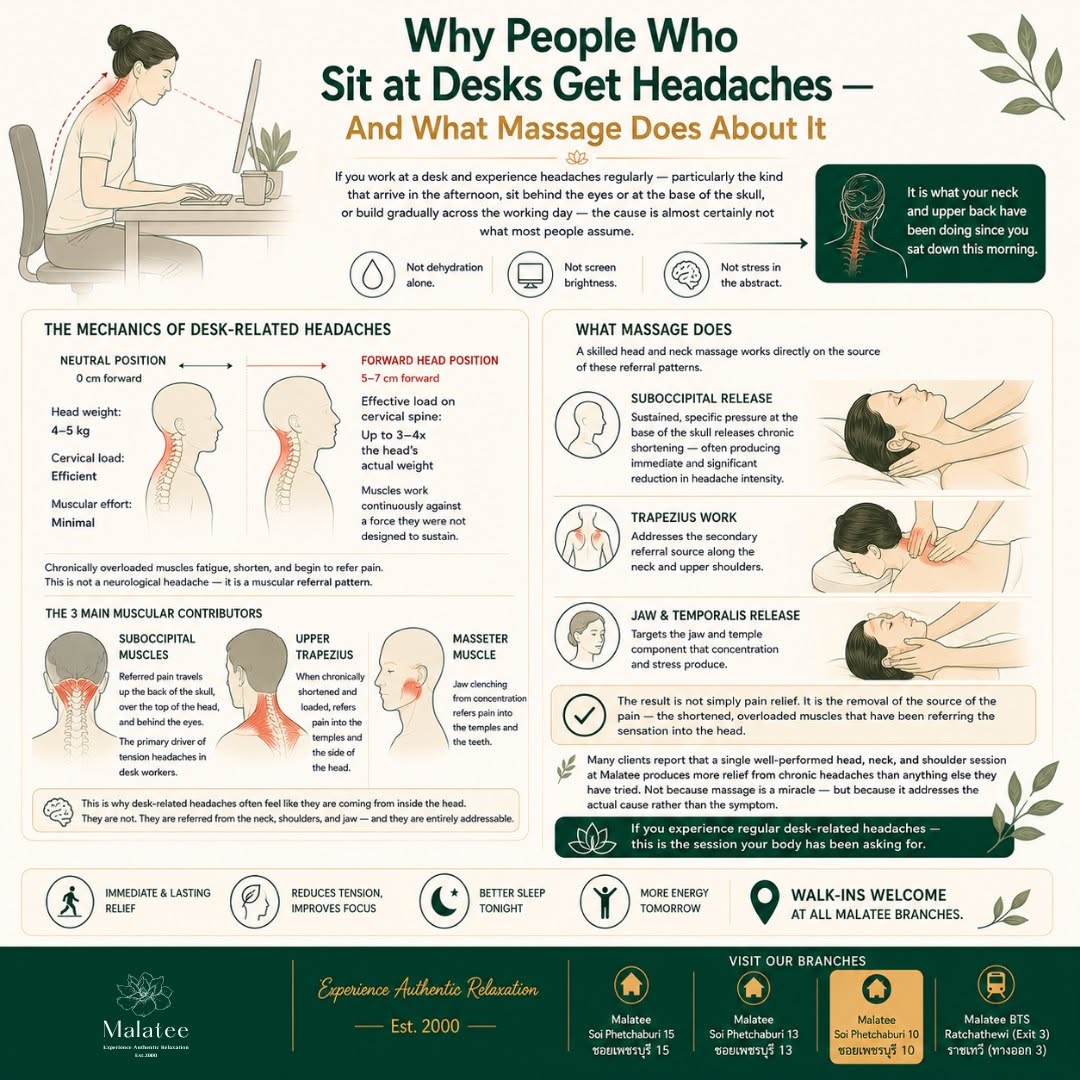
If you work at a desk and experience headaches regularly — particularly the kind that arrive in the afternoon, that sit behind the eyes or at the base of the skull, or that build gradually across the working day — the cause is almost certainly not what most people assume.
It is not dehydration alone. It is not screen brightness. It is not stress in the abstract sense.
It is what your neck and upper back have been doing since you sat down this morning.
The mechanics of desk-related headaches
The average head weighs between 4 and 5 kilograms. In a neutral position — ears aligned with shoulders, chin level — the cervical spine manages this load efficiently with minimal muscular effort.
In the forward head position that sustained screen work produces, this changes dramatically. For every centimetre the head moves forward from neutral, the effective load on the cervical spine increases significantly. By the time the head is in the typical screen-working position — 5 to 7 centimetres forward of neutral — the cervical spine is managing a load equivalent to several times the head’s actual weight.
The muscles that manage this load — particularly the suboccipital group at the base of the skull — are working continuously against a force they were not designed to sustain. They fatigue. They shorten. They begin to refer pain.
The suboccipital muscles, when chronically overloaded, produce a specific pattern of referred pain that travels up through the back of the skull, over the top of the head, and into the area behind the eyes. This is the tension headache that most desk workers know — and it is not a headache in the neurological sense. It is a muscular referral pattern from the base of the skull.
The trapezius — the broad muscle running from the neck across the top of the shoulders — is the second major contributor. When chronically shortened and loaded, the upper trapezius refers pain into the temples and the side of the head. The masseter — the jaw muscle that clenches under sustained concentration — refers pain into the temples and the teeth.
This is why desk-related headaches often feel like they are coming from inside the head. They are not. They are referred from the neck, shoulders, and jaw — and they are entirely addressable through skilled manual therapy.
What massage does
A skilled head and neck massage at Malatee works directly on the source of these referral patterns.
The suboccipital release at the base of the skull addresses the primary driver of tension headaches in desk workers. Sustained, specific pressure at the suboccipital muscles releases the chronic shortening that has been producing the referral pattern — often producing immediate and significant reduction in headache intensity.
The trapezius work along the neck and upper shoulders addresses the secondary referral source. The masseter and temporalis release addresses the jaw and temple component that concentration and stress produce.
The result is not simply pain relief. It is the removal of the source of the pain — the shortened, overloaded muscles that have been referring the sensation into the head.
Many clients report that a single well-performed head, neck, and shoulder session at Malatee produces more relief from chronic headaches than anything else they have tried. Not because massage is a miracle — but because it addresses the actual cause rather than the symptom.
If you experience regular desk-related headaches — this is the session your body has been asking for.
Walk-ins welcome at all Malatee branches.
为什么久坐工作的人经常头痛——以及按摩如何帮助
如果你在桌前工作并经常头痛——特别是那种在下午出现、坐落在眼睛后方或颅底、或在工作日中逐渐加重的头痛——原因几乎肯定不是大多数人所假设的那样。
不只是脱水,不是屏幕亮度,不是抽象意义上的压力。
而是你的颈部和上背部从今天早上坐下来就一直在做的事。
伏案头痛的力学原理
头部平均重量在4至5公斤之间。在中立位置——耳朵与肩膀对齐,下巴水平——颈椎以最小的肌肉努力高效管理这个重量。
在持续屏幕工作所产生的头部前伸姿势中,这一切发生了显著变化。头部每从中立位向前移动一厘米,颈椎承受的有效负荷就显著增加。当头部处于典型的屏幕工作位置时,颈椎所管理的负荷相当于头部实际重量的数倍。
管理这种负荷的肌肉——特别是颅底的枕下肌群——持续对抗它们并非为此设计的力量。它们疲劳,缩短,开始产生放射性疼痛。
枕下肌群在长期过载时,会产生一种特定的放射性疼痛模式,沿颅骨后部向上,越过头顶,进入眼睛后方区域。这就是大多数伏案工作者所熟悉的紧张性头痛——它在神经学意义上不是头痛,而是来自颅底的肌肉放射模式。
上斜方肌在长期缩短和过载时,将疼痛放射至太阳穴和头部两侧。咬肌——在持续专注下咬紧的下颌肌肉——将疼痛放射至太阳穴和牙齿。
这就是为什么与工作相关的头痛常常感觉像是从头部内部发出——实际上它们来自颈部、肩膀和下颌的放射,完全可以通过专业手法治疗来处理。
按摩能做什么
Malatee 专业的头颈按摩直接作用于这些放射模式的来源——颅底枕下肌群的放松处理伏案工作者紧张性头痛的主要驱动因素,斜方肌操作处理颈部和肩膀的继发放射来源,咬肌和颞肌放松处理下颌和太阳穴的压力成分。
结果不只是疼痛缓解,而是疼痛来源的消除——那些一直将感觉放射到头部的缩短、过载的肌肉。
如果你经常出现与工作相关的头痛——这正是你的身体一直在要求的疗程。
欢迎直接前往 Malatee 任意门店,无需预约。
ทำไมคนที่นั่งทำงานนานๆ ถึงปวดหัวบ่อย — และนวดช่วยได้อย่างไร
ถ้าคุณทำงานที่โต๊ะและมีอาการปวดหัวสม่ำเสมอ — โดยเฉพาะแบบที่มาในช่วงบ่าย นั่งอยู่หลังตา หรือที่ฐานกะโหลก หรือสะสมขึ้นเรื่อยๆ ตลอดวันทำงาน — สาเหตุเกือบแน่นอนไม่ใช่สิ่งที่คนส่วนใหญ่สันนิษฐาน
ไม่ใช่แค่การขาดน้ำ ไม่ใช่ความสว่างของหน้าจอ ไม่ใช่ความเครียดในความหมายนามธรรม
แต่คือสิ่งที่คอและหลังส่วนบนของคุณทำมาตั้งแต่นั่งลงเช้านี้
กลไกของอาการปวดหัวจากการทำงานที่โต๊ะ
ศีรษะโดยเฉลี่ยมีน้ำหนัก 4-5 กิโลกรัม ในท่าที่เป็นกลาง — หูอยู่แนวเดียวกับไหล่ คางระดับ — กระดูกสันหลังส่วนคอจัดการภาระนี้ได้อย่างมีประสิทธิภาพโดยใช้ความพยายามกล้ามเนื้อน้อยที่สุด
ในท่าศีรษะยื่นไปข้างหน้าที่การทำงานหน้าจอต่อเนื่องสร้างขึ้น สิ่งนี้เปลี่ยนไปอย่างมาก สำหรับทุกเซนติเมตรที่ศีรษะเคลื่อนไปข้างหน้าจากท่าที่เป็นกลาง ภาระที่มีประสิทธิผลบนกระดูกสันหลังส่วนคอเพิ่มขึ้นอย่างมีนัยสำคัญ
กล้ามเนื้อที่จัดการภาระนี้ — โดยเฉพาะกลุ่ม Suboccipital ที่ฐานกะโหลก — ทำงานต่อเนื่องต่อต้านแรงที่ไม่ได้ถูกออกแบบมาให้รองรับ พวกมันเหนื่อย สั้นลง เริ่มส่งความเจ็บปวดไปยังบริเวณอื่น
กล้ามเนื้อ Suboccipital เมื่อโหลดเรื้อรัง สร้างรูปแบบความเจ็บปวดที่ส่งขึ้นผ่านด้านหลังกะโหลก ข้ามส่วนบนของศีรษะ และเข้าสู่บริเวณหลังตา นี่คืออาการปวดหัวตึงที่คนทำงานที่โต๊ะส่วนใหญ่รู้จัก และมันไม่ใช่อาการปวดหัวในแง่ประสาทวิทยา แต่คือรูปแบบการส่งความเจ็บปวดจากกล้ามเนื้อที่ฐานกะโหลก
Trapezius ส่วนบนเมื่อสั้นและโหลดเรื้อรัง ส่งความเจ็บปวดเข้าสู่ขมับและด้านข้างของศีรษะ Masseter — กล้ามเนื้อกรามที่กัดแน่นระหว่างสมาธิต่อเนื่อง — ส่งความเจ็บปวดเข้าสู่ขมับและฟัน
นี่คือเหตุผลที่อาการปวดหัวที่เกี่ยวกับงานมักรู้สึกเหมือนมาจากภายในศีรษะ ความจริงคือมันส่งมาจากคอ บ่า และกราม — และสามารถจัดการได้อย่างสมบูรณ์ผ่านการบำบัดด้วยมือที่มีทักษะ
การนวดทำอะไร
การนวดหัวและคอที่มีทักษะที่มาลาตีทำงานโดยตรงบนแหล่งที่มาของรูปแบบการส่งเหล่านี้
การคลาย Suboccipital ที่ฐานกะโหลกจัดการตัวขับเคลื่อนหลักของอาการปวดหัวตึงในคนทำงานที่โต๊ะ การทำงาน Trapezius ตามคอและบ่าส่วนบนจัดการแหล่งการส่งรอง การปล่อย Masseter และ Temporalis จัดการส่วนประกอบกรามและขมับ
ผลลัพธ์ไม่ใช่แค่การบรรเทาความเจ็บปวด แต่คือการกำจัดแหล่งที่มาของความเจ็บปวด
ถ้าคุณมีอาการปวดหัวที่เกี่ยวกับงานสม่ำเสมอ — นี่คือการนวดที่ร่างกายขอมาตลอด
ไม่ต้องนัด Walk-in ยินดีต้อนรับทุกสาขา
Experience Authentic Relaxation | Est. 2000
Visit Our Branches:
• Malatee Soi Phetchaburi 15
• Malatee Soi Phetchaburi 13
• Malatee Soi Phetchaburi 10
• Malatee BTS Ratchathewi (Exit 3)
#MalateeThaiMassage#มาลาตีนวดไทย#HeadacheMassage#ปวดหัว#OfficeSyndrome#ออฟฟิศซินโดรม#ThaiMassageBangkok#นวดแผนไทย#HeadMassage#นวดหัว#WellnessBangkok#BangkokMassage#ถนนเพชรบุรี#นวดเพื่อสุขภาพ#NeckMassage
Lorem Ipsum is simply dummy text of the printing and typesetting industry