
Why Guests Return: What Consistent Care Looks Like at Malatee
Malatee Thai Massage has welcomed guests in Bangkok since 2000, and our name comes from the Malatee jasmine, the most
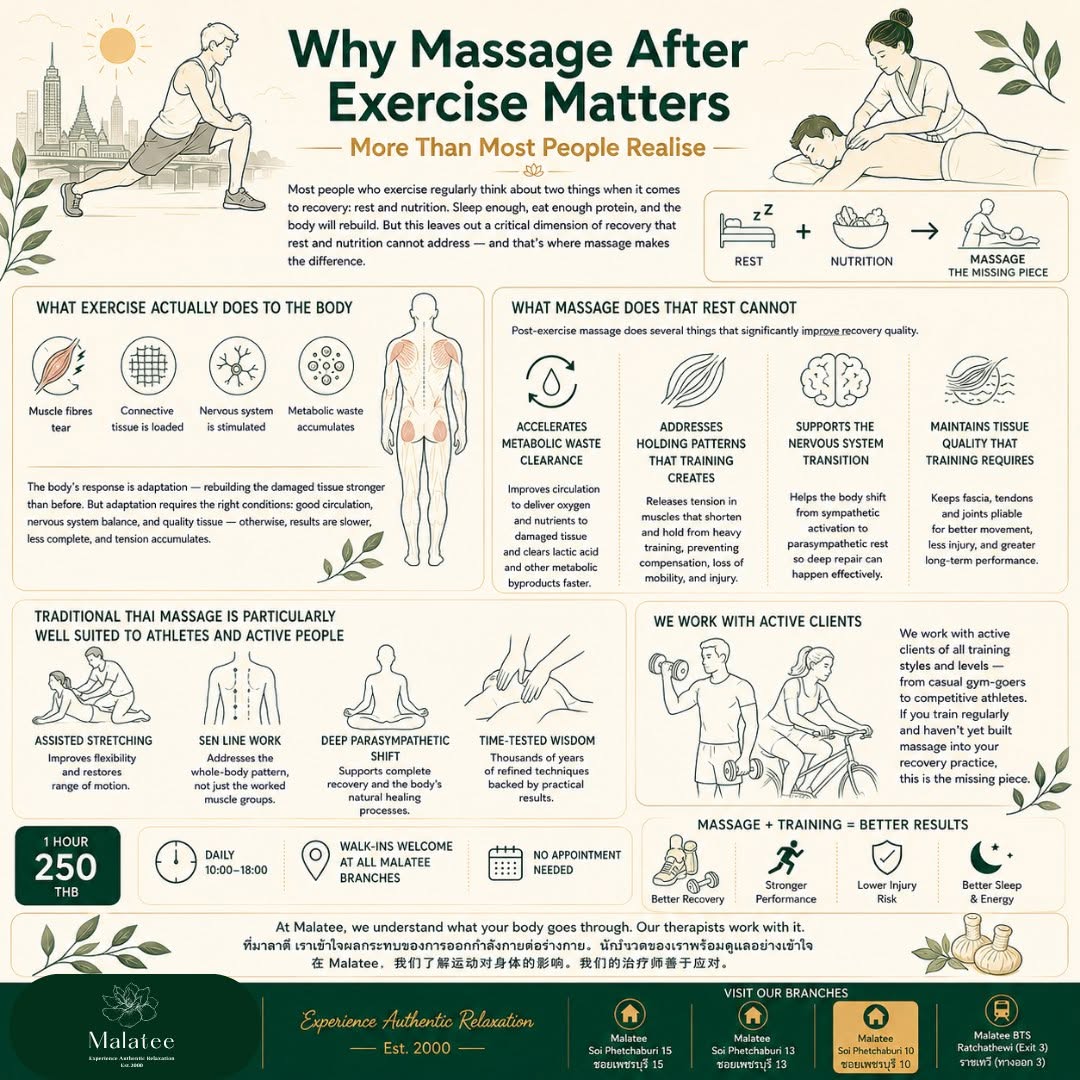
Most people who exercise regularly think about two things when it comes to recovery: rest and nutrition. Sleep enough, eat enough protein, and the body will rebuild.
This is accurate as far as it goes. But it leaves out a dimension of recovery that rest and nutrition cannot address — and that dimension is where a significant portion of the gains from training either compound or get lost.
What exercise actually does to the body
When you train — whether that’s running, weights, yoga, cycling, or any other form — you are creating controlled damage. Muscle fibres tear microscopically. The connective tissue is loaded. The nervous system is stimulated intensely. Metabolic waste accumulates in the worked tissue.
The body’s response to this damage is adaptation — rebuilding the damaged tissue stronger than before. This is how training works. The damage is the stimulus. The adaptation is the result.
But adaptation requires specific conditions. The tissue needs adequate circulation to deliver the nutrients that rebuilding requires and to clear the metabolic waste that exercise produces. The nervous system needs to complete its shift from the sympathetic activation of exercise back toward the parasympathetic state in which repair happens most effectively. The muscle fibres need to be in a state that allows them to remodel rather than simply scar.
When these conditions aren’t optimal — which they often aren’t without intervention — adaptation is slower, less complete, and more likely to produce the kind of chronic tension and holding patterns that accumulate over weeks and months of training.
What massage does that rest cannot
Rest removes the exercise stimulus and allows the body to begin its recovery process. But rest alone doesn’t optimise the conditions in which that process happens.
Post-exercise massage does several things that significantly improve recovery quality:
 It accelerates metabolic waste clearance
The mechanical stimulation of massage significantly improves local circulation — delivering oxygen and nutrients to damaged tissue and clearing the lactic acid and other metabolic byproducts that accumulate during exercise. This process happens during rest, but at a much slower rate than with manual stimulation.
It addresses the holding patterns that training creates
Heavy training loads create specific muscular holding patterns — the hip flexors that shorten from heavy squatting, the upper trapezius that loads from overhead pressing, the thoracic spine that compresses from sustained forward posture during cycling or rowing. These patterns don’t release fully during rest. Left unaddressed, they compound across training sessions, reducing range of motion and increasing injury risk over time.
It supports the nervous system transition
After intense exercise, the nervous system needs to complete its shift from sympathetic activation back toward parasympathetic rest. This transition is what allows the deepest repair processes to occur — the hormonal environment, the cellular repair, the quality of the overnight recovery. Massage accelerates this transition, producing the parasympathetic shift that allows the body’s repair processes to operate at their best.
It maintains the tissue quality that training requires
Chronically loaded tissue — particularly connective tissue like fascia, tendons, and joint capsules — loses pliability over time without intervention. This reduction in tissue quality reduces movement efficiency, increases injury risk, and limits the range of motion that training can develop. Regular massage maintains the tissue quality that effective training requires.
Traditional Thai Massage is particularly well suited to athletes and active people
The assisted stretching component of Traditional Thai Massage directly addresses the connective tissue and range of motion dimensions that exercise creates. The full-body Sen line work addresses the whole pattern — not just the worked muscle groups. The parasympathetic shift is deep and well-established.
At Malatee, we work with active clients across all training styles and levels — from casual gym-goers to competitive athletes. If you train regularly and haven’t yet built massage into your recovery practice, this is the missing piece.
Walk-ins welcome at all Malatee branches.
为什么运动后按摩比大多数人意识到的更重要
大多数经常锻炼的人在恢复方面只考虑两件事:休息和营养。睡够,吃足够的蛋白质,身体就会重建。
这在一定程度上是准确的,但它遗漏了一个休息和营养无法解决的恢复维度——而这个维度正是训练成果或者复利积累或者大量流失的地方。
运动对身体真正做了什么
训练时,无论是跑步、力量训练、瑜伽还是骑行,你都在制造受控的损伤。肌纤维在微观层面撕裂,结缔组织承受负荷,神经系统受到强烈刺激,代谢废物在被使用的组织中积累。
身体对这种损伤的反应是适应——将受损组织重建得比以前更强。但适应需要特定条件。组织需要充足的血液循环来输送重建所需的营养,并清除运动产生的代谢废物。神经系统需要从运动的交感神经激活完成向副交感神经状态的转换。
按摩做到了休息做不到的事
加速代谢废物清除——按摩的机械刺激显著改善局部循环,清除乳酸等代谢副产品
处理训练产生的紧绷模式——深蹲缩短的髋屈肌,过头动作负荷的上斜方肌,骑行或划船时前倾姿势压迫的胸椎。这些模式在休息中不会完全释放,若不处理,会在训练周期中积累,降低活动范围并随时间增加受伤风险
支持神经系统转换——从交感神经激活回到副交感神经休息状态,允许深层修复过程发生
维持训练所需的组织质量——长期负荷的结缔组织没有干预会随时间失去弹性
泰式传统按摩特别适合运动人士——辅助拉伸直接处理运动所产生的结缔组织和活动范围维度,全身Sen Lines操作处理整个模式,副交感神经转换深而稳定。
欢迎直接前往 Malatee 任意门店,无需预约。
ทำไมนวดหลังออกกำลังกายถึงสำคัญกว่าที่คิด
คนส่วนใหญ่ที่ออกกำลังกายสม่ำเสมอคิดถึงสองสิ่งในเรื่องการฟื้นตัว: พักผ่อนและโภชนาการ นอนพอ กินโปรตีนพอ และร่างกายจะสร้างใหม่
สิ่งนี้ถูกต้องในระดับหนึ่ง แต่มันละเว้นมิติของการฟื้นตัวที่การพักผ่อนและโภชนาการไม่สามารถจัดการได้ — และมิตินั้นคือที่ที่ผลลัพธ์จากการฝึกส่วนสำคัญสะสมหรือสูญหาย
การออกกำลังกายทำอะไรกับร่างกายจริงๆ
เมื่อคุณฝึก — ไม่ว่าจะเป็นวิ่ง ยกน้ำหนัก โยคะ ปั่นจักรยาน หรือรูปแบบอื่น — คุณกำลังสร้างความเสียหายที่ควบคุมได้ เส้นใยกล้ามเนื้อฉีกในระดับจุลทรรศน์ เนื้อเยื่อเกี่ยวพันถูกโหลด ระบบประสาทถูกกระตุ้นอย่างเข้มข้น ของเสียจากการเผาผลาญสะสมในเนื้อเยื่อที่ทำงาน
การตอบสนองของร่างกายต่อความเสียหายนี้คือการปรับตัว แต่การปรับตัวต้องการเงื่อนไขเฉพาะ เนื้อเยื่อต้องการการไหลเวียนที่เพียงพอ ระบบประสาทต้องเปลี่ยนจากการกระตุ้นซิมพาเทติกของการออกกำลังกายกลับสู่สภาวะพาราซิมพาเทติก
สิ่งที่การนวดทำที่การพักผ่อนทำไม่ได้
เร่งการกำจัดของเสียจากการเผาผลาญ — การกระตุ้นทางกลของการนวดปรับปรุงการไหลเวียนในพื้นที่อย่างมีนัยสำคัญ กำจัดกรดแลคติกและผลพลอยได้จากการเผาผลาญอื่นๆ
จัดการรูปแบบการยึดที่การฝึกสร้าง — กล้ามเนื้อสะโพกที่สั้นลงจากการสควอทหนัก Trapezius ส่วนบนที่โหลดจากการกดศีรษะ กระดูกสันหลังส่วนอกที่กดทับจากการปั่นจักรยาน รูปแบบเหล่านี้ไม่ปล่อยออกอย่างสมบูรณ์ระหว่างการพักผ่อน ถ้าไม่จัดการจะสะสมและเพิ่มความเสี่ยงต่อการบาดเจ็บ
สนับสนุนการเปลี่ยนแปลงระบบประสาท — จากการกระตุ้นซิมพาเทติกกลับสู่การพักผ่อนพาราซิมพาเทติก ช่วยให้กระบวนการซ่อมแซมที่ลึกที่สุดเกิดขึ้น
รักษาคุณภาพเนื้อเยื่อที่การฝึกต้องการ — เนื้อเยื่อเกี่ยวพันที่โหลดเรื้อรังสูญเสียความยืดหยุ่นตามเวลาโดยไม่มีการแทรกแซง
การนวดแผนไทยเหมาะเป็นพิเศษสำหรับนักกีฬาและคนที่กระตือรือร้น — ส่วนการยืดแบบช่วยเหลือจัดการเนื้อเยื่อเกี่ยวพันและช่วงการเคลื่อนไหวที่การออกกำลังกายสร้าง การทำงานตามแนวเส้นสิบทั้งร่างกายจัดการรูปแบบทั้งหมด การเปลี่ยนแปลงพาราซิมพาเทติกลึกและมั่นคง
ถ้าคุณฝึกสม่ำเสมอและยังไม่ได้สร้างการนวดเข้าไปในการฝึกฟื้นตัว นี่คือชิ้นส่วนที่หายไป
ไม่ต้องนัด Walk-in ยินดีต้อนรับทุกสาขา
Experience Authentic Relaxation | Est. 2000
Visit Our Branches:
• Malatee Soi Phetchaburi 15
• Malatee Soi Phetchaburi 13
• Malatee Soi Phetchaburi 10
• Malatee BTS Ratchathewi (Exit 3)
#MalateeThaiMassage#มาลาตีนวดไทย#PostWorkoutMassage#นวดหลังออกกำลังกาย#ActiveRecovery#ThaiMassageBangkok#นวดแผนไทย#WellnessBangkok#BangkokMassage#ถนนเพชรบุรี#นวดเพื่อสุขภาพ#MassageForAthletes#SportsMassage
Lorem Ipsum is simply dummy text of the printing and typesetting industry