
Why Guests Return: What Consistent Care Looks Like at Malatee
Malatee Thai Massage has welcomed guests in Bangkok since 2000, and our name comes from the Malatee jasmine, the most
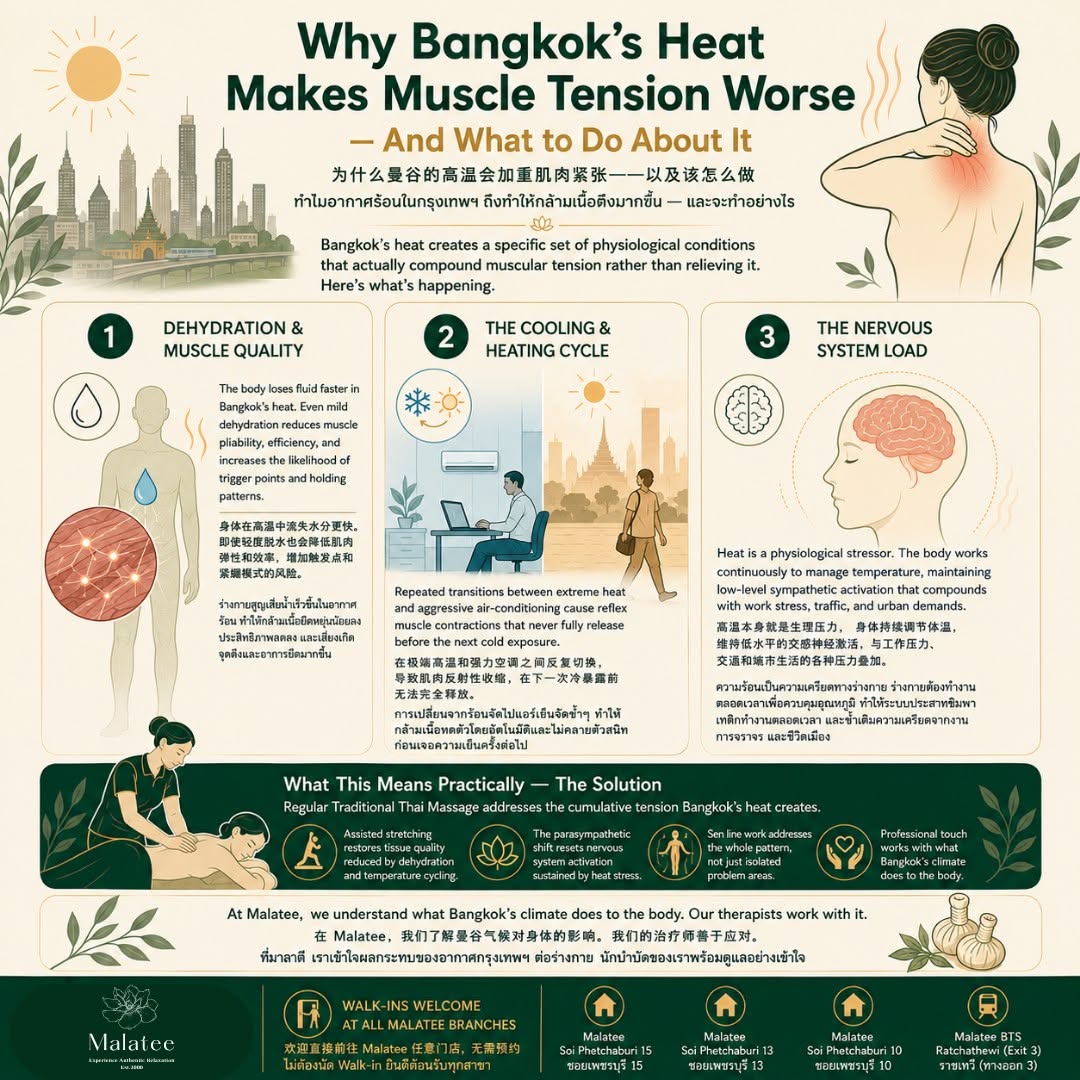
Most people assume that heat relaxes muscles. And in some contexts, it does — applied therapeutically, in controlled amounts, heat increases tissue pliability and supports release.
But Bangkok’s ambient heat is a different thing entirely.
The sustained heat of living and working in a tropical city — particularly during the hottest months — creates a specific set of physiological conditions that actually compound muscular tension rather than relieving it.
Here’s what’s happening.
Dehydration and muscle quality
The body loses fluid significantly faster in Bangkok’s heat than in temperate climates. Even mild dehydration — the kind that doesn’t produce obvious thirst — has measurable effects on muscle tissue quality. Muscle cells that are under-hydrated are less pliable, less able to contract and release efficiently, and more prone to developing trigger points and sustained holding patterns.
Most people working in Bangkok are mildly dehydrated for significant portions of the day without realising it. The air-conditioned office environment creates a false sense of comfort — the body isn’t sweating visibly, but fluid loss continues at an elevated rate.
The cooling and heating cycle
Bangkok’s working life involves repeated transitions between extreme heat and aggressive air-conditioning. This temperature cycling produces a specific muscular response: the body contracts muscles reflexively in cold environments as part of its thermoregulatory response, then fails to fully release that contraction before the next cold exposure.
People who commute between hot streets and cold offices — which is most of Bangkok’s working population — are cycling through this pattern multiple times a day. The cumulative effect is a background level of muscular tension that adds to everything else the working day produces.
The nervous system load
Sustained exposure to heat is a physiological stressor — even when it doesn’t feel particularly stressful. The body is working continuously to manage its temperature, which maintains a low-level sympathetic nervous system activation that compounds with the activation produced by work stress, traffic, and the general demands of urban life.
This background activation makes it harder for the body to release tension during rest — which is why many Bangkok residents find that a good night’s sleep doesn’t fully address the tension they’re carrying.
What this means practically
Regular massage — particularly Traditional Thai Massage — addresses the cumulative tension that Bangkok’s heat creates in ways that rest, hydration, and time alone cannot. The assisted stretching restores the tissue quality that dehydration and temperature cycling reduce. The parasympathetic shift resets the nervous system activation that heat stress sustains. The full-body Sen line work addresses the whole pattern rather than isolated areas.
At Malatee, we understand what Bangkok’s climate does to the body. Our therapists work with it.
Walk-ins welcome at all Malatee branches.
为什么曼谷的高温会加重肌肉紧张——以及该怎么做
大多数人认为热量能放松肌肉。在某些情况下确实如此——有针对性地施加适量热力,可以增加组织弹性并支持释放。
但曼谷的环境高温完全是另一回事。
在热带城市生活和工作所持续承受的高温——尤其是在最热的月份——会制造一套特定的生理条件,实际上是在加重肌肉紧张,而非缓解它。
脱水与肌肉质量
在曼谷的高温下,身体失去液体的速度远快于温带气候。即使是轻微脱水——那种不会产生明显口渴感的程度——也会对肌肉组织质量产生可测量的影响。水分不足的肌肉细胞弹性更差,收缩和释放的效率更低,更容易出现触发点和持续紧绷模式。
冷热循环
曼谷的职场生活涉及极端高温与强力空调之间的反复切换。这种温度循环产生特定的肌肉反应:身体在寒冷环境中反射性收缩肌肉作为体温调节的一部分,然后在下一次冷暴露之前无法完全释放这种收缩。
神经系统负荷
持续暴露于高温是一种生理应激——即使感觉并不特别有压力。身体持续工作以管理体温,维持着低水平的交感神经激活,与工作压力、交通和城市生活的一般需求所产生的激活叠加在一起。
定期按摩——尤其是泰式传统按摩——以休息、补水和时间单独无法实现的方式,处理曼谷高温所创造的累积紧张。
欢迎直接前往 Malatee 任意门店,无需预约。
ทำไมอากาศร้อนในกรุงเทพฯ ถึงทำให้กล้ามเนื้อตึงมากขึ้น — และจะทำอย่างไร
คนส่วนใหญ่คิดว่าความร้อนคลายกล้ามเนื้อ ในบางบริบทก็ใช่ — ความร้อนที่ใช้บำบัดในปริมาณที่ควบคุมได้เพิ่มความยืดหยุ่นของเนื้อเยื่อและสนับสนุนการคลาย
แต่ความร้อนของสภาพแวดล้อมกรุงเทพฯ เป็นคนละเรื่องกันโดยสิ้นเชิง
ความร้อนที่ต่อเนื่องจากการอาศัยและทำงานในเมืองเขตร้อน สร้างสภาวะทางสรีรวิทยาเฉพาะที่ทบซ้อนความตึงกล้ามเนื้อแทนที่จะบรรเทา
การขาดน้ำและคุณภาพกล้ามเนื้อ
ร่างกายสูญเสียของเหลวเร็วกว่าในสภาพอากาศอบอุ่นอย่างมีนัยสำคัญ การขาดน้ำเล็กน้อย — ชนิดที่ไม่ทำให้รู้สึกกระหายชัดเจน — ส่งผลต่อคุณภาพเนื้อเยื่อกล้ามเนื้อที่วัดได้ เซลล์กล้ามเนื้อที่ขาดน้ำมีความยืดหยุ่นน้อยกว่า หดตัวและคลายตัวได้อย่างมีประสิทธิภาพน้อยกว่า และมีแนวโน้มพัฒนาจุดกระตุ้นและรูปแบบการยึดมากกว่า
วงจรความร้อนและความเย็น
ชีวิตการทำงานในกรุงเทพฯ เกี่ยวข้องกับการเปลี่ยนแปลงซ้ำๆ ระหว่างความร้อนสุดขีดและแอร์เย็นจัด วงจรอุณหภูมินี้สร้างการตอบสนองกล้ามเนื้อเฉพาะ: ร่างกายหดกล้ามเนื้อโดยสะท้อนในสภาพแวดล้อมเย็นเป็นส่วนหนึ่งของการควบคุมอุณหภูมิ แล้วไม่สามารถปล่อยการหดตัวนั้นได้อย่างสมบูรณ์ก่อนการสัมผัสความเย็นครั้งต่อไป
ภาระระบบประสาท
การสัมผัสความร้อนต่อเนื่องเป็นความเครียดทางสรีรวิทยา แม้จะไม่รู้สึกเครียดโดยเฉพาะ ร่างกายทำงานต่อเนื่องเพื่อจัดการอุณหภูมิ รักษาการกระตุ้นระบบประสาทซิมพาเทติกระดับต่ำที่ทบกับการกระตุ้นจากความเครียดงาน การจราจร และความต้องการชีวิตเมือง
การนวดสม่ำเสมอ — โดยเฉพาะการนวดแผนไทย — จัดการความตึงสะสมที่อากาศร้อนกรุงเทพฯ สร้างในแบบที่การพักผ่อน การดื่มน้ำ และเวลาเพียงอย่างเดียวทำไม่ได้
ไม่ต้องนัด Walk-in ยินดีต้อนรับทุกสาขา
Experience Authentic Relaxation | Est. 2000
Visit Our Branches:
• Malatee Soi Phetchaburi 15
• Malatee Soi Phetchaburi 13
• Malatee Soi Phetchaburi 10
• Malatee BTS Ratchathewi (Exit 3)
#MalateeThaiMassage#มาลาตีนวดไทย#BangkokHeat#อากาศร้อน#ThaiMassageBangkok#นวดแผนไทย#WellnessBangkok#BangkokMassage#ถนนเพชรบุรี#นวดเพื่อสุขภาพ#MuscleHealth#BangkokLife#WellnessTips
Lorem Ipsum is simply dummy text of the printing and typesetting industry