
Why Guests Return: What Consistent Care Looks Like at Malatee
Malatee Thai Massage has welcomed guests in Bangkok since 2000, and our name comes from the Malatee jasmine, the most
If you’ve ever received a Thai massage and noticed that the therapist seems to be following a specific pathway through the body — rather than simply working wherever feels tight — there’s a reason for that.
They’re working along the Sen lines.
Understanding what Sen lines are helps explain why Traditional Thai Massage feels different from other forms of bodywork — and why its effects often go beyond what you might expect from a massage.
The origin
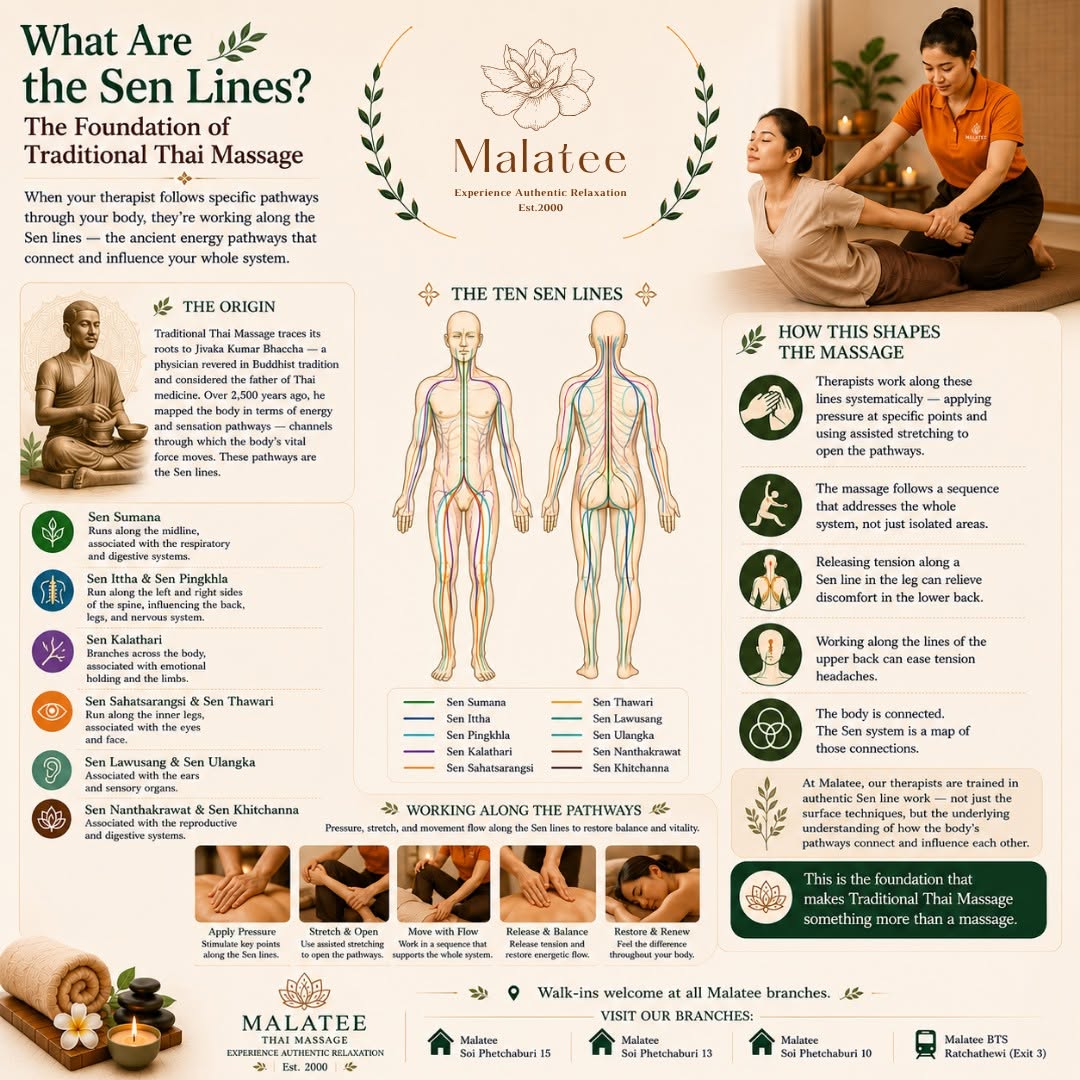
Traditional Thai Massage traces its roots to Jivaka Kumar Bhaccha — a physician revered in Buddhist tradition and considered the father of Thai medicine. The system he developed, over 2,500 years ago, mapped the body not just in terms of muscles and bones, but in terms of energy and sensation pathways — channels through which the body’s vital force moves.
These pathways are the Sen lines.
What Sen lines are
The Sen system identifies ten primary lines that run through the body. These are not the same as anatomical structures like nerves or blood vessels — though they often run alongside them. They are therapeutic pathways: routes along which pressure, stretching, and manipulation produce effects that extend well beyond the immediate point of contact.
Each of the ten lines has a name, a pathway, and a set of areas it influences:
 Sen Sumana — runs along the midline, associated with the respiratory and digestive systems
Sen Ittha & Sen Pingkhla — run along the left and right sides of the spine, influencing the back, legs, and nervous system
Sen Kalathari — branches across the body, associated with emotional holding and the limbs
Sen Sahatsarangsi & Sen Thawari — run along the inner legs, associated with the eyes and face
Sen Lawusang & Sen Ulangka — associated with the ears and sensory organs
Sen Nanthakrawat & Sen Khitchanna — associated with the reproductive and digestive systems
**How this shapes the massage**
A Thai massage therapist doesn’t simply work on wherever feels tight. They work along these lines systematically — applying pressure at specific points, using assisted stretching to open the pathways, and moving through the body in a sequence designed to address the whole system rather than isolated areas.
This is why Thai massage often produces effects that seem disproportionate to where the therapist was working. Releasing tension along a Sen line in the leg can relieve discomfort in the lower back. Working along the lines of the upper back can ease tension headaches.
The body is connected. The Sen system is a map of those connections.
At Malatee, our therapists are trained in authentic Sen line work — not just the surface techniques, but the underlying understanding of how the body’s pathways connect and influence each other.
This is the foundation that makes Traditional Thai Massage something more than a massage.
 Walk-ins welcome at all Malatee branches.
 เส้นสิบคืออะไร? รากฐานของการนวดแผนไทย
ถ้าคุณเคยได้รับการนวดแผนไทยและสังเกตว่าหมอนวดดูเหมือนจะเดินตามเส้นทางเฉพาะในร่างกาย — แทนที่จะทำงานเฉพาะจุดที่ตึง — มีเหตุผลอยู่เบื้องหลังนั้น
พวกเขากำลังทำงานตามแนวเส้นสิบ
การเข้าใจว่าเส้นสิบคืออะไรช่วยอธิบายว่าทำไมการนวดแผนไทยถึงรู้สึกต่างจากการนวดรูปแบบอื่น — และทำไมผลลัพธ์ของมันมักเกินกว่าที่คาดหวังจากการนวดทั่วไป
ต้นกำเนิด
การนวดแผนไทยมีรากฐานมาจากหมอชีวกโกมารภัจจ์ — แพทย์ที่ได้รับการเคารพนับถือในประเพณีพุทธศาสนาและถือเป็นบิดาของการแพทย์ไทย ระบบที่พระองค์พัฒนาขึ้นเมื่อกว่า 2,500 ปีที่แล้ว ทำแผนที่ร่างกายไม่ใช่แค่ในแง่กล้ามเนื้อและกระดูก แต่ในแง่เส้นทางพลังงานและความรู้สึก — ช่องทางที่พลังงานสำคัญของร่างกายเคลื่อนที่ผ่าน
เส้นทางเหล่านั้นคือเส้นสิบ
เส้นสิบคืออะไร
ระบบเส้นสิบระบุเส้นหลักสิบเส้นที่วิ่งผ่านร่างกาย สิ่งเหล่านี้ไม่เหมือนกับโครงสร้างทางกายวิภาคอย่างเส้นประสาทหรือหลอดเลือด — แม้ว่ามักจะวิ่งควบคู่กัน แต่เป็นเส้นทางบำบัด: เส้นทางที่การกด การยืด และการจัดการสร้างผลที่ขยายออกไปไกลกว่าจุดสัมผัสทันที
แต่ละเส้นในสิบเส้นมีชื่อ เส้นทาง และบริเวณที่มีอิทธิพล:
เส้นสุมนา — วิ่งตามแนวกลาง เกี่ยวข้องกับระบบทางเดินหายใจและย่อยอาหาร
เส้นอิทา & เส้นปิงคลา — วิ่งตามด้านซ้ายและขวาของกระดูกสันหลัง มีอิทธิพลต่อหลัง ขา และระบบประสาท
เส้นกาลทารี — แตกแขนงทั่วร่างกาย เกี่ยวข้องกับการเก็บอารมณ์และแขนขา
เส้นสหัสรังสี & เส้นทวารี — วิ่งตามขาด้านใน เกี่ยวข้องกับดวงตาและใบหน้า
เส้นลาวุสัง & เส้นอุลังกา — เกี่ยวข้องกับหูและอวัยวะรับความรู้สึก
เส้นนันทกระวาน & เส้นคิตฉนะ — เกี่ยวข้องกับระบบสืบพันธุ์และย่อยอาหาร
สิ่งนี้กำหนดรูปแบบการนวดอย่างไร
หมอนวดแผนไทยไม่ได้แค่ทำงานในบริเวณที่ตึง แต่ทำงานตามแนวเส้นเหล่านี้อย่างเป็นระบบ — กดที่จุดเฉพาะ ใช้การยืดแบบช่วยเหลือเพื่อเปิดเส้นทาง และเคลื่อนผ่านร่างกายในลำดับที่ออกแบบมาเพื่อจัดการระบบทั้งหมดแทนที่จะเป็นบริเวณเฉพาะ
นี่คือเหตุผลที่การนวดแผนไทยมักให้ผลลัพธ์ที่ดูไม่สัมพันธ์กับจุดที่หมอนวดกำลังทำงาน การคลายความตึงตามแนวเส้นสิบที่ขาสามารถบรรเทาความไม่สบายที่หลังส่วนล่างได้ การทำงานตามแนวเส้นของหลังส่วนบนสามารถบรรเทาอาการปวดหัวตึงได้
ร่างกายเชื่อมต่อกัน เส้นสิบคือแผนที่ของการเชื่อมต่อเหล่านั้น
ที่มาลาตี หมอนวดของเราได้รับการฝึกในการทำงานตามแนวเส้นสิบแบบดั้งเดิม — ไม่ใช่แค่เทคนิคผิวเผิน แต่ความเข้าใจพื้นฐานว่าเส้นทางของร่างกายเชื่อมต่อและมีอิทธิพลต่อกันอย่างไร
นี่คือรากฐานที่ทำให้การนวดแผนไทยเป็นมากกว่าการนวด
ไม่ต้องนัด Walk-in ยินดีต้อนรับทุกสาขา
什么是”Sen Lines”(十条经络)?泰式传统按摩的根基
如果你曾接受过泰式按摩,并注意到按摩师似乎在沿着身体的特定路径进行操作——而不只是哪里紧就按哪里——这背后是有原因的。
他们在沿着”Sen Lines”(十条经络)进行工作。
理解Sen Lines是什么,有助于解释为什么泰式传统按摩的感受与其他形式的身体疗愈如此不同——以及为什么它的效果往往超出你对一次按摩的预期。
起源
泰式传统按摩的根源可以追溯到阿育吠陀医师耆婆(Jivaka Kumar Bhaccha)——他在佛教传统中备受尊崇,被视为泰式医学之父。他在逾2,500年前建立的这套体系,不只从肌肉和骨骼的角度描绘身体,更从能量与感知通道的角度进行了系统梳理——这些通道是身体生命能量流动的路径。
这些通道,就是Sen Lines。
Sen Lines是什么
Sen系统识别出贯穿全身的十条主要经络。它们与神经或血管等解剖结构不同——尽管常常与之并行走向。它们是治疗性通道:沿这些路径施加的按压、拉伸和手法操作,所产生的效果远超直接接触点本身。
十条经络各有其名称、走向和影响区域:
Sumana——沿身体中线走行,与呼吸系统和消化系统相关
Ittha & Pingkhla——沿脊柱左右两侧走行,影响背部、腿部和神经系统
Kalathari——分支遍布全身,与情绪积存和四肢相关
Sahatsarangsi & Thawari——沿腿部内侧走行,与眼睛和面部相关
Lawusang & Ulangka——与耳朵和感觉器官相关
Nanthakrawat & Khitchanna——与生殖系统和消化系统相关
这如何影响按摩方式
泰式按摩师不只是针对感觉紧绷的地方进行操作,而是系统地沿这些经络运作——在特定穴位施压,通过辅助拉伸开通经络路径,按照专为整体系统设计的顺序在全身移动,而非仅针对局部区域。
这就是为什么泰式按摩的效果常常与按摩师工作的位置看似不直接相关。沿腿部Sen Line释放紧张,可以缓解下背部的不适;沿上背部经络操作,可以舒缓紧张性头痛。
身体是相互连通的。Sen系统就是这些连接的地图。
在 Malatee,我们的按摩师接受了正宗Sen Line操作的专业培训——不只是表层技法,更包括对身体经络如何相互连接与影响的深层理解。
这是使泰式传统按摩超越普通按摩的根本所在。
欢迎直接前往 Malatee 任意门店,无需预约。
 Experience Authentic Relaxation | Est. 2000
 Visit Our Branches:
• Malatee Soi Phetchaburi 15
• Malatee Soi Phetchaburi 13
• Malatee Soi Phetchaburi 10
• Malatee BTS Ratchathewi (Exit 3)
#MalateeThaiMassage#มาลาตีนวดไทย#SenLines#เส้นสิบ#ThaiMassageBangkok#นวดแผนไทย#ThaiMassageEducation#ความรู้เรื่องนวดไทย#WellnessBangkok#BangkokMassage#นวดเพื่อสุขภาพ#ถนนเพชรบุรี#ThaiHealing#JivakaKumarBhaccha
Lorem Ipsum is simply dummy text of the printing and typesetting industry