
Why Guests Return: What Consistent Care Looks Like at Malatee
Malatee Thai Massage has welcomed guests in Bangkok since 2000, and our name comes from the Malatee jasmine, the most
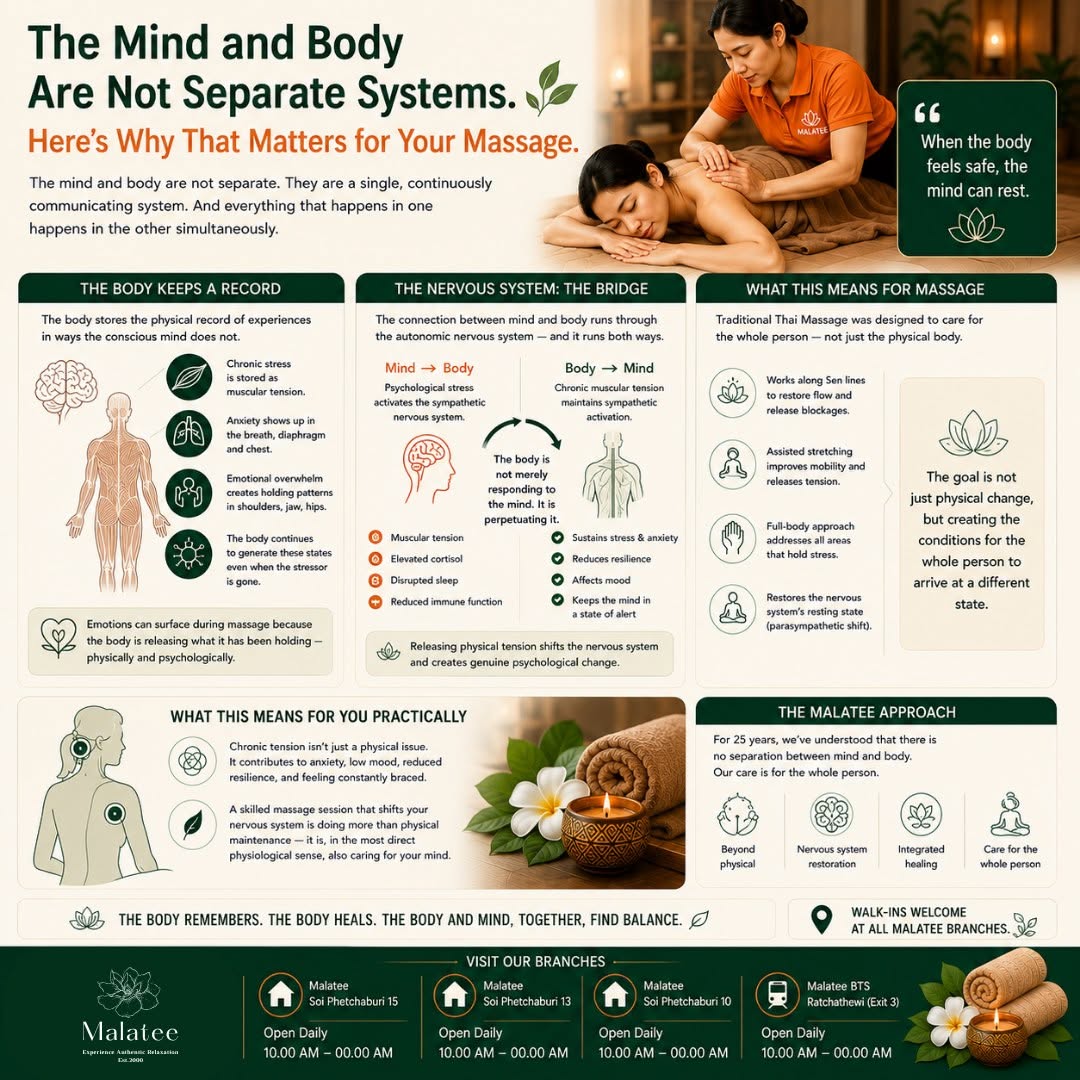
Western medicine has traditionally treated the mind and body as distinct domains — the body as a physical system managed by doctors, the mind as a psychological one managed by therapists and psychiatrists. This separation has been useful in some contexts. But it has also obscured something that practitioners of Traditional Thai Massage have understood for over 2,500 years.
The mind and body are not separate. They are a single, continuously communicating system. And everything that happens in one happens in the other simultaneously.
This is not a philosophical position. It is increasingly well-supported by neuroscience, psychoneuroimmunology, and somatic research. And understanding it changes how you think about what massage actually does.
**The body keeps a record**
One of the most significant developments in modern understanding of stress and trauma is the recognition that the body — the physical tissue, the muscular system, the nervous system — records and stores experiences in ways that the conscious mind does not.
Chronic stress is stored as muscular tension. Long periods of anxiety are reflected in the patterns of the diaphragm and the chest muscles. Emotional overwhelm produces physical holding patterns — in the shoulders, the jaw, the hips — that persist long after the emotional event has passed.
This is not metaphor. The muscles literally hold the physical record of psychological experience. The nervous system continues to generate the physiological state associated with past stress even when the stressor is no longer present.
This is why people sometimes find unexpected emotional responses arising during massage — a sudden welling of emotion, a feeling of relief that goes beyond the physical, a release that feels more profound than muscle relaxation alone can explain. What is happening is not a coincidence or an anomaly. It is the body releasing something it has been holding — at both the physical and the psychological level — simultaneously.
**The nervous system as the bridge**
The connection between psychological state and physical condition runs through the autonomic nervous system — and it runs in both directions.
Psychological stress activates the sympathetic nervous system, which produces muscular tension, elevated cortisol, disrupted sleep, and reduced immune function. This is well understood.
What is less widely appreciated is the reverse: chronic muscular tension maintains sympathetic activation, which sustains the psychological state of stress, anxiety, and reduced resilience — even when the original stressor is no longer present.
The body is not merely responding to the mind. It is perpetuating it.
This bidirectional relationship is why working with the body is a legitimate way to work with the mind. Releasing the physical tension that is sustaining sympathetic activation produces genuine psychological change — not as a secondary benefit, but as a direct mechanism.
**What this means for massage**
Traditional Thai Massage — in its original conception — never separated physical and psychological wellbeing. The Sen line system, the assisted stretching, the full-body approach, the specific attention to areas known to hold stress — all of this was understood as caring for the whole person, not just the physical container.
At Malatee, this integrated understanding is reflected in how our therapists work. The goal of a session is not simply to produce physical changes in tissue. It is to create the conditions — through the parasympathetic shift, the release of held tension, the restoration of the nervous system’s resting state — in which the whole person can arrive at a different state.
**What this means for you practically**
If you carry anxiety, low mood, reduced resilience, or a persistent sense of being braced against something — consider the physical dimension of what you’re experiencing. The muscles that are chronically tight are contributing to that state, not just reflecting it.
And consider that a skilled massage session — one that genuinely shifts the nervous system — is doing something more than physical maintenance. It is, in the most direct physiological sense, also caring for the mind.
At Malatee, we have understood this for 25 years. Our care is for the whole person — because there is no other kind.
Walk-ins welcome at all Malatee branches.
จิตใจและร่างกายไม่ใช่ระบบที่แยกจากกัน นี่คือเหตุผลที่มันสำคัญสำหรับการนวดของคุณ
การแพทย์ตะวันตกดั้งเดิมปฏิบัติต่อจิตใจและร่างกายเป็นขอบเขตที่แตกต่างกัน — ร่างกายเป็นระบบกายภาพที่จัดการโดยแพทย์ จิตใจเป็นระบบจิตวิทยาที่จัดการโดยนักบำบัดและจิตแพทย์ การแยกนี้มีประโยชน์ในบางบริบท แต่มันยังปิดบังสิ่งที่ผู้ปฏิบัติการนวดแผนไทยเข้าใจมากกว่า 2,500 ปีแล้ว
จิตใจและร่างกายไม่ได้แยกกัน มันคือระบบเดียวที่สื่อสารอย่างต่อเนื่อง และทุกอย่างที่เกิดขึ้นในอย่างหนึ่งเกิดขึ้นในอีกอย่างหนึ่งพร้อมกัน
นี่ไม่ใช่ตำแหน่งทางปรัชญา มันได้รับการสนับสนุนจากประสาทวิทยาศาสตร์ จิตประสาทภูมิคุ้มกันวิทยา และการวิจัยโซมาติกมากขึ้นเรื่อยๆ และการเข้าใจมันเปลี่ยนวิธีที่คุณคิดเกี่ยวกับสิ่งที่การนวดทำจริงๆ
 ร่างกายเก็บบันทึก
หนึ่งในพัฒนาการที่สำคัญที่สุดในความเข้าใจสมัยใหม่เกี่ยวกับความเครียดและบาดแผลคือการตระหนักรู้ว่าร่างกาย — เนื้อเยื่อกายภาพ ระบบกล้ามเนื้อ ระบบประสาท — บันทึกและเก็บประสบการณ์ในแบบที่จิตสำนึกไม่ได้ทำ
ความเครียดเรื้อรังถูกเก็บเป็นความตึงของกล้ามเนื้อ ช่วงเวลายาวนานของความวิตกกังวลสะท้อนในรูปแบบของกะบังลมและกล้ามเนื้อหน้าอก ความท่วมท้นทางอารมณ์สร้างรูปแบบการยึดทางกาย — ที่บ่า กราม สะโพก — ที่คงอยู่นานหลังจากเหตุการณ์ทางอารมณ์ผ่านไป
นี่ไม่ใช่อุปลักษณ์ กล้ามเนื้อเก็บบันทึกทางกายภาพของประสบการณ์ทางจิตวิทยาตามตัวอักษร ระบบประสาทยังคงสร้างสภาวะสรีรวิทยาที่เกี่ยวข้องกับความเครียดในอดีตแม้เมื่อตัวเครียดไม่มีอยู่อีกต่อไป
นี่คือเหตุผลที่คนบางครั้งพบการตอบสนองทางอารมณ์ที่ไม่คาดหวังระหว่างการนวด — ความรู้สึกท่วมท้นฉับพลัน ความรู้สึกโล่งใจที่เกินกว่ากายภาพ การคลายตัวที่รู้สึกลึกซึ้งกว่าที่การผ่อนคลายกล้ามเนื้อเพียงอย่างเดียวอธิบายได้ สิ่งที่เกิดขึ้นไม่ใช่ความบังเอิญหรือความผิดปกติ มันคือร่างกายที่ปล่อยสิ่งที่มันแบกอยู่ — ทั้งในระดับกายภาพและจิตวิทยา — พร้อมกัน
ระบบประสาทเป็นสะพาน
ความเชื่อมต่อระหว่างสภาวะทางจิตวิทยาและสภาพทางกายวิ่งผ่านระบบประสาทอัตโนมัติ — และวิ่งในทั้งสองทิศทาง
ความเครียดทางจิตวิทยากระตุ้นระบบประสาทซิมพาเทติก ซึ่งสร้างความตึงของกล้ามเนื้อ คอร์ติซอลสูง การนอนหลับที่ถูกรบกวน และการทำงานของภูมิคุ้มกันที่ลดลง สิ่งนี้เข้าใจดีแล้ว
สิ่งที่ได้รับการชื่นชมน้อยกว่าคือสิ่งที่กลับกัน: ความตึงของกล้ามเนื้อเรื้อรังรักษาการกระตุ้นซิมพาเทติก ซึ่งรักษาสภาวะทางจิตวิทยาของความเครียด ความวิตกกังวล และความยืดหยุ่นที่ลดลง — แม้เมื่อตัวเครียดเดิมไม่มีอยู่อีกต่อไป
ร่างกายไม่ได้แค่ตอบสนองต่อจิตใจ มันคงอยู่มัน
ความสัมพันธ์สองทิศทางนี้คือเหตุผลที่การทำงานกับร่างกายเป็นวิธีที่ถูกต้องในการทำงานกับจิตใจ การปล่อยความตึงทางกายที่รักษาการกระตุ้นซิมพาเทติกสร้างการเปลี่ยนแปลงทางจิตวิทยาที่แท้จริง — ไม่ใช่เป็นประโยชน์รอง แต่เป็นกลไกโดยตรง
สิ่งนี้หมายความว่าอะไรในทางปฏิบัติสำหรับคุณ
ถ้าคุณแบกรับความวิตกกังวล อารมณ์ต่ำ ความยืดหยุ่นที่ลดลง หรือความรู้สึกคงที่ว่าต้องเกร็งรับมือกับบางอย่าง — ลองพิจารณามิติทางกายภาพของสิ่งที่คุณประสบ กล้ามเนื้อที่ตึงเรื้อรังมีส่วนในสภาวะนั้น ไม่ใช่แค่สะท้อนมัน
และลองพิจารณาว่าการนวดที่มีทักษะ — ที่เปลี่ยนระบบประสาทอย่างแท้จริง — กำลังทำบางอย่างมากกว่าการบำรุงรักษาทางกาย มันคือ ในแง่สรีรวิทยาที่ตรงที่สุด กำลังดูแลจิตใจด้วย
ที่มาลาตี เราเข้าใจสิ่งนี้มา 25 ปีแล้ว การดูแลของเราคือการดูแลทั้งคน — เพราะไม่มีประเภทอื่น
ไม่ต้องนัด Walk-in ยินดีต้อนรับทุกสาขา
身心不是两个独立的系统。这对你的按摩意味着什么。
传统西方医学历来将身体和心灵视为不同的领域——身体是由医生管理的物理系统,心灵是由治疗师和精神科医生管理的心理系统。这种分离在某些情境下是有用的,但它也遮蔽了泰式传统按摩从业者逾2,500年前就已理解的事情。
身心并不分离。它们是一个持续沟通的单一系统。在其中一个发生的一切,同时也在另一个中发生。
这不是一个哲学立场,而是越来越多地被神经科学、心理神经免疫学和躯体研究所支持的事实。理解它,会改变你对按摩真正作用的认知。
身体保存着记录
现代对压力和创伤理解中最重要的进展之一,是认识到身体——物理组织、肌肉系统、神经系统——以意识心灵无法做到的方式记录和储存体验。
慢性压力以肌肉紧张的形式储存。长期焦虑反映在横膈膜和胸部肌肉的模式中。情感上的超负荷在身体上形成紧绷模式——在肩膀、下颌、髋部——在情感事件过去很久之后依然持续。
这不是比喻。肌肉字面意义上保存着心理体验的物理记录。神经系统会继续产生与过去压力相关的生理状态,即使压力源已不再存在。
这就是为什么人们有时会在按摩过程中发现意外的情感反应——突然涌现的情绪,超越身体层面的释然感,一种比单纯肌肉放松所能解释的更深刻的释放感。这不是巧合或异常,而是身体在释放它一直承载的东西——在身体和心理两个层面上同时发生。
神经系统作为桥梁
心理状态与身体状况之间的联系,通过自主神经系统传递——而且是双向的。
心理压力激活交感神经系统,产生肌肉紧张、皮质醇升高、睡眠紊乱和免疫功能下降。这是众所周知的。
较少被关注的是反向过程:慢性肌肉紧张维持交感神经激活,从而维持压力、焦虑和韧性下降的心理状态——即使原始压力源已不再存在。
身体不只是在回应心灵,它在延续心灵的状态。
这种双向关系,正是为什么处理身体是处理心灵的合理途径。释放维持交感神经激活的身体紧张,会产生真实的心理变化——不是作为次要益处,而是作为直接机制。
这在实践中对你意味着什么
如果你承载着焦虑、情绪低落、韧性下降,或持续感觉需要绷紧身体应对什么——请考虑你所经历的身体维度。慢性紧绷的肌肉在促成那种状态,而不只是反映它。
也请考虑:一次技术精湛的按摩——真正转换神经系统状态的那种——所做的远不止身体维护。它在最直接的生理意义上,同时也在照顾心灵。
在 Malatee,我们25年来一直理解这一点。我们的照护,是对整个人的照护——因为没有其他的方式。
欢迎直接前往 Malatee 任意门店,无需预约。
Experience Authentic Relaxation | Est. 2000
Visit Our Branches:
• Malatee Soi Phetchaburi 15
• Malatee Soi Phetchaburi 13
• Malatee Soi Phetchaburi 10
• Malatee BTS Ratchathewi (Exit 3)
#MalateeThaiMassage#มาลาตีนวดไทย#MindBodyConnection#จิตใจและร่างกาย#ThaiMassageBangkok#นวดแผนไทย#HolisticWellness#WellnessBangkok#BangkokMassage#นวดเพื่อสุขภาพ#ถนนเพชรบุรี#SomaticHealing#MentalHealth#ThaiHealing
Lorem Ipsum is simply dummy text of the printing and typesetting industry