
Why Guests Return: What Consistent Care Looks Like at Malatee
Malatee Thai Massage has welcomed guests in Bangkok since 2000, and our name comes from the Malatee jasmine, the most
ประวัติและต้นกำเนิดของการนวดแผนไทย
The History & Origins of Traditional Thai Massage
传统泰式按摩的历史与起源
.
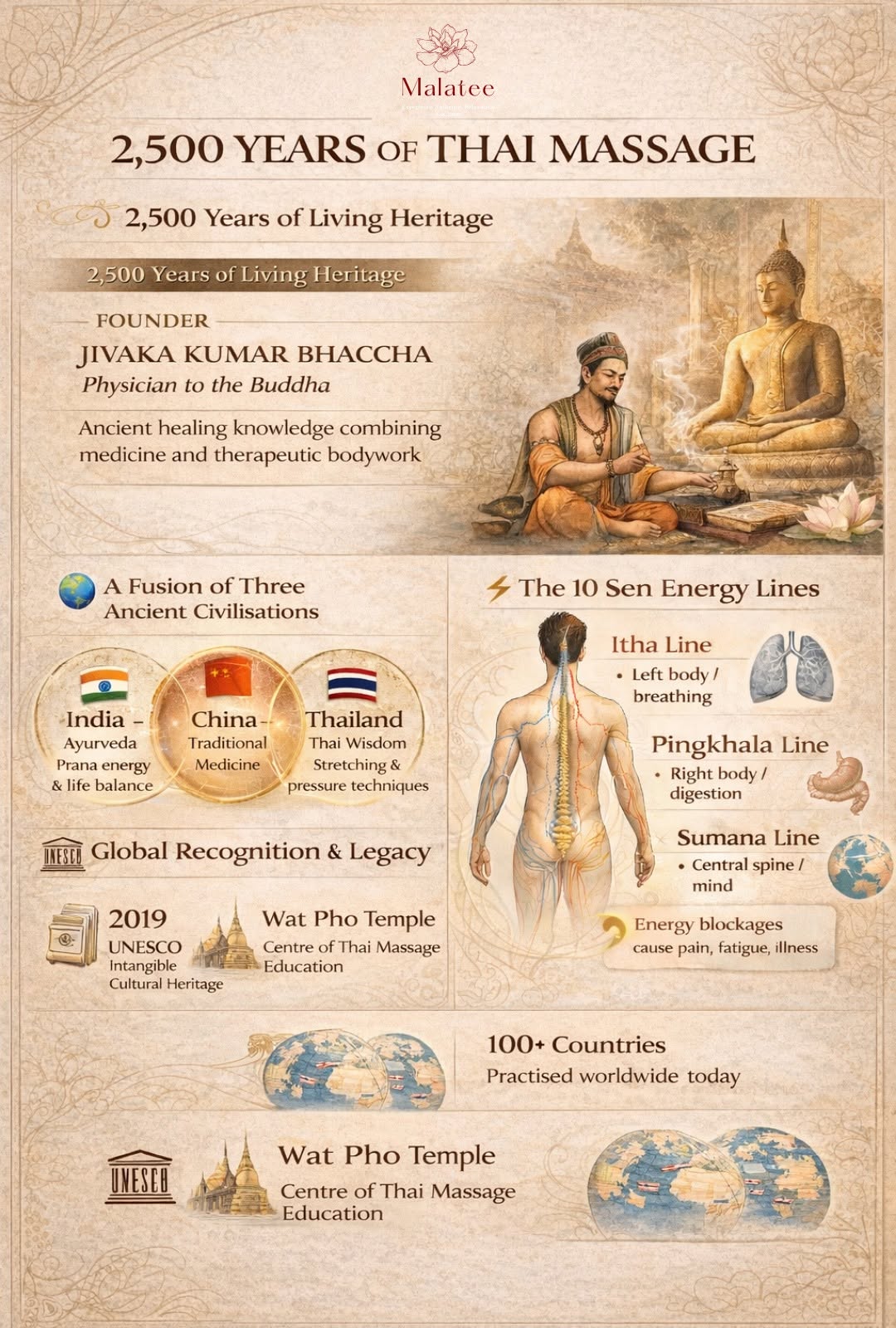
ประวัติ 2,500 ปีที่ยังมีชีวิตอยู่
การนวดแผนไทยโบราณมีรากฐานมาจากการแพทย์แผนโบราณที่สืบทอดกันมากว่า 2,500 ปี ผู้ก่อตั้งที่ได้รับการยอมรับคือ ชีวกโกมารภัจจ์ หมอประจำพระองค์ของพระพุทธเจ้า ซึ่งเชี่ยวชาญทั้งการแพทย์อายุรเวทและหัตถเวช
· · · · · · · · · · · · · · · · · · · · · · · · · · · · · · · · · · · · · · · ·
การผสมผสานภูมิปัญญา 3 อารยธรรม
อินเดีย (อายุรเวท) แนวคิดเรื่องพลังงานชีวิต (Prana) และเส้นพลังงาน
จีน การกดจุดและการสมดุลพลังงาน Qi
ไทย เทคนิคการยืดเส้นและกดจุดที่พัฒนาขึ้นเองในภูมิภาค
· · · · · · · · · · · · · · · · · · · · · · · · · · · · · · · · · · · · · · · ·
เส้นพลังงาน 10 เส้น (Sen Lines)
หัวใจของการนวดแผนไทยคือการทำงานกับเส้นพลังงานหลัก 10 เส้นที่ไหลผ่านร่างกาย เรียกว่า ‘เส้นเอ็น’ หรือ Sen Lines เมื่อพลังงานไหลได้สะดวก ร่างกายและจิตใจจะอยู่ในสมดุล เมื่ออุดตัน จะเกิดอาการปวดเมื่อยและเจ็บป่วย
เส้นอิทา ควบคุมด้านซ้ายของร่างกาย เชื่อมกับระบบหายใจ
เส้นปิงคลา ควบคุมด้านขวาของร่างกาย เชื่อมกับระบบย่อยอาหาร
เส้นสุมนา เส้นกลาง วิ่งตามแนวกระดูกสันหลัง ส่งผลต่อจิตใจ
· · · · · · · · · · · · · · · · · · · · · · · · · · · · · · · · · · · · · · · ·
การสืบทอดและการยอมรับระดับโลก
ปี 2562 UNESCO ขึ้นทะเบียนการนวดแผนไทยเป็นมรดกทางวัฒนธรรมที่จับต้องไม่ได้
วัดโพธิ์ เป็นศูนย์กลางการสอนนวดแผนไทยมาตั้งแต่สมัยรัชกาลที่ 3
ปัจจุบัน นวดแผนไทยเป็นที่รู้จักและใช้บำบัดกว่า 100 ประเทศทั่วโลก
.
2,500 Years of Living Heritage
Traditional Thai massage traces its origins over 2,500 years to ancient healing traditions. Its credited founder is Jivaka Kumar Bhaccha — personal physician to the Buddha — who mastered both Ayurvedic medicine and therapeutic bodywork.
· · · · · · · · · · · · · · · · · · · · · · · · · · · · · · · · · · · · · · · ·
A Fusion of Three Ancient Civilisations
India (Ayurveda) The concept of life energy (Prana) and energy pathways
China Acupressure and the balancing of Qi energy
Thailand Unique stretching and pressure techniques developed in the region
· · · · · · · · · · · · · · · · · · · · · · · · · · · · · · · · · · · · · · · ·
The 10 Sen Energy Lines
At the heart of Thai massage is the concept of 10 major Sen (energy) lines running throughout the body. When energy flows freely, the body and mind are in balance. When blocked, pain, fatigue, and illness follow.
Itha Line Controls the left side of the body; connected to the respiratory system
Pingkhala Line Controls the right side of the body; connected to digestion
Sumana Line The central line along the spine; influences the mind and emotions
· · · · · · · · · · · · · · · · · · · · · · · · · · · · · · · · · · · · · · · ·
Global Recognition & Legacy
2019 UNESCO inscribed traditional Thai massage as Intangible Cultural Heritage
Wat Pho Temple Has served as the centre of Thai massage education since the reign of King Rama III
Today Practised and recognised as therapeutic treatment in over 100 countries worldwide
.
2,500年的活态遗产
传统泰式按摩的历史可追溯至2,500年前的古代疗愈传统。其公认的创始人是吉瓦卡·科马拉帕特(Jivaka Kumar Bhaccha)——佛陀的私人医生,精通阿育吠陀医学与手法治疗。
· · · · · · · · · · · · · · · · · · · · · · · · · · · · · · · · · · · · · · · ·
三大古代文明的融合
印度(阿育吠陀) 生命能量(Prana)与能量通道的概念
中国 穴位按压与气(Qi)能量的平衡
泰国 在本地区发展出的独特拉伸与按压技法
· · · · · · · · · · · · · · · · · · · · · · · · · · · · · · · · · · · · · · · ·
10条Sen能量经络
泰式按摩的核心是贯穿全身的10条主要Sen(能量)经络。当能量自由流动时,身心处于平衡状态;当经络堵塞时,则会引发疼痛、疲劳与疾病。
伊塔经络 控制身体左侧,与呼吸系统相连
平伽拉经络 控制身体右侧,与消化系统相连
苏玛纳经络 沿脊柱走行的中央经络,影响心智与情绪
· · · · · · · · · · · · · · · · · · · · · · · · · · · · · · · · · · · · · · · ·
全球认可与传承
2019年 联合国教科文组织将传统泰式按摩列为非物质文化遗产
卧佛寺 自拉玛三世时代起便是泰式按摩教育的中心
当今 泰式按摩已在全球100多个国家作为治疗性疗法被认可和实践
.
Malatee Thai Massage | Est. 2000
.
มาลาตี นวดไทย — MONDAY | ถนนเพชรบุรีตัดใหม่ | ตั้งแต่ปี 2000
Malatee Thai Massage — MONDAY | New Phetchaburi Road | Est. 2000
玛拉蒂泰式按摩 — MONDAY | 新碧差汶里路 | 创立于2000年
Lorem Ipsum is simply dummy text of the printing and typesetting industry