
Why Guests Return: What Consistent Care Looks Like at Malatee
Malatee Thai Massage has welcomed guests in Bangkok since 2000, and our name comes from the Malatee jasmine, the most
Most people come to massage when something hurts.
The neck has been stiff for three days. The lower back is complaining after a long week. The shoulders are carrying two months of accumulated tension and it’s finally become impossible to ignore.
This is recovery massage — and it works. Coming in when the body is already signalling that something needs attention is better than not coming in at all.
But there’s another way to use massage that most people never fully explore — and it’s arguably more valuable.
Preventive massage.
**The difference in intention**
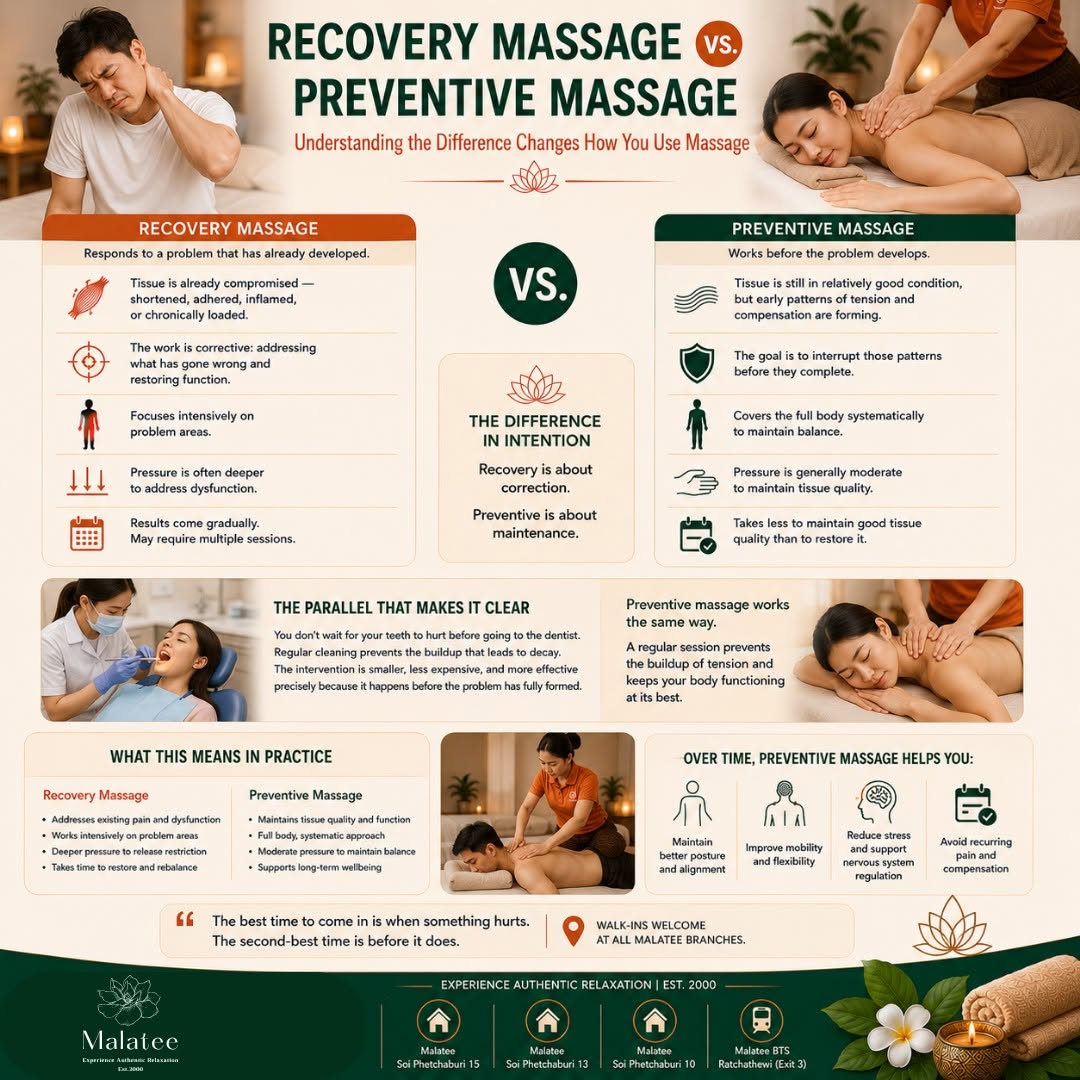
Recovery massage responds to a problem that has already developed. The tissue is already compromised — shortened, adhered, inflamed, or chronically loaded. The work is corrective: addressing what has gone wrong and restoring function.
Preventive massage works before the problem develops. The tissue is still in relatively good condition, but the patterns that lead to dysfunction are already forming — the early tightening, the beginning of postural compensation, the subtle restriction in movement that hasn’t yet become pain.
The goal is to interrupt those patterns before they complete.
**Why preventive massage is more efficient**
Think of it in terms of the effort required.
When tissue has been compromised for months — shortened hip flexors, chronically loaded upper trapezius, restricted thoracic spine — addressing it requires significant work. Multiple sessions. A period of time during which the tissue gradually responds and changes.
When the same tissue is addressed early — before the holding pattern has become established, before the compensation has created secondary problems — the work is lighter, faster, and the results come more quickly.
It takes less to maintain good tissue quality than to restore it.
**The parallel that makes it clear**
Most people understand this logic in other contexts.
You don’t wait for your teeth to hurt before going to the dentist. Regular cleaning prevents the buildup that leads to decay. The intervention is smaller, less expensive, and more effective precisely because it happens before the problem has fully formed.
Preventive massage works the same way. A regular session — once a week, once every two weeks, whatever fits your life — maintains the tissue quality, the range of motion, the nervous system regulation, and the postural balance that a reactive approach has to work much harder to restore.
**What this means in practice**
Preventive massage looks different from recovery massage. The pressure is generally more moderate — not addressing acute dysfunction, but maintaining the conditions that prevent it from developing. The session covers the full body systematically rather than focusing intensively on problem areas. The therapist is working to maintain, not to correct.
Over time, clients who use massage preventively notice something that clients who only come reactively rarely experience: a sustained baseline of physical wellbeing. They stop having the three-day neck stiffness. The lower back stops becoming an issue. The body maintains a quality of function that doesn’t require crisis management.
At Malatee, our therapists work with both approaches — responsive when the body needs correction, and progressive when the goal is maintenance. If you’re not sure which mode fits where you are right now, a brief conversation with our staff before your session will point you in the right direction.
The best time to come in is when something hurts. The second-best time is before it does.
 Walk-ins welcome at all Malatee branches.
 นวดเพื่อฟื้นฟู vs. นวดเพื่อป้องกัน — การเข้าใจความแตกต่างเปลี่ยนวิธีที่คุณใช้การนวด
คนส่วนใหญ่มานวดเมื่อมีบางอย่างเจ็บ
คอแข็งมาสามวัน หลังส่วนล่างบ่นหลังสัปดาห์ที่ยาวนาน บ่าแบกความตึงสะสมสองเดือนและในที่สุดก็กลายเป็นสิ่งที่ไม่สามารถเพิกเฉยได้อีก
นี่คือการนวดเพื่อฟื้นฟู — และมันได้ผล การมาเมื่อร่างกายส่งสัญญาณแล้วว่าต้องการความสนใจดีกว่าไม่มาเลย
แต่มีอีกวิธีหนึ่งในการใช้การนวดที่คนส่วนใหญ่ไม่เคยสำรวจอย่างเต็มที่ — และอาจมีคุณค่ากว่า
การนวดเพื่อป้องกัน
 ความแตกต่างในเจตนา
การนวดเพื่อฟื้นฟูตอบสนองต่อปัญหาที่พัฒนาขึ้นแล้ว เนื้อเยื่อถูกกระทบไปแล้ว — สั้นลง ยึดติด อักเสบ หรือโหลดเรื้อรัง งานนั้นเพื่อแก้ไข: จัดการสิ่งที่ผิดพลาดและคืนการทำงาน
การนวดเพื่อป้องกันทำงานก่อนที่ปัญหาจะพัฒนา เนื้อเยื่อยังอยู่ในสภาพค่อนข้างดี แต่รูปแบบที่นำไปสู่ความผิดปกติกำลังก่อตัวอยู่แล้ว — การตึงเริ่มต้น การเริ่มต้นของการชดเชยท่าทาง ข้อจำกัดเล็กๆ ในการเคลื่อนไหวที่ยังไม่กลายเป็นความเจ็บปวด
เป้าหมายคือขัดจังหวะรูปแบบเหล่านั้นก่อนที่มันจะสมบูรณ์
ทำไมการนวดเพื่อป้องกันจึงมีประสิทธิภาพมากกว่า
คิดในแง่ของความพยายามที่ต้องการ
เมื่อเนื้อเยื่อถูกกระทบมาหลายเดือน — กล้ามเนื้อสะโพกที่สั้นลง Trapezius ส่วนบนที่โหลดเรื้อรัง กระดูกสันหลังส่วนอกที่ถูกจำกัด — การจัดการมันต้องการงานอย่างมีนัยสำคัญ หลายครั้ง ช่วงเวลาที่เนื้อเยื่อค่อยๆ ตอบสนองและเปลี่ยนแปลง
เมื่อเนื้อเยื่อเดียวกันได้รับการจัดการแต่เนิ่นๆ — ก่อนที่รูปแบบการยึดจะก่อตั้ง ก่อนที่การชดเชยจะสร้างปัญหาทุติยภูมิ — งานเบากว่า เร็วกว่า และผลลัพธ์มาเร็วกว่า
ต้องการความพยายามน้อยกว่าในการรักษาคุณภาพเนื้อเยื่อที่ดีกว่าการคืนมัน
การเปรียบเทียบที่ทำให้ชัดเจน
คนส่วนใหญ่เข้าใจตรรกะนี้ในบริบทอื่น
คุณไม่รอให้ฟันเจ็บก่อนถึงไปหาทันตแพทย์ การทำความสะอาดสม่ำเสมอป้องกันการสะสมที่นำไปสู่การผุ การแทรกแซงนั้นเล็กกว่า ถูกกว่า และมีประสิทธิภาพมากกว่าเพราะมันเกิดขึ้นก่อนที่ปัญหาจะก่อตัวเต็มที่
การนวดเพื่อป้องกันทำงานในแบบเดียวกัน การนวดสม่ำเสมอ — สัปดาห์ละครั้ง สองสัปดาห์ครั้ง ไม่ว่าจะเหมาะกับชีวิตของคุณ — รักษาคุณภาพเนื้อเยื่อ ช่วงการเคลื่อนไหว การควบคุมระบบประสาท และความสมดุลของท่าทางที่แนวทางเชิงรับต้องทำงานหนักกว่ามากในการคืนมา
สิ่งนี้หมายความว่าอย่างไรในทางปฏิบัติ
การนวดเพื่อป้องกันมีลักษณะต่างจากการนวดเพื่อฟื้นฟู แรงกดโดยทั่วไปปานกลางกว่า — ไม่ได้จัดการความผิดปกติเฉียบพลัน แต่รักษาเงื่อนไขที่ป้องกันไม่ให้มันพัฒนา การนวดครอบคลุมร่างกายทั้งหมดอย่างเป็นระบบแทนที่จะเน้นอย่างเข้มข้นในบริเวณที่มีปัญหา หมอนวดทำงานเพื่อรักษา ไม่ใช่แก้ไข
เมื่อเวลาผ่านไป ลูกค้าที่ใช้การนวดเพื่อป้องกันสังเกตเห็นบางอย่างที่ลูกค้าที่มาเฉพาะเมื่อเกิดปัญหาแทบไม่เคยประสบ: ฐานของความเป็นอยู่ทางกายภาพที่ยั่งยืน พวกเขาหยุดมีอาการคอแข็งสามวัน หลังส่วนล่างหยุดเป็นปัญหา ร่างกายรักษาคุณภาพของการทำงานที่ไม่ต้องการการจัดการวิกฤต
ที่มาลาตี หมอนวดของเราทำงานกับทั้งสองแนวทาง — ตอบสนองเมื่อร่างกายต้องการการแก้ไข และก้าวหน้าเมื่อเป้าหมายคือการบำรุงรักษา ถ้าคุณไม่แน่ใจว่าโหมดไหนเหมาะกับตำแหน่งที่คุณอยู่ตอนนี้ การพูดคุยสั้นๆ กับเจ้าหน้าที่ก่อนการนวดจะชี้ทางที่ถูกต้อง
เวลาที่ดีที่สุดในการมาคือเมื่อมีบางอย่างเจ็บ เวลาที่ดีที่สุดอันดับสองคือก่อนที่มันจะเจ็บ
ไม่ต้องนัด Walk-in ยินดีต้อนรับทุกสาขา
恢复性按摩 vs. 预防性按摩——理解这个区别,会改变你使用按摩的方式。
大多数人在某处疼痛时才想到按摩。
脖子已经僵硬了三天。漫长一周后下背部开始抗议。肩膀积累了两个月的紧张,终于到了无法忽视的地步。
这就是恢复性按摩——它有效。当身体已经在发出信号时前来,总比完全不来要好。
但还有另一种使用按摩的方式,大多数人从未真正探索过——而且可以说更有价值。
预防性按摩。
意图上的区别
恢复性按摩是对已经形成的问题作出回应。组织已经受损——缩短、粘连、发炎或慢性过载。工作是纠正性的:处理已经出错的部分,恢复功能。
预防性按摩在问题形成之前介入。组织仍处于相对良好的状态,但导致功能障碍的模式已经在形成——早期收紧、姿势代偿的开始、尚未成为疼痛的细微活动受限。
目标是在这些模式完全成形之前将其打断。
为什么预防性按摩更有效率
从所需投入的角度来思考。
当组织已经受损数月——缩短的髋屈肌、慢性过载的上斜方肌、受限的胸椎——处理它需要大量工作,多次疗程,以及组织逐渐响应和改变的一段时间。
当同样的组织在早期得到处理——在紧绷模式尚未固化之前,在代偿尚未造成继发问题之前——工作更轻,更快,效果也来得更迅速。
维持良好的组织质量,所需的投入远少于恢复它。
让这一点变得清晰的类比
大多数人在其他情境下理解这个逻辑。
你不会等到牙痛了才去看牙医。定期洗牙可以防止导致龋齿的积累。这种干预更小、更便宜,效果也更好——恰恰是因为它发生在问题完全形成之前。
预防性按摩以同样的方式运作。定期按摩——每周一次,每两周一次,无论什么节奏适合你的生活——维护组织质量、活动范围、神经系统调节和姿势平衡,而被动应对的方式则需要更大的代价才能将这些恢复。
这在实践中意味着什么
预防性按摩与恢复性按摩看起来不同。力度通常更适中——不是在处理急性功能障碍,而是维护防止其发展的条件。疗程系统性地覆盖全身,而不是集中处理问题区域。按摩师在维护,而非纠正。
随着时间推移,将按摩用于预防的客人会注意到一种只靠被动应对的客人几乎从未体验过的东西:持续的身体健康基准线。那种三天的脖子僵硬不再出现。下背部不再成为问题。身体维持着一种不需要危机管理的功能质量。
在 Malatee,我们的按摩师兼顾两种方式——当身体需要纠正时作出响应,当目标是维护时持续推进。如果你不确定哪种模式适合你当前的状态,在按摩开始前与我们的工作人员简短沟通,就能为你指引正确的方向。
前来的最好时机是当某处疼痛时。第二好的时机是在它疼痛之前。
欢迎直接前往 Malatee 任意门店,无需预约。
 Experience Authentic Relaxation | Est. 2000
 Visit Our Branches:
• Malatee Soi Phetchaburi 15
• Malatee Soi Phetchaburi 13
• Malatee Soi Phetchaburi 10
• Malatee BTS Ratchathewi (Exit 3)
#MalateeThaiMassage#มาลาตีนวดไทย#PreventiveMassage#RecoveryMassage#นวดป้องกัน#นวดฟื้นฟู#ThaiMassageBangkok#นวดแผนไทย#WellnessBangkok#BangkokMassage#นวดเพื่อสุขภาพ#ถนนเพชรบุรี#RegularMassage#MassageEducation
Lorem Ipsum is simply dummy text of the printing and typesetting industry