
Why Guests Return: What Consistent Care Looks Like at Malatee
Malatee Thai Massage has welcomed guests in Bangkok since 2000, and our name comes from the Malatee jasmine, the most
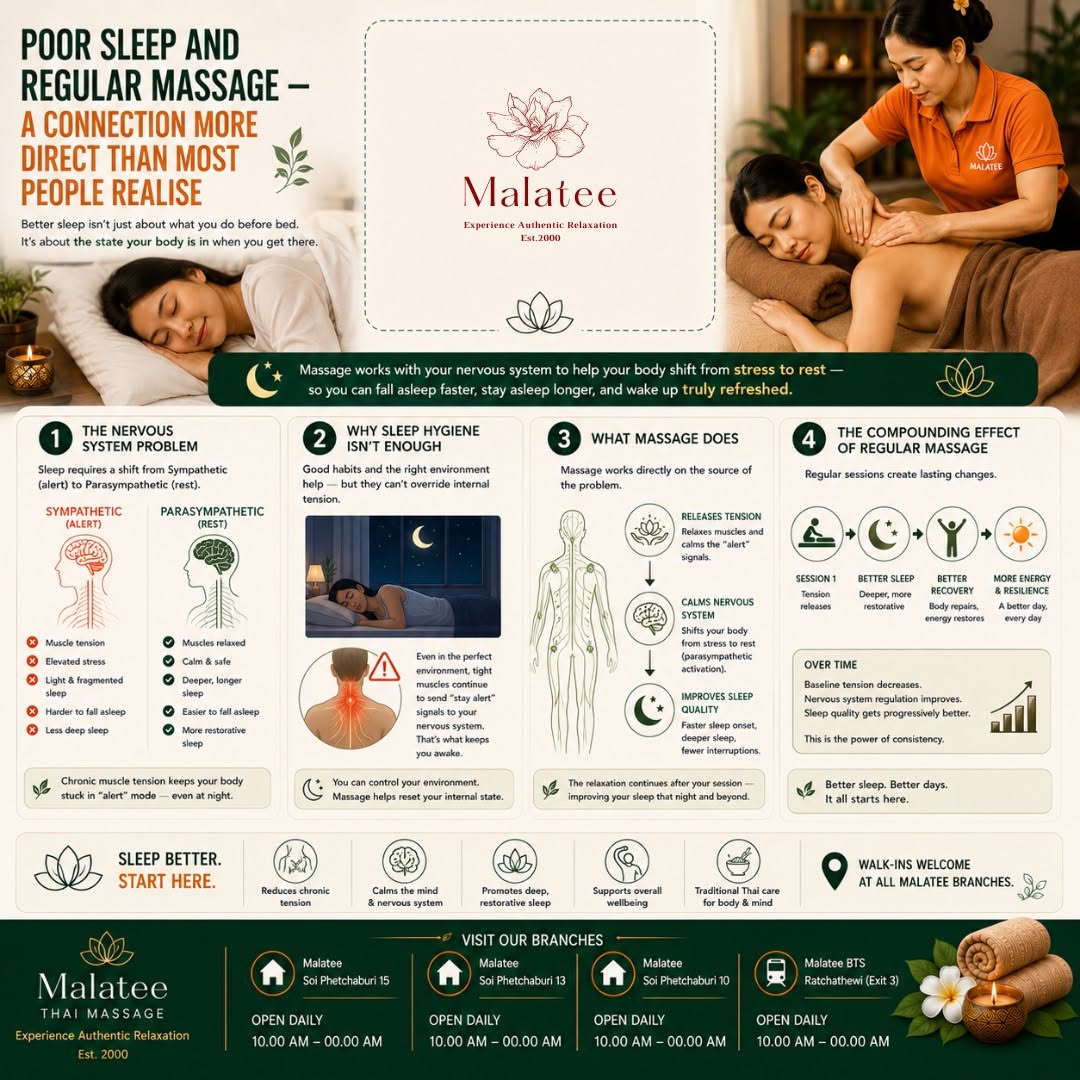
If you struggle with sleep — difficulty falling asleep, waking in the night, sleeping lightly, waking unrefreshed — you’ve probably tried the standard advice. Reduce screen time before bed. Keep the room cool and dark. Avoid caffeine after midday. Maintain a consistent sleep schedule.
These are all valid. But they address sleep from the outside — managing the conditions around sleep without addressing what may be preventing it from the inside.
For many people with persistent sleep difficulties, the core issue is not the environment or the habits. It is the physiological state the body is in when it arrives at bedtime.
And that physiological state is something massage addresses directly.
**The nervous system problem**
Sleep requires a shift from sympathetic to parasympathetic nervous system dominance. The sympathetic state — the alert, responsive, ready state — is the mode the body needs during the day. The parasympathetic state — rest, digest, restore — is the mode required for sleep onset and maintenance.
For people who carry chronic muscular tension, this shift is harder to make.
Chronic muscle tension maintains a low-level sympathetic activation that persists even when the person is lying still in a dark room. The muscles are sending a continuous signal to the nervous system that something requires attention. The nervous system interprets this as a reason to stay slightly alert. The threshold between waking and sleep is raised. Falling asleep takes longer. Sleep is lighter and more fragmented. The restorative deep sleep stages — where the body does its most significant repair work — become harder to reach.
This is not a sleep problem in the conventional sense. It is a nervous system regulation problem that expresses itself through poor sleep.
**Why standard sleep hygiene doesn’t fix this**
Sleep hygiene — all the habits and environment adjustments — works by reducing the stimuli that keep the nervous system alert. But it cannot reduce the internal signal that chronic muscular tension is generating.
You can turn off every screen, eliminate every light source, set the room to the perfect temperature, and take the most consistent sleep schedule in the world. If the body is carrying significant chronic tension, the internal signal continues. The nervous system remains partially activated. Sleep quality remains compromised.
**What massage does**
A massage session — particularly one that produces a significant parasympathetic shift — directly addresses the source of that internal signal.
When skilled therapeutic touch releases the chronic tension that has been maintained in the muscles, the nervous system receives different information. The muscles are no longer communicating threat or load. The holding patterns release. The background activation decreases.
The nervous system shifts.
This shift does not disappear at the end of the session. Research on post-massage sleep quality consistently shows that people sleep more deeply and with fewer interruptions on the night of a massage, and that with regular sessions, the baseline quality of sleep improves over time — not just the night of the session, but across the week.
The mechanism is clear: regular massage progressively reduces the chronic tension that has been maintaining sympathetic activation. As that baseline decreases, the nervous system finds it easier to make the shift toward parasympathetic rest at bedtime. Sleep quality improves — not as a coincidence, but as a direct consequence.
**The compounding effect**
This is one of the areas where the difference between occasional massage and regular massage is most pronounced.
A single session produces a temporary reduction in tension and a temporary improvement in sleep quality. Regular sessions produce a progressive reduction in baseline tension — which means progressively better sleep, progressively more effective overnight recovery, and progressively more energy and resilience during the day.
The sleep improvement is not the side effect of massage. It is one of the core mechanisms.
**What this means practically**
If you have been struggling with sleep quality and have not yet explored regular massage as part of your approach — consider this the case for trying it.
At Malatee, our therapists understand the relationship between physical tension, nervous system state, and sleep. If you come in mentioning sleep difficulty, they will work with that context — paying particular attention to the areas and techniques most directly associated with nervous system regulation and parasympathetic activation.
Sleep better. Start here.
Walk-ins welcome at all Malatee branches.
การนอนหลับไม่ดีและการนวดสม่ำเสมอ — ความเชื่อมโยงที่ตรงกว่าที่คนส่วนใหญ่ตระหนัก
ถ้าคุณมีปัญหากับการนอนหลับ — หลับยาก ตื่นกลางดึก นอนหลับตื้น ตื่นมาแล้วไม่รู้สึกสดชื่น — คุณน่าจะลองคำแนะนำมาตรฐานแล้ว ลดเวลาหน้าจอก่อนนอน ทำให้ห้องเย็นและมืด หลีกเลี่ยงคาเฟอีนหลังเที่ยง รักษาตารางการนอนที่สม่ำเสมอ
สิ่งเหล่านี้ล้วนถูกต้อง แต่มันจัดการการนอนหลับจากภายนอก — จัดการเงื่อนไขรอบการนอนโดยไม่จัดการสิ่งที่อาจป้องกันมันจากภายใน
สำหรับคนจำนวนมากที่มีปัญหาการนอนหลับต่อเนื่อง ปัญหาหลักไม่ใช่สภาพแวดล้อมหรือนิสัย แต่คือสภาวะสรีรวิทยาที่ร่างกายอยู่ในนั้นเมื่อมาถึงเวลานอน
และสภาวะสรีรวิทยานั้นคือสิ่งที่การนวดจัดการโดยตรง
ปัญหาระบบประสาท
การนอนหลับต้องการการเปลี่ยนจากระบบประสาทซิมพาเทติกไปสู่การครอบงำของพาราซิมพาเทติก สำหรับคนที่แบกรับความตึงกล้ามเนื้อเรื้อรัง การเปลี่ยนแปลงนี้ทำได้ยากกว่า
ความตึงกล้ามเนื้อเรื้อรังรักษาการกระตุ้นซิมพาเทติกระดับต่ำที่คงอยู่แม้เมื่อบุคคลนอนนิ่งในห้องมืด กล้ามเนื้อส่งสัญญาณต่อเนื่องไปยังระบบประสาทว่ามีบางอย่างต้องการความสนใจ ระบบประสาทตีความสิ่งนี้เป็นเหตุผลที่จะยังคงตื่นตัวเล็กน้อย เกณฑ์ระหว่างการตื่นและการหลับสูงขึ้น การหลับใช้เวลานานขึ้น การนอนหลับตื้นและแตกเป็นชิ้นส่วนมากขึ้น
นี่ไม่ใช่ปัญหาการนอนหลับในแง่ทั่วไป แต่เป็นปัญหาการควบคุมระบบประสาทที่แสดงออกผ่านการนอนหลับที่ไม่ดี
 ทำไมสุขอนามัยการนอนมาตรฐานถึงไม่แก้ไขสิ่งนี้
สุขอนามัยการนอน ทำงานโดยลดสิ่งเร้าที่ทำให้ระบบประสาทตื่นตัว แต่ไม่สามารถลดสัญญาณภายในที่ความตึงกล้ามเนื้อเรื้อรังสร้างขึ้น ถ้าร่างกายแบกรับความตึงเรื้อรังอย่างมีนัยสำคัญ สัญญาณภายในยังคงต่อเนื่อง คุณภาพการนอนหลับยังคงถูกกระทบ
การนวดทำอะไร
เซสชั่นการนวดที่สร้างการเปลี่ยนแปลงพาราซิมพาเทติกอย่างมีนัยสำคัญจัดการแหล่งที่มาของสัญญาณภายในนั้นโดยตรง เมื่อการสัมผัสบำบัดที่มีทักษะปล่อยความตึงเรื้อรัง ระบบประสาทได้รับข้อมูลที่ต่างออกไป รูปแบบการยึดคลาย การกระตุ้นพื้นหลังลดลง ระบบประสาทเปลี่ยน
การวิจัยเกี่ยวกับคุณภาพการนอนหลับหลังการนวดอย่างสม่ำเสมอแสดงให้เห็นว่าคนนอนหลับลึกกว่าและมีการขัดจังหวะน้อยกว่าในคืนที่นวด และด้วยการนวดสม่ำเสมอ คุณภาพการนอนหลับพื้นฐานดีขึ้นตามเวลา
ผลสะสม
นี่คือหนึ่งในพื้นที่ที่ความแตกต่างระหว่างการนวดเป็นครั้งคราวและการนวดสม่ำเสมอเด่นชัดที่สุด การนวดสม่ำเสมอสร้างการลดความตึงพื้นฐานแบบก้าวหน้า ซึ่งหมายถึงการนอนหลับที่ดีขึ้นแบบก้าวหน้า การฟื้นตัวข้ามคืนที่มีประสิทธิภาพมากขึ้น และพลังงานและความยืดหยุ่นมากขึ้นในระหว่างวัน
ไม่ต้องนัด Walk-in ยินดีต้อนรับทุกสาขา
睡眠不佳与定期按摩——一种比大多数人意识到的更直接的联系。
如果你有睡眠问题——难以入睡、夜间醒来、睡眠浅、醒来后不觉得精力恢复——你可能已经尝试过标准建议:睡前减少屏幕使用,保持房间凉爽黑暗,中午后避免咖啡因,保持固定的睡眠时间表。
这些都是有效的,但它们从外部处理睡眠——管理睡眠周围的条件,而没有处理可能从内部阻碍睡眠的因素。
对于许多有持续睡眠困难的人来说,核心问题不是环境或习惯,而是身体在到达就寝时间时所处的生理状态。
而那种生理状态,正是按摩直接处理的。
神经系统问题
睡眠需要从交感神经主导转向副交感神经主导。对于承载慢性肌肉紧张的人来说,这种转换更难实现。
慢性肌肉紧张维持着一种低水平的交感神经激活,即使在黑暗房间里静静躺着也持续存在。肌肉持续向神经系统发出信号,暗示有什么需要关注。神经系统将此解读为保持轻度警觉的理由。入睡阈值升高,入睡需要更长时间,睡眠更浅且更易中断,恢复性的深度睡眠阶段变得更难进入。
这不是传统意义上的睡眠问题,而是一个通过睡眠质量差表现出来的神经系统调节问题。
为什么标准睡眠卫生无法解决这个问题
睡眠卫生通过减少让神经系统保持警觉的刺激来发挥作用,但它无法减少慢性肌肉紧张所产生的内部信号。如果身体承载着显著的慢性紧张,内部信号就会持续,睡眠质量持续受损。
按摩的作用
一次产生显著副交感神经转换的按摩疗程,直接处理那种内部信号的来源。当专业的治疗性触压释放慢性紧张时,神经系统接收到不同的信息,紧绷模式释放,背景激活减少,神经系统发生转变。
关于按摩后睡眠质量的研究持续表明:按摩当晚睡眠更深、中断更少,而定期按摩后,基础睡眠质量随时间改善——不只是按摩当晚,而是整个一周。
复利效果
这是偶尔按摩与定期按摩之间差异最显著的领域之一。定期按摩逐步降低基础紧张水平——意味着逐步更好的睡眠,逐步更有效的夜间恢复,以及白天逐步更充沛的精力和韧性。
欢迎直接前往 Malatee 任意门店,无需预约。
Experience Authentic Relaxation | Est. 2000
Visit Our Branches:
• Malatee Soi Phetchaburi 15
• Malatee Soi Phetchaburi 13
• Malatee Soi Phetchaburi 10
• Malatee BTS Ratchathewi (Exit 3)
#MalateeThaiMassage#มาลาตีนวดไทย#SleepAndMassage#นอนหลับ#ThaiMassageBangkok#นวดแผนไทย#SleepQuality#WellnessBangkok#BangkokMassage#นวดเพื่อสุขภาพ#ถนนเพชรบุรี#BetterSleep#SleepWellness#MassageTherapy
Lorem Ipsum is simply dummy text of the printing and typesetting industry