
Why Guests Return: What Consistent Care Looks Like at Malatee
Malatee Thai Massage has welcomed guests in Bangkok since 2000, and our name comes from the Malatee jasmine, the most
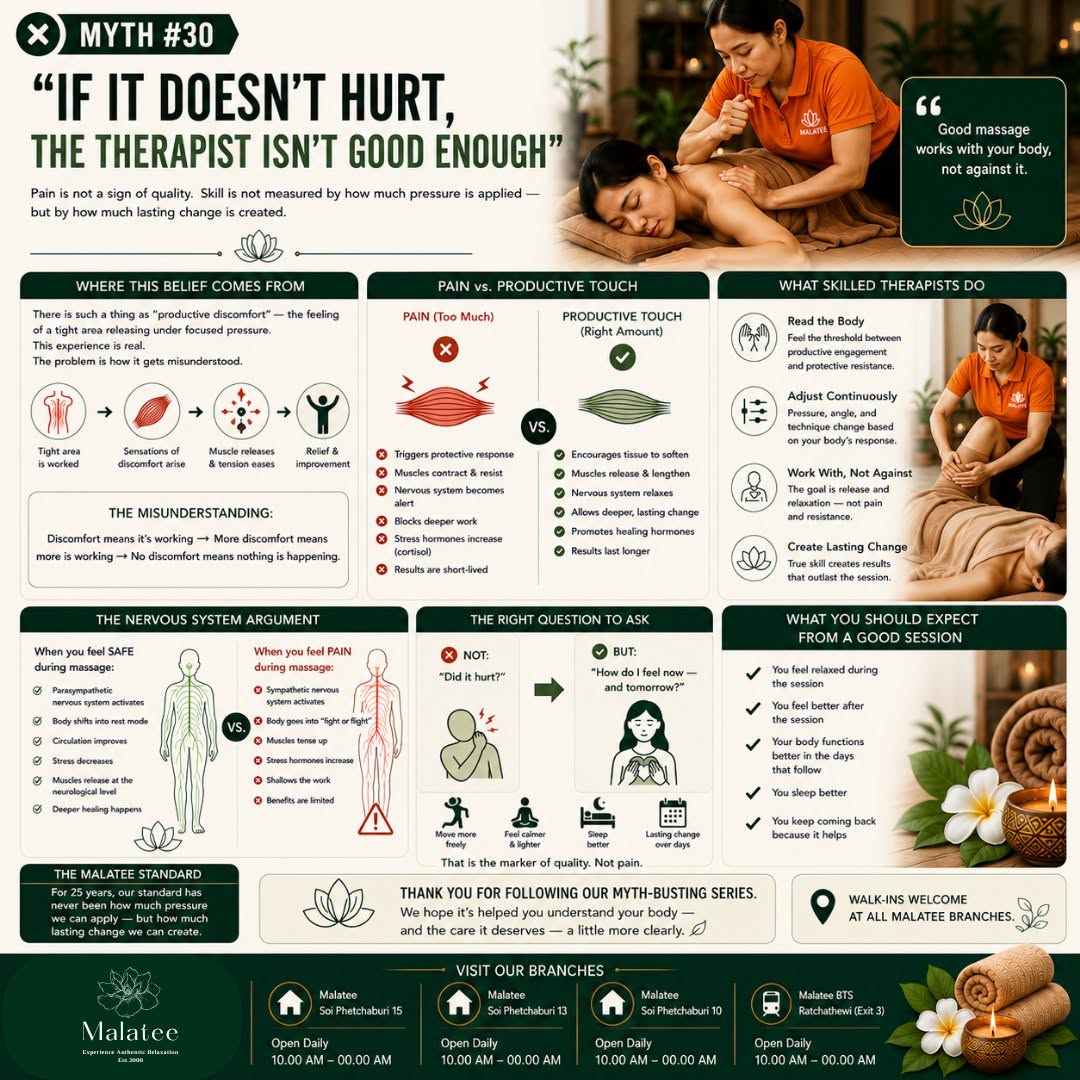
We’ve reached the thirtieth myth in this series — and this one feels like the right one to end on, because it ties together so much of what we’ve explored over the past weeks.
The belief that pain during massage is a sign of quality — that a therapist who doesn’t cause discomfort isn’t working hard enough, isn’t skilled enough, or isn’t doing anything useful — is perhaps the single most damaging misconception in massage culture.
It’s worth unpacking carefully. Because it’s not entirely without a basis. And because understanding why it’s wrong helps explain what good massage actually is.
**Where the belief comes from**
There is a genuine phenomenon in massage where working through a tight, restricted area produces a specific kind of discomfort — what experienced therapists describe as “productive discomfort” or “therapeutic sensation.” It’s the feeling of something releasing. A specific, localised sensation that communicates: something is changing here.
This is real. And people who have experienced it — the moment a chronically tight muscle finally lets go under sustained pressure — understand why it can feel meaningful.
The problem is what this legitimate experience gets generalised into.
The logic goes: discomfort means something is being addressed. Therefore more discomfort means more is being addressed. Therefore a massage without discomfort is a massage where nothing is happening.
Each step of this logic is flawed.
**Why pain during massage is not a marker of quality**
Pain — actual pain, not therapeutic sensation — triggers the body’s protective response. Muscles contract. The nervous system activates. The body physically resists what is being done to it.
This is the opposite of what effective massage requires. Effective massage works with tissue that has been encouraged to soften and release. When the body is in a state of protective contraction, the therapist is working against the tissue rather than with it. The mechanical input reaches the surface but doesn’t penetrate to where change actually occurs.
A therapist who works within the body’s tolerance — who finds the pressure that produces release rather than resistance — is achieving more than one who works beyond it. The tissue is responding. The nervous system is not threatened. The change is happening at the right depth.
**The nervous system argument**
We’ve explored this in earlier posts, but it bears repeating here.
The therapeutic benefit of massage — beyond the purely mechanical — depends significantly on the parasympathetic nervous system response. When the body feels safe and not threatened, it shifts toward rest. Circulation improves. Hormonal markers of stress decrease. The holding patterns in the muscles begin to release at the neurological level, not just the mechanical one.
Pain activates the sympathetic nervous system. It raises cortisol. It produces the exact neurological state that prevents the deepest layers of benefit from occurring.
A session that produces pain may produce some mechanical change in tissue. But it cannot produce the full depth of benefit that a session within the therapeutic range achieves.
**What skilled therapists actually do**
A genuinely skilled therapist does not maximise pressure. They read the body — feeling for the threshold between productive engagement and protective resistance — and work precisely at that threshold.
This requires more skill than simply applying force. It requires sensitivity, experience, and the ability to adjust continuously based on how each individual body is responding. Different areas of the body. Different sessions. Different days. The threshold changes constantly, and a skilled therapist tracks it throughout.
When Malatee clients occasionally comment that a session felt “too gentle” — we take the feedback seriously and adjust. But we also take the time to explain what the body was actually doing during those sixty minutes, because what felt gentle was often doing significant work at the right depth.
**The right question to ask**
Not: “Did it hurt?”
But: “How do I feel now — and tomorrow?”
A session done well produces results that outlast the session itself. Muscles that move more freely. A nervous system that has genuinely shifted. Sleep that night that is noticeably better. A body that tells you, over the following days, that something changed.
That is the marker of quality.
Not pain.
At Malatee, we’ve been practising this for 25 years. The standard we hold is not how much pressure we can apply — it’s how much lasting change we can create.
Thank you for following this Myth-Busting series. We hope it’s helped you understand your body — and the care it deserves — a little more clearly. 
 Walk-ins welcome at all Malatee branches.
 Myth #30: “ถ้าไม่เจ็บตอนนวด แสดงว่าหมอนวดไม่เก่ง”
เราถึง Myth ที่ 30 ในซีรีส์นี้แล้ว — และนี่รู้สึกว่าเป็นอันที่เหมาะที่จะปิดท้าย เพราะมันเชื่อมโยงสิ่งมากมายที่เราสำรวจมาตลอดหลายสัปดาห์
ความเชื่อที่ว่าความเจ็บปวดระหว่างการนวดเป็นสัญญาณของคุณภาพ — ว่าหมอนวดที่ไม่ทำให้รู้สึกไม่สบายไม่ได้ทำงานหนักพอ ไม่เก่งพอ หรือไม่ได้ทำอะไรที่มีประโยชน์ — อาจเป็นความเข้าใจผิดที่เป็นอันตรายที่สุดในวัฒนธรรมการนวด
ควรค่าแก่การแกะออกอย่างระมัดระวัง เพราะมันไม่ได้ไร้พื้นฐานโดยสิ้นเชิง และการเข้าใจว่าทำไมมันผิดช่วยอธิบายว่าการนวดที่ดีคืออะไรจริงๆ
 ความเชื่อมาจากไหน
มีปรากฏการณ์จริงในการนวดที่การทำงานผ่านบริเวณที่ตึงและถูกจำกัดสร้างความไม่สบายชนิดเฉพาะ — สิ่งที่หมอนวดที่มีประสบการณ์อธิบายว่า “ความไม่สบายที่มีประสิทธิผล” หรือ “ความรู้สึกบำบัด” มันคือความรู้สึกว่ามีบางอย่างกำลังปล่อยออก ความรู้สึกเฉพาะจุดที่สื่อสารว่า: บางอย่างกำลังเปลี่ยนแปลงที่นี่
สิ่งนี้เป็นจริง และคนที่ประสบมัน — ช่วงเวลาที่กล้ามเนื้อที่ตึงเรื้อรังในที่สุดปล่อยออกภายใต้แรงกดที่ยั่งยืน — เข้าใจว่าทำไมมันสามารถรู้สึกมีความหมาย
ปัญหาคือสิ่งที่ประสบการณ์ที่ถูกต้องนี้ถูกทำให้เป็นทั่วไป
ตรรกะเป็นแบบนี้: ความไม่สบายหมายความว่ามีบางอย่างได้รับการจัดการ ดังนั้นความไม่สบายมากขึ้นหมายความว่ามีบางอย่างได้รับการจัดการมากขึ้น ดังนั้นการนวดที่ไม่มีความไม่สบายคือการนวดที่ไม่มีอะไรเกิดขึ้น
แต่ละขั้นตอนของตรรกะนี้มีข้อบกพร่อง
ทำไมความเจ็บปวดระหว่างการนวดถึงไม่ใช่ตัวบ่งชี้คุณภาพ
ความเจ็บปวด — ความเจ็บปวดจริงๆ ไม่ใช่ความรู้สึกบำบัด — กระตุ้นการตอบสนองป้องกันของร่างกาย กล้ามเนื้อหดตัว ระบบประสาทกระตุ้น ร่างกายต่อต้านทางกายภาพต่อสิ่งที่กำลังทำกับมัน
นี่คือตรงข้ามของสิ่งที่การนวดที่มีประสิทธิภาพต้องการ การนวดที่มีประสิทธิภาพทำงานกับเนื้อเยื่อที่ได้รับการสนับสนุนให้นุ่มและปล่อยออก เมื่อร่างกายอยู่ในสภาวะการหดตัวป้องกัน หมอนวดกำลังทำงานต่อต้านเนื้อเยื่อแทนที่จะทำงานกับมัน การรับสัญญาณทางกลเข้าถึงพื้นผิวแต่ไม่ซึมลึกสู่จุดที่การเปลี่ยนแปลงเกิดขึ้นจริงๆ
หมอนวดที่ทำงานภายในความอดทนของร่างกาย — ที่ค้นหาแรงกดที่สร้างการปล่อยออกแทนการต่อต้าน — บรรลุผลมากกว่าคนที่ทำงานเกินมัน เนื้อเยื่อตอบสนอง ระบบประสาทไม่ถูกคุกคาม การเปลี่ยนแปลงเกิดขึ้นในความลึกที่ถูกต้อง
การโต้แย้งด้านระบบประสาท
ประโยชน์การบำบัดของการนวด — นอกเหนือจากที่เป็นกลไกล้วนๆ — ขึ้นอยู่กับการตอบสนองของระบบประสาทพาราซิมพาเทติกอย่างมีนัยสำคัญ เมื่อร่างกายรู้สึกปลอดภัยและไม่ถูกคุกคาม มันเปลี่ยนสู่การพักผ่อน การไหลเวียนดีขึ้น ตัวบ่งชี้ฮอร์โมนความเครียดลดลง รูปแบบการยึดในกล้ามเนื้อเริ่มปล่อยออกในระดับประสาทวิทยา ไม่ใช่แค่เชิงกล
ความเจ็บปวดกระตุ้นระบบประสาทซิมพาเทติก มันเพิ่มคอร์ติซอล มันสร้างสภาวะประสาทวิทยาที่แน่นอนที่ป้องกันไม่ให้ชั้นของประโยชน์ที่ลึกที่สุดเกิดขึ้น
หมอนวดที่มีทักษะทำอะไรจริงๆ
หมอนวดที่มีทักษะจริงๆ ไม่ได้ขยายแรงกดให้สูงสุด พวกเขาอ่านร่างกาย — รู้สึกถึงเกณฑ์ระหว่างการมีส่วนร่วมที่มีประสิทธิผลและการต่อต้านป้องกัน — และทำงานที่เกณฑ์นั้นพอดี
สิ่งนี้ต้องการทักษะมากกว่าการใช้แรงเพียงอย่างเดียว มันต้องการความไว ประสบการณ์ และความสามารถในการปรับตัวอย่างต่อเนื่องตามวิธีที่ร่างกายแต่ละคนตอบสนอง
คำถามที่ถูกต้องที่จะถาม:
ไม่ใช่ “มันเจ็บไหม?”
แต่คือ “ฉันรู้สึกอย่างไรตอนนี้ — และพรุ่งนี้?”
การนวดที่ทำได้ดีสร้างผลลัพธ์ที่คงอยู่นานกว่าการนวดเอง กล้ามเนื้อที่เคลื่อนไหวได้อิสระกว่า ระบบประสาทที่เปลี่ยนแปลงจริงๆ การนอนหลับในคืนนั้นที่ดีขึ้นอย่างเห็นได้ชัด ร่างกายที่บอกคุณ ตลอดวันหลังจากนั้น ว่ามีบางอย่างเปลี่ยนแปลง
นั่นคือตัวบ่งชี้คุณภาพ ไม่ใช่ความเจ็บปวด
ที่มาลาตี เราปฏิบัติสิ่งนี้มา 25 ปีแล้ว มาตรฐานที่เรายึดถือไม่ใช่แรงกดที่เราสามารถใช้ได้มากแค่ไหน แต่คือการเปลี่ยนแปลงที่ยั่งยืนที่เราสร้างได้มากแค่ไหน
ขอบคุณที่ติดตาม Myth-Busting Series นี้ หวังว่ามันช่วยให้คุณเข้าใจร่างกายของคุณ — และการดูแลที่มันสมควรได้รับ — ชัดเจนขึ้นอีกเล็กน้อย
ไม่ต้องนัด Walk-in ยินดีต้อนรับทุกสาขา
误解 #30:”按摩不痛,说明按摩师技术不好”
我们来到了这个系列的第30个误解——结束于这一个,感觉恰到好处,因为它串联起了我们过去几周探索的许多内容。
“按摩时疼痛是质量的标志”——这个信念,也许是按摩文化中最具破坏性的误解。
值得仔细拆解。因为它并非全无依据。而理解它为何是错的,有助于解释真正好的按摩究竟是什么。
这个信念从何而来
在按摩中确实存在一种真实的现象:处理一个紧绷、受限的区域时,会产生一种特定的不适感——经验丰富的按摩师称之为”有效性不适”或”治疗性感觉”。这是一种”某些东西正在松开”的感受——一种局部的、特定的感觉,传达着:这里正在发生变化。
这是真实的。经历过它的人——当一块长期紧绷的肌肉终于在持续按压下松开的那一刻——能够理解为什么它感觉有意义。
问题在于这个合理的体验被过度泛化了。
逻辑是这样的:不适感意味着有问题得到处理;因此更多不适意味着处理得更多;因此没有不适的按摩就是什么都没发生的按摩。
这个逻辑的每一步都存在缺陷。
为什么按摩时疼痛不是质量的标志
疼痛——真正的疼痛,而非治疗性感觉——会触发身体的保护性反应。肌肉收缩,神经系统激活,身体从生理上抵抗正在对它做的事情。
这恰恰与有效按摩所需的相反。有效按摩作用于已经被引导放松和释放的组织。当身体处于保护性收缩状态时,按摩师是在对抗组织而非与之合作。机械刺激触及表层,却无法渗透到变化真正发生的深处。
在身体耐受范围内工作的按摩师——找到产生释放而非抵抗的力度——所达到的效果,远超越过这个范围的按摩师。组织在响应,神经系统未受到威胁,变化在正确的深度发生。
值得问的正确问题
不是:”痛吗?”
而是:”现在——以及明天——我感觉怎么样?”
做得好的按摩所产生的效果,会延续到疗程之后。肌肉活动更自如,神经系统真正发生了转变,当晚的睡眠明显更好,身体在随后几天告诉你:有些东西改变了。
这才是质量的标志。不是疼痛。
在 Malatee,我们践行这一标准已经25年。我们坚守的标准,不是我们能施加多大的压力——而是我们能创造多少持久的改变。
感谢你一直关注这个辟谣系列。希望它帮助你更清晰地了解自己的身体——以及它所值得的照护。
欢迎直接前往 Malatee 任意门店,无需预约。
 Experience Authentic Relaxation | Est. 2000
 Visit Our Branches:
• Malatee Soi Phetchaburi 15
• Malatee Soi Phetchaburi 13
• Malatee Soi Phetchaburi 10
• Malatee BTS Ratchathewi (Exit 3)
#MalateeThaiMassage#มาลาตีนวดไทย#MassageMyth#Myth30#ความเชื่อผิดๆเรื่องนวด#ThaiMassageBangkok#นวดแผนไทย#MassageFacts#HonestWellness#WellnessBangkok#BangkokMassage#นวดเพื่อสุขภาพ#ถนนเพชรบุรี#MythBusting
Lorem Ipsum is simply dummy text of the printing and typesetting industry