
Why Guests Return: What Consistent Care Looks Like at Malatee
Malatee Thai Massage has welcomed guests in Bangkok since 2000, and our name comes from the Malatee jasmine, the most
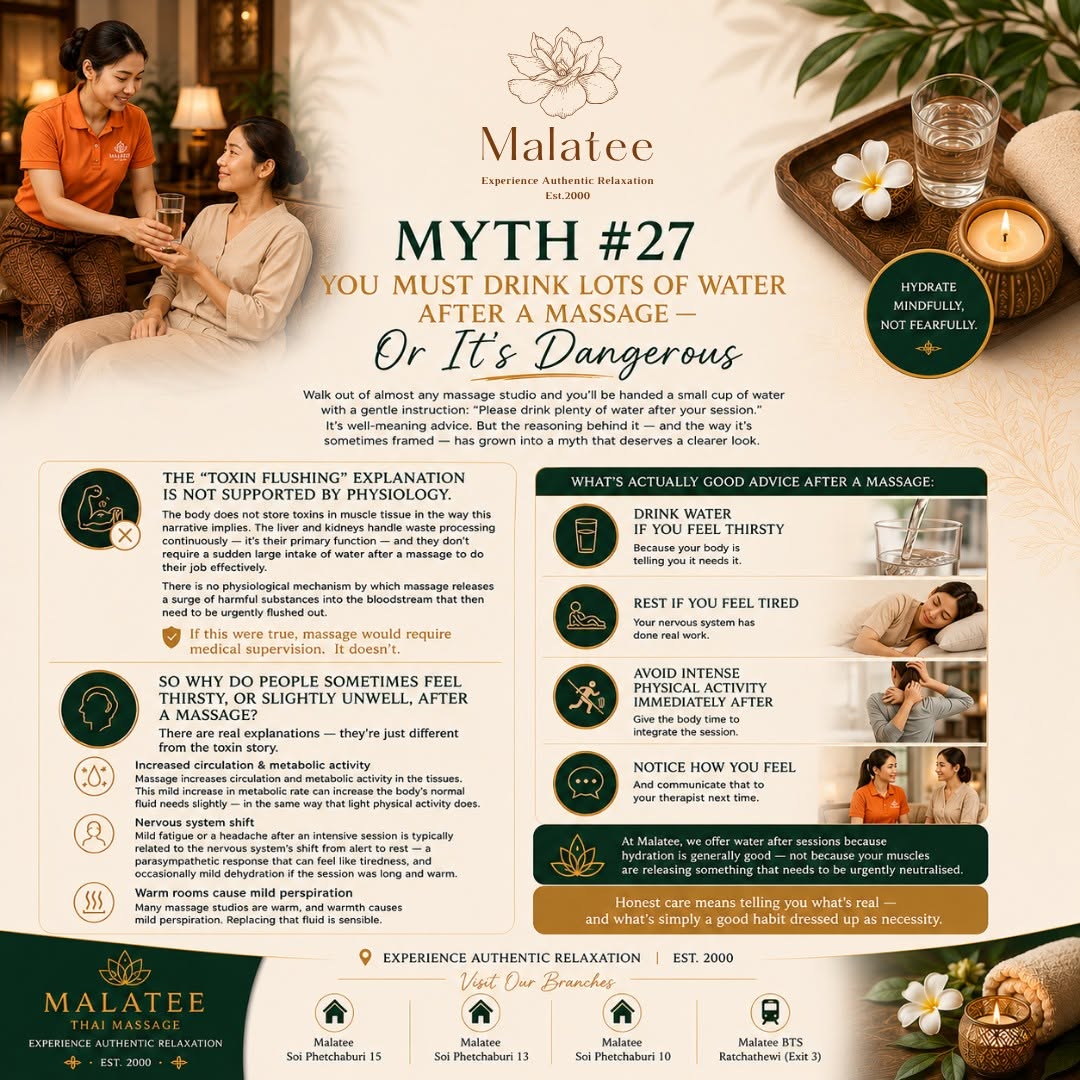
Walk out of almost any massage studio and you’ll be handed a small cup of water with a gentle instruction: “Please drink plenty of water after your session.”
It’s well-meaning advice. But the reasoning behind it — and the way it’s sometimes framed — has grown into a myth that deserves a clearer look.
The claim you’ll often hear: massage releases toxins from the muscles into the bloodstream, and you need to drink large amounts of water to flush them out — otherwise they’ll make you feel unwell, or worse.
Let’s address this directly.
The “toxin flushing” explanation is not supported by physiology.
The body does not store toxins in muscle tissue in the way this narrative implies. The liver and kidneys handle waste processing continuously — it’s their primary function — and they don’t require a sudden large intake of water after a massage to do their job effectively. There is no physiological mechanism by which massage releases a surge of harmful substances into the bloodstream that then need to be urgently flushed out.
If this were true, massage would require medical supervision. It doesn’t.
So why do people sometimes feel thirsty, or slightly unwell, after a massage?
There are real explanations — they’re just different from the toxin story.
Massage increases circulation and metabolic activity in the tissues. This mild increase in metabolic rate can increase the body’s normal fluid needs slightly — in the same way that light physical activity does. Drinking water after a massage is sensible for the same reason drinking water after a walk is sensible. Not urgent. Not medicinal. Just good practice.
Some people experience mild fatigue or a headache after an intensive session. This is typically related to the nervous system’s shift from alert to rest — a parasympathetic response that can feel like tiredness, and occasionally mild dehydration if the session was long and the room warm. Again — drinking water helps. But not because toxins are being flushed.
There’s also the simple fact that many massage studios are warm, and warmth causes mild perspiration. Replacing that fluid is sensible.
What’s actually good advice after a massage:
 Drink water if you feel thirsty — because your body is telling you it needs it
Rest if you feel tired — your nervous system has done real work
Avoid intense physical activity immediately after — give the body time to integrate the session
Notice how you feel — and communicate that to your therapist next time
At Malatee, we offer water after sessions because hydration is generally good — not because your muscles are releasing something that needs to be urgently neutralised.
Honest care means telling you what’s real — and what’s simply a good habit dressed up as necessity.
 Myth #27: “นวดแล้วต้องดื่มน้ำเยอะๆ ไม่งั้นเป็นอันตราย”
เดินออกจากร้านนวดเกือบทุกที่และคุณจะได้รับน้ำแก้วเล็กๆ พร้อมคำแนะนำอ่อนโยน: “กรุณาดื่มน้ำมากๆ หลังการนวดนะคะ”
เป็นคำแนะนำที่มีเจตนาดี แต่เหตุผลเบื้องหลังมัน — และวิธีที่มันบางครั้งถูกกล่าวถึง — ได้เติบโตเป็นความเชื่อที่ควรได้รับการพิจารณาอย่างชัดเจนกว่านี้
สิ่งที่คุณมักได้ยิน: การนวดปล่อยสารพิษจากกล้ามเนื้อเข้าสู่กระแสเลือด และคุณต้องดื่มน้ำในปริมาณมากเพื่อขับพวกมันออก — ไม่งั้นจะทำให้คุณรู้สึกไม่สบาย หรือแย่กว่านั้น
ขอตอบสิ่งนี้โดยตรง
คำอธิบายเรื่อง “การล้างสารพิษ” ไม่ได้รับการสนับสนุนจากสรีรวิทยา
ร่างกายไม่ได้เก็บสารพิษในเนื้อเยื่อกล้ามเนื้อในแบบที่เรื่องเล่านี้บอก ตับและไตจัดการกระบวนการกำจัดของเสียอย่างต่อเนื่อง — นั่นคือหน้าที่หลักของพวกมัน — และพวกมันไม่ต้องการการดื่มน้ำปริมาณมากฉับพลันหลังการนวดเพื่อทำงานได้อย่างมีประสิทธิภาพ ไม่มีกลไกทางสรีรวิทยาที่การนวดปล่อยสารที่เป็นอันตรายพุ่งเข้าสู่กระแสเลือดที่จำเป็นต้องขับออกอย่างเร่งด่วน
ถ้าเป็นเช่นนั้นจริง การนวดจะต้องมีการดูแลทางการแพทย์ แต่มันไม่ใช่
แล้วทำไมบางคนถึงรู้สึกกระหายน้ำ หรือรู้สึกไม่สบายเล็กน้อยหลังการนวด?
มีคำอธิบายที่แท้จริง — เพียงแต่ต่างจากเรื่องสารพิษ
การนวดเพิ่มการไหลเวียนและกิจกรรมเมตาบอลิกในเนื้อเยื่อ การเพิ่มขึ้นของอัตราเมตาบอลิกเล็กน้อยนี้อาจทำให้ความต้องการของเหลวตามปกติของร่างกายเพิ่มขึ้นเล็กน้อย — เหมือนกับที่การออกกำลังกายเบาๆ ทำ การดื่มน้ำหลังการนวดเป็นเรื่องสมเหตุสมผลด้วยเหตุผลเดียวกับที่การดื่มน้ำหลังการเดินสมเหตุสมผล ไม่เร่งด่วน ไม่ใช่ยา เพียงแต่เป็นการปฏิบัติที่ดี
บางคนรู้สึกเหนื่อยเล็กน้อยหรือปวดหัวหลังการนวดอย่างหนัก สิ่งนี้มักเกี่ยวข้องกับการเปลี่ยนแปลงของระบบประสาทจากตื่นตัวสู่พักผ่อน — การตอบสนองของพาราซิมพาเทติกที่อาจรู้สึกเหมือนความเหนื่อยล้า และบางครั้งมีอาการขาดน้ำเล็กน้อยถ้าการนวดยาวนานและห้องอบอุ่น อีกครั้ง — การดื่มน้ำช่วย แต่ไม่ใช่เพราะสารพิษกำลังถูกขับออก
และยังมีความจริงง่ายๆ ที่ว่าร้านนวดหลายแห่งอบอุ่น และความอบอุ่นทำให้เหงื่อออกเล็กน้อย การเติมของเหลวนั้นสมเหตุสมผล
คำแนะนำที่ดีจริงๆ หลังการนวด:
ดื่มน้ำถ้าคุณรู้สึกกระหาย — เพราะร่างกายบอกคุณว่าต้องการ
พักผ่อนถ้าคุณรู้สึกเหนื่อย — ระบบประสาทของคุณทำงานจริงๆ
หลีกเลี่ยงการออกกำลังกายหนักทันทีหลังการนวด — ให้ร่างกายมีเวลาซึมซับการนวด
สังเกตความรู้สึก — และสื่อสารกับหมอนวดครั้งต่อไป
ที่มาลาตี เราเสนอน้ำหลังการนวดเพราะการดื่มน้ำดีต่อสุขภาพโดยทั่วไป — ไม่ใช่เพราะกล้ามเนื้อของคุณกำลังปล่อยบางอย่างที่ต้องทำให้เป็นกลางอย่างเร่งด่วน
การดูแลที่ซื่อสัตย์หมายถึงการบอกคุณสิ่งที่เป็นจริง — และสิ่งที่เป็นแค่นิสัยที่ดีที่ถูกแต่งตัวเป็นความจำเป็น
误解 #27:”按摩后必须大量喝水,否则会有危险”
走出几乎任何一家按摩店,你都会被递上一小杯水,并附上一句温柔的叮嘱:”请按摩后多喝水哦。”
这是好意的建议。但它背后的逻辑——以及有时被描述的方式——已经演变成一个值得认真审视的误解。
你经常听到的说法是:按摩会将肌肉中的毒素释放进入血液,你需要大量喝水来将其冲出体外——否则会让你感到不适,甚至更糟。
让我们直接说清楚。
“排毒”的解释,没有生理学依据。
身体并不像这个说法所暗示的那样,将毒素储存在肌肉组织中。肝脏和肾脏持续不断地处理废物——这是它们的主要功能——它们不需要在按摩后突然大量喝水才能有效运作。在生理学上,并不存在按摩会将有害物质大量释放进入血液、需要紧急冲洗的机制。
如果真是这样,按摩就需要医疗监督了。事实并非如此。
那么,为什么有些人在按摩后会感到口渴,或者略感不适?
有真实的解释——只是与”排毒”无关。
按摩会促进组织中的血液循环和代谢活动。这种轻微的代谢率提升,可能会略微增加身体正常的液体需求——就像轻度体力活动会带来的效果一样。按摩后喝水是合理的,理由与散步后喝水相同。不紧急,不是药物,只是好习惯。
有些人在深度按摩后会感到轻微疲劳或头痛。这通常与神经系统从警觉转向休息有关——一种副交感神经反应,可能感觉像疲倦,如果疗程较长且房间温暖,偶尔也会有轻微脱水的情况。同样——喝水有帮助,但不是因为在冲洗毒素。
还有一个简单的事实:许多按摩场所温度较高,温暖会导致轻微出汗,补充流失的液体是合理的。
按摩后真正好的建议:
感到口渴就喝水——因为身体在告诉你它需要
感到疲倦就休息——你的神经系统真的在工作
避免按摩后立即进行剧烈运动——给身体时间整合这次疗程
留意自己的感受——下次告诉你的按摩师
在 Malatee,我们在疗程后提供水,是因为补水总体上对健康有益——而不是因为你的肌肉正在释放什么需要紧急中和的东西。
诚实的照护,意味着告诉你什么是真实的——以及什么只是一个被包装成”必要”的好习惯。
 Experience Authentic Relaxation | Est. 2000
 Visit Our Branches:
• Malatee Soi Phetchaburi 15
• Malatee Soi Phetchaburi 13
• Malatee Soi Phetchaburi 10
• Malatee BTS Ratchathewi (Exit 3)
#MalateeThaiMassage#มาลาตีนวดไทย#MassageMyth#ความเชื่อผิดๆเรื่องนวด#ThaiMassageBangkok#นวดแผนไทย#MassageFacts#WellnessEducation#HonestWellness#BangkokWellness#นวดเพื่อสุขภาพ#ถนนเพชรบุรี#MassageTruths#BangkokMassage
Lorem Ipsum is simply dummy text of the printing and typesetting industry