
Why Guests Return: What Consistent Care Looks Like at Malatee
Malatee Thai Massage has welcomed guests in Bangkok since 2000, and our name comes from the Malatee jasmine, the most
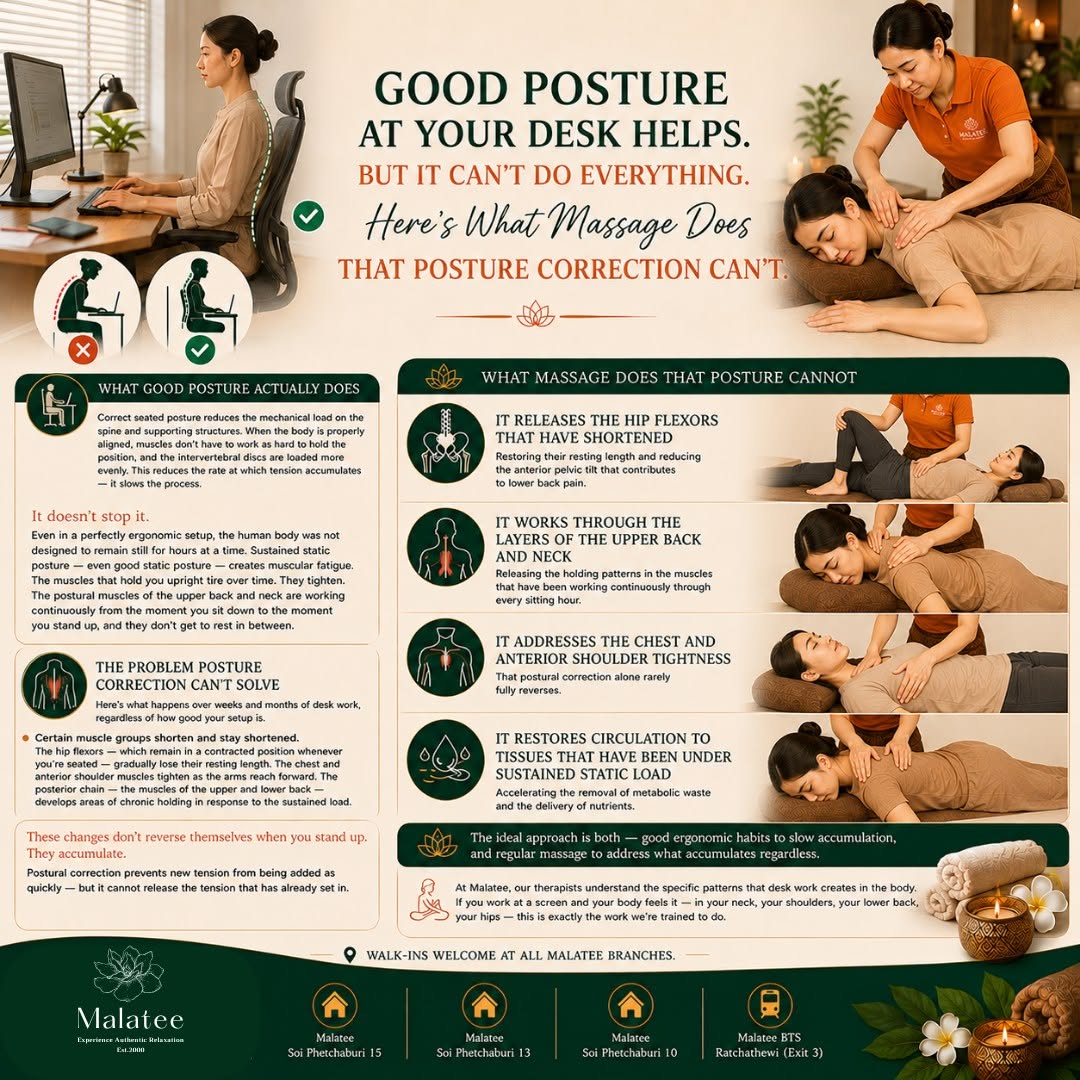
The advice is everywhere: sit up straight, adjust your monitor height, invest in an ergonomic chair, keep your feet flat on the floor. And this advice is genuinely useful — as far as it goes.
But there’s a limit to what posture correction can achieve. And understanding that limit helps explain why so many people who do everything right ergonomically still carry chronic tension in their neck, shoulders, and lower back.
**What good posture actually does**
Correct seated posture reduces the mechanical load on the spine and supporting structures. When the body is properly aligned, muscles don’t have to work as hard to hold the position, and the intervertebral discs are loaded more evenly. This reduces the rate at which tension accumulates — it slows the process.
It doesn’t stop it.
Even in a perfectly ergonomic setup, the human body was not designed to remain still for hours at a time. Sustained static posture — even good static posture — creates muscular fatigue. The muscles that hold you upright tire over time. They tighten. The postural muscles of the upper back and neck are working continuously from the moment you sit down to the moment you stand up, and they don’t get to rest in between.
**The problem posture correction can’t solve**
Here’s what happens over weeks and months of desk work, regardless of how good your setup is.
Certain muscle groups shorten and stay shortened. The hip flexors — which remain in a contracted position whenever you’re seated — gradually lose their resting length. The chest and anterior shoulder muscles tighten as the arms reach forward. The posterior chain — the muscles of the upper and lower back — develops areas of chronic holding in response to the sustained load.
These changes don’t reverse themselves when you stand up. They accumulate. Postural correction prevents new tension from being added as quickly — but it cannot release the tension that has already set in.
This is the gap that massage fills.
**What massage does that posture cannot**
Massage works directly on tissue that has already changed — not by encouraging better positioning going forward, but by addressing what has already happened.
 It releases the hip flexors that have shortened from years of sitting — restoring their resting length and reducing the anterior pelvic tilt that contributes to lower back pain
It works through the layers of the upper back and neck — releasing the holding patterns in the muscles that have been working continuously through every sitting hour
It addresses the chest and anterior shoulder tightness that postural correction alone rarely fully reverses
It restores circulation to tissues that have been under sustained static load — accelerating the removal of metabolic waste and the delivery of nutrients
The ideal approach is both — good ergonomic habits to slow accumulation, and regular massage to address what accumulates regardless.
At Malatee, our therapists understand the specific patterns that desk work creates in the body. If you work at a screen and your body feels it — in your neck, your shoulders, your lower back, your hips — this is exactly the work we’re trained to do.
 Walk-ins welcome at all Malatee branches.

 ท่านั่งทำงานที่ดีช่วยได้ แต่ทำได้ไม่ทุกอย่าง นี่คือสิ่งที่การนวดทำได้ที่การแก้ท่านั่งทำไม่ได้
คำแนะนำมีอยู่ทุกที่: นั่งตัวตรง ปรับความสูงหน้าจอ ลงทุนกับเก้าอี้ Ergonomic วางเท้าราบบนพื้น และคำแนะนำเหล่านี้มีประโยชน์จริง — ในระดับที่มันไปได้
แต่มีขีดจำกัดของสิ่งที่การแก้ไขท่าทางสามารถทำได้ และการเข้าใจขีดจำกัดนั้นช่วยอธิบายว่าทำไมคนจำนวนมากที่ทำทุกอย่างถูกต้องในแง่ Ergonomic ยังคงมีความตึงเรื้อรังที่คอ บ่า และหลังส่วนล่าง
ท่านั่งที่ดีทำอะไรได้จริงๆ
ท่านั่งที่ถูกต้องลดภาระทางกลไกบนกระดูกสันหลังและโครงสร้างรองรับ เมื่อร่างกายอยู่ในแนวที่เหมาะสม กล้ามเนื้อไม่ต้องทำงานหนักมากในการรักษาท่า และหมอนรองกระดูกถูกโหลดสม่ำเสมอกว่า สิ่งนี้ลดอัตราที่ความตึงสะสม — มันชะลอกระบวนการ
แต่ไม่หยุดมัน
แม้ในการตั้งค่า Ergonomic ที่สมบูรณ์แบบ ร่างกายมนุษย์ไม่ได้ถูกออกแบบมาให้อยู่นิ่งเป็นชั่วโมง ท่าทางนิ่งที่ยั่งยืน — แม้แต่ท่าทางนิ่งที่ดี — สร้างความล้าของกล้ามเนื้อ กล้ามเนื้อที่ยึดคุณตัวตรงเหนื่อยตามเวลา พวกมันตึงขึ้น กล้ามเนื้อท่าทางของหลังส่วนบนและคอทำงานอย่างต่อเนื่องตั้งแต่นาทีที่คุณนั่งลงจนถึงนาทีที่คุณลุกขึ้น และพวกมันไม่ได้พักในระหว่างนั้น
ปัญหาที่การแก้ท่านั่งแก้ไม่ได้
นี่คือสิ่งที่เกิดขึ้นตลอดหลายสัปดาห์และเดือนของการทำงานที่โต๊ะ ไม่ว่าการตั้งค่าของคุณจะดีแค่ไหน
กลุ่มกล้ามเนื้อบางกลุ่มสั้นลงและอยู่สั้นลงต่อไป กล้ามเนื้อสะโพกด้านหน้า — ซึ่งอยู่ในท่าหดตัวเมื่อคุณนั่ง — ค่อยๆ สูญเสียความยาวพักตามธรรมชาติ กล้ามเนื้อหน้าอกและบ่าด้านหน้าตึงขึ้นเมื่อแขนยื่นไปข้างหน้า ระบบหลัง — กล้ามเนื้อของหลังส่วนบนและล่าง — พัฒนาบริเวณที่ยึดเรื้อรังเพื่อตอบสนองต่อภาระที่ยั่งยืน
การเปลี่ยนแปลงเหล่านี้ไม่ได้กลับคืนเองเมื่อคุณลุกขึ้น พวกมันสะสม การแก้ไขท่าทางป้องกันไม่ให้ความตึงใหม่ถูกเพิ่มเข้ามาเร็วนัก — แต่ไม่สามารถปล่อยความตึงที่ตั้งรกรากแล้ว
นี่คือช่องว่างที่การนวดเติมเต็ม
สิ่งที่การนวดทำได้ที่ท่าทางทำไม่ได้
การนวดทำงานโดยตรงบนเนื้อเยื่อที่เปลี่ยนแปลงไปแล้ว — ไม่ใช่ด้วยการสนับสนุนตำแหน่งที่ดีกว่าข้างหน้า แต่ด้วยการจัดการสิ่งที่เกิดขึ้นไปแล้ว
คลายกล้ามเนื้อสะโพกด้านหน้าที่สั้นลงจากหลายปีของการนั่ง — คืนความยาวพักและลดการเอียงของกระดูกเชิงกรานที่มีส่วนทำให้ปวดหลังส่วนล่าง
ทำงานผ่านชั้นของหลังส่วนบนและคอ — คลายรูปแบบการยึดในกล้ามเนื้อที่ทำงานอย่างต่อเนื่องตลอดทุกชั่วโมงการนั่ง
จัดการความตึงของหน้าอกและบ่าด้านหน้าที่การแก้ไขท่าทางเพียงอย่างเดียวแทบไม่เคยย้อนกลับได้อย่างสมบูรณ์
คืนการไหลเวียนไปยังเนื้อเยื่อที่อยู่ภายใต้ภาระนิ่งที่ยั่งยืน — เร่งการกำจัดของเสียเมตาบอลิกและการส่งสารอาหาร
แนวทางที่ดีที่สุดคือทั้งสองอย่าง — นิสัย Ergonomic ที่ดีเพื่อชะลอการสะสม และการนวดสม่ำเสมอเพื่อจัดการสิ่งที่สะสมไม่ว่าอย่างไร
ที่มาลาตี หมอนวดของเราเข้าใจรูปแบบเฉพาะที่การทำงานที่โต๊ะสร้างในร่างกาย ถ้าคุณทำงานหน้าจอและร่างกายรู้สึกมัน — ที่คอ บ่า หลังส่วนล่าง สะโพก — นี่คืองานที่เราได้รับการฝึกมาเพื่อทำ
ไม่ต้องนัด Walk-in ยินดีต้อนรับทุกสาขา
正确坐姿有帮助。但它能做到的有限。以下是按摩能做到而坐姿矫正做不到的事。
这些建议随处可见:坐直、调整显示器高度、投资一把符合人体工学的椅子、双脚平放在地板上。这些建议确实有用——在它们能发挥作用的范围内。
但姿态矫正能实现的是有限度的。理解这个限度,有助于解释为什么那么多在人体工学方面做得面面俱到的人,颈部、肩膀和下背部依然存在慢性紧张。
良好坐姿实际上能做什么
正确的坐姿减少了脊柱和支撑结构所承受的机械负荷。当身体处于正确对齐的状态,肌肉不需要那么费力地维持姿势,椎间盘的受力也更加均匀。这降低了紧张积累的速率——它在减缓这个过程。
但它无法停止这个过程。
即使在完全符合人体工学的环境中,人体也并非为长时间静止而设计。持续的静态姿势——哪怕是良好的静态姿势——会产生肌肉疲劳。维持你坐直的肌肉会随时间疲惫,随之收紧。上背部和颈部的姿势肌,从你坐下的那一刻到站起来的那一刻,持续不间断地工作,中间得不到休息。
姿态矫正无法解决的问题
以下是无论你的工作设置多么完善,经过数周数月的伏案工作后都会发生的事。
某些肌肉群会缩短并保持缩短状态。髋屈肌——在你坐着时始终处于收缩位置——逐渐失去自然的静息长度。随着手臂向前伸展,胸部和肩膀前侧的肌肉变得紧绷。后链肌群——上下背部的肌肉——在持续负荷的应对中形成慢性紧绷区域。
这些变化在你站起来时并不会自动逆转。它们会积累。姿势矫正能防止新的紧张被快速添加——但无法释放已经形成的紧张。
这就是按摩所填补的空白。
按摩能做到而姿势无法做到的事
按摩直接作用于已经发生改变的组织——不是通过鼓励更好的未来姿势,而是通过处理已经发生的事情。
释放因多年久坐而缩短的髋屈肌——恢复其静息长度,减少导致下背痛的骨盆前倾
深入处理上背部和颈部的层层紧张——释放在每一个久坐小时中持续工作的肌肉所形成的紧绷模式
应对胸部和肩膀前侧的紧张——这是单靠姿势矫正几乎无法完全逆转的问题
恢复长期承受静态负荷的组织的血液循环——加速代谢废物的清除和营养物质的输送
最理想的方案是两者兼顾——良好的人体工学习惯以减缓积累,加上定期按摩来处理无论如何都会积累的紧张。
在 Malatee,我们的按摩师深刻理解久坐工作在身体中形成的特定模式。如果你长时间面对屏幕工作,而身体在颈部、肩膀、下背部或髋部有所反应——这正是我们经过专业培训去处理的工作。
欢迎直接前往 Malatee 任意门店,无需预约。
 Experience Authentic Relaxation | Est. 2000
 Visit Our Branches:
• Malatee Soi Phetchaburi 15
• Malatee Soi Phetchaburi 13
• Malatee Soi Phetchaburi 10
• Malatee BTS Ratchathewi (Exit 3)
#MalateeThaiMassage#มาลาตีนวดไทย#OfficeSyndrome#ออฟฟิศซินโดรม#DeskWork#ThaiMassageBangkok#นวดแผนไทย#PostureAndMassage#WellnessBangkok#BangkokMassage#นวดเพื่อสุขภาพ#ถนนเพชรบุรี#Ergonomics#NeckAndShoulderPain
Lorem Ipsum is simply dummy text of the printing and typesetting industry