
Why Guests Return: What Consistent Care Looks Like at Malatee
Malatee Thai Massage has welcomed guests in Bangkok since 2000, and our name comes from the Malatee jasmine, the most
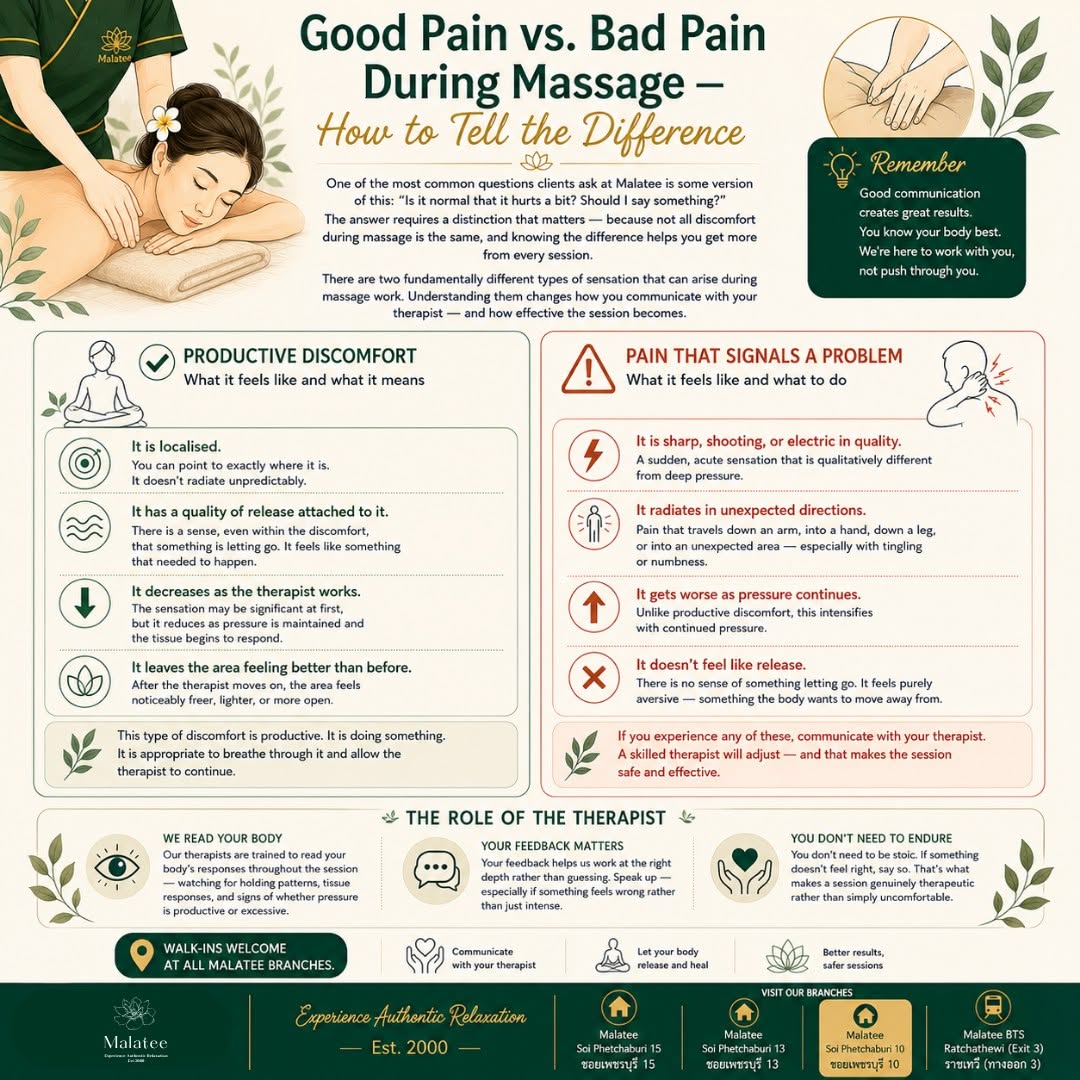
One of the most common questions clients ask at Malatee is some version of this: “Is it normal that it hurts a bit? Should I say something?”
The answer requires a distinction that matters — because not all discomfort during massage is the same, and knowing the difference helps you get more from every session.
There are two fundamentally different types of sensation that can arise during massage work. Understanding them changes how you communicate with your therapist — and how effective the session becomes.
Productive discomfort — what it feels like and what it means
The first type is what experienced therapists call productive discomfort or therapeutic sensation. It has specific characteristics:
It is localised. You can point to exactly where it is. It doesn’t radiate unpredictably.
It has a quality of release attached to it. There is a sense, even within the discomfort, that something is letting go. Many clients describe it as feeling like something that needed to happen — a tightness finally being addressed.
It decreases as the therapist works. The sensation may be significant at first contact with a tight area, but it reduces as pressure is maintained and the tissue begins to respond.
It leaves the area feeling better than before. After the therapist moves on, the area that produced the sensation feels noticeably freer, lighter, or more open than it did before the work.
This is the sensation of tissue releasing — of a chronically shortened muscle finally being encouraged to let go, of a fascial restriction being worked through, of a holding pattern being interrupted. It is a signal that the work is reaching something real.
This type of discomfort is productive. It is doing something. It is appropriate to breathe through it and allow the therapist to continue.
Pain that signals a problem — what it feels like and what to do
The second type is different in character — and it is important to communicate it to your therapist immediately.
It is sharp, shooting, or electric in quality. A sudden, acute sensation that is qualitatively different from the dull, deep pressure of productive discomfort.
It radiates in unexpected directions. Pain that travels down an arm, into a hand, down a leg, or into an area far from where the therapist is working — particularly if it is accompanied by tingling or numbness — signals that a nerve structure may be involved.
It gets worse as pressure continues. Unlike productive discomfort, which decreases as tissue responds, this type of pain intensifies with continued pressure.
It doesn’t feel like release. There is no sense of something letting go. It feels purely aversive — something the body wants to move away from rather than through.
If you experience any of these during a session, you should communicate with your therapist immediately. A skilled therapist will adjust — changing the angle, reducing the pressure, or moving to a different area entirely. This is not a sign of failure. It is exactly the communication that makes the session safe and effective.
The role of the therapist
At Malatee, our therapists are trained to read the body’s responses throughout the session — not just to apply techniques. They are watching for holding patterns, for tissue responses, for the signals that tell them whether pressure is productive or excessive.
But they also need you. Your feedback — particularly when something feels wrong rather than just intense — makes it possible for us to work at the right depth rather than guessing.
You don’t need to endure anything. You don’t need to be stoic. If something doesn’t feel right, say so. That is what makes a session genuinely therapeutic rather than simply uncomfortable.
Walk-ins welcome at all Malatee branches.
按摩中的”好痛”与”该停的痛”——如何分辨
Malatee 客人最常问的问题之一是:”有点痛是正常的吗?我应该说什么吗?”
这个问题需要一个重要的区分——因为按摩中的不适感并非都相同,了解其中差异能让你从每次疗程中获益更多。
有益的不适——它的感受和含义
第一种是有经验的按摩师所称的”有效性不适”或”治疗性感觉”,它有以下特征:
是局部的——你能精确指出它在哪里,不会无规律地扩散。
伴随着释放感——即使在不适中,也有一种”某些东西正在松开”的感觉。
随按摩师操作而减少——在接触紧绷区域时感觉可能很强烈,但随着压力维持和组织开始响应而减少。
之后感觉更好——按摩师移开后,产生感觉的区域感觉明显更自由、更轻盈。
这是组织释放的信号,是有效的工作。可以配合呼吸,让按摩师继续。
需要停止的疼痛——它的感受和应对
第二种在性质上完全不同,需要立即告知按摩师:
是尖锐的、放射状的或电击感——与有效不适的钝重深压感在性质上截然不同。
向意外方向扩散——沿手臂、进入手部、沿腿部或进入远离按摩师操作处的区域,尤其伴随麻刺感时,可能涉及神经结构。
随压力持续而加重——与有效不适不同,这种疼痛在持续压力下会加剧。
没有释放感——没有”某些东西正在松开”的感觉,只是纯粹的排斥感。
如果出现上述任何情况,请立即告知按摩师。专业按摩师会调整——改变角度、减轻压力或移至其他区域。
在 Malatee,我们的按摩师接受过全程读取身体反应的培训。但他们也需要你的反馈——特别是当某些感觉不对时。你不需要忍耐任何东西。说出来,这才是让疗程真正有治疗效果的方式。
欢迎直接前往 Malatee 任意门店,无需预约。
ความเจ็บปวดที่ดีกับความเจ็บปวดที่ควรหยุด — วิธีแยกแยะ
หนึ่งในคำถามที่พบบ่อยที่สุดที่ลูกค้ามาลาตีถามคือ “ที่รู้สึกเจ็บเล็กน้อยนี้ปกติไหม? ควรบอกอะไรไหม?”
คำตอบต้องการการแยกแยะที่สำคัญ — เพราะความไม่สบายระหว่างการนวดไม่ได้เหมือนกันทั้งหมด และการรู้ความแตกต่างช่วยให้คุณได้รับประโยชน์มากขึ้นจากทุกเซสชั่น
ความไม่สบายที่มีประสิทธิผล — ความรู้สึกและความหมาย
ประเภทแรกคือสิ่งที่หมอนวดที่มีประสบการณ์เรียกว่า “ความไม่สบายที่มีประสิทธิผล” หรือ “ความรู้สึกบำบัด” มันมีลักษณะเฉพาะ:
เฉพาะที่ — คุณสามารถชี้ได้ว่าอยู่ที่ไหนพอดี มันไม่กระจายไปในทิศทางที่คาดไม่ถึง
มีความรู้สึกของการปล่อยออกติดมาด้วย — แม้ในความไม่สบาย มีความรู้สึกว่ามีบางอย่างกำลังปล่อย ลูกค้าหลายคนอธิบายว่ารู้สึกเหมือนบางอย่างที่ต้องเกิดขึ้น — ความตึงที่ในที่สุดได้รับการจัดการ
ลดลงเมื่อหมอนวดทำงาน — ความรู้สึกอาจรุนแรงในตอนแรกที่สัมผัสบริเวณที่ตึง แต่ลดลงเมื่อรักษาแรงกดและเนื้อเยื่อเริ่มตอบสนอง
รู้สึกดีขึ้นหลังจากนั้น — หลังจากหมอนวดผ่านไป บริเวณที่มีความรู้สึกรู้สึกอิสระกว่า เบากว่าอย่างเห็นได้ชัด
นี่คือสัญญาณของการปล่อยเนื้อเยื่อ เป็นงานที่ได้ผล เหมาะสมที่จะหายใจผ่านมันและให้หมอนวดทำงานต่อ
ความเจ็บปวดที่ควรสื่อสาร — ความรู้สึกและสิ่งที่ควรทำ
ประเภทที่สองแตกต่างในลักษณะ — และสำคัญที่ต้องสื่อสารกับหมอนวดทันที:
คมฉับ ยิง หรือเหมือนไฟฟ้า — ความรู้สึกฉับพลันเฉียบพลันที่แตกต่างจากแรงกดลึกทื่อๆ ของความไม่สบายที่มีประสิทธิผลในเชิงคุณภาพ
กระจายไปในทิศทางที่ไม่คาดคิด — ความเจ็บปวดที่เดินทางลงแขน เข้ามือ ลงขา หรือเข้าสู่บริเวณที่ห่างไกลจากที่หมอนวดทำงาน โดยเฉพาะถ้าประกอบกับอาการชาหรือเสียวซ่า อาจบ่งบอกว่าโครงสร้างประสาทเกี่ยวข้อง
แย่ลงเมื่อแรงกดดำเนินต่อ — ต่างจากความไม่สบายที่มีประสิทธิผล ความเจ็บปวดประเภทนี้รุนแรงขึ้นด้วยแรงกดต่อเนื่อง
ไม่รู้สึกเหมือนการปล่อยออก — ไม่มีความรู้สึกว่าบางอย่างกำลังปล่อย แค่รู้สึกไม่ดีอย่างแท้จริง
ถ้าคุณประสบสิ่งเหล่านี้ระหว่างเซสชั่น บอกหมอนวดทันที หมอนวดที่มีทักษะจะปรับ — เปลี่ยนมุม ลดแรงกด หรือย้ายไปบริเวณอื่น
ที่มาลาตี หมอนวดของเราได้รับการฝึกให้อ่านการตอบสนองของร่างกายตลอดเซสชั่น แต่พวกเขายังต้องการคุณ ข้อเสนอแนะของคุณทำให้เราสามารถทำงานได้ในความลึกที่เหมาะสม
คุณไม่ต้องอดทนกับอะไร ถ้ามีบางอย่างรู้สึกไม่ถูกต้อง พูดออกมา นั่นคือสิ่งที่ทำให้เซสชั่นมีประสิทธิภาพการบำบัดอย่างแท้จริง
ไม่ต้องนัด Walk-in ยินดีต้อนรับทุกสาขา
Experience Authentic Relaxation | Est. 2000
Visit Our Branches:
• Malatee Soi Phetchaburi 15
• Malatee Soi Phetchaburi 13
• Malatee Soi Phetchaburi 10
• Malatee BTS Ratchathewi (Exit 3)
#MalateeThaiMassage#มาลาตีนวดไทย#MassageTips#ปวดระหว่างนวด#ThaiMassageBangkok#นวดแผนไทย#WellnessBangkok#BangkokMassage#ถนนเพชรบุรี#นวดเพื่อสุขภาพ#MassageEducation#GoodPain#WellnessTips
Lorem Ipsum is simply dummy text of the printing and typesetting industry