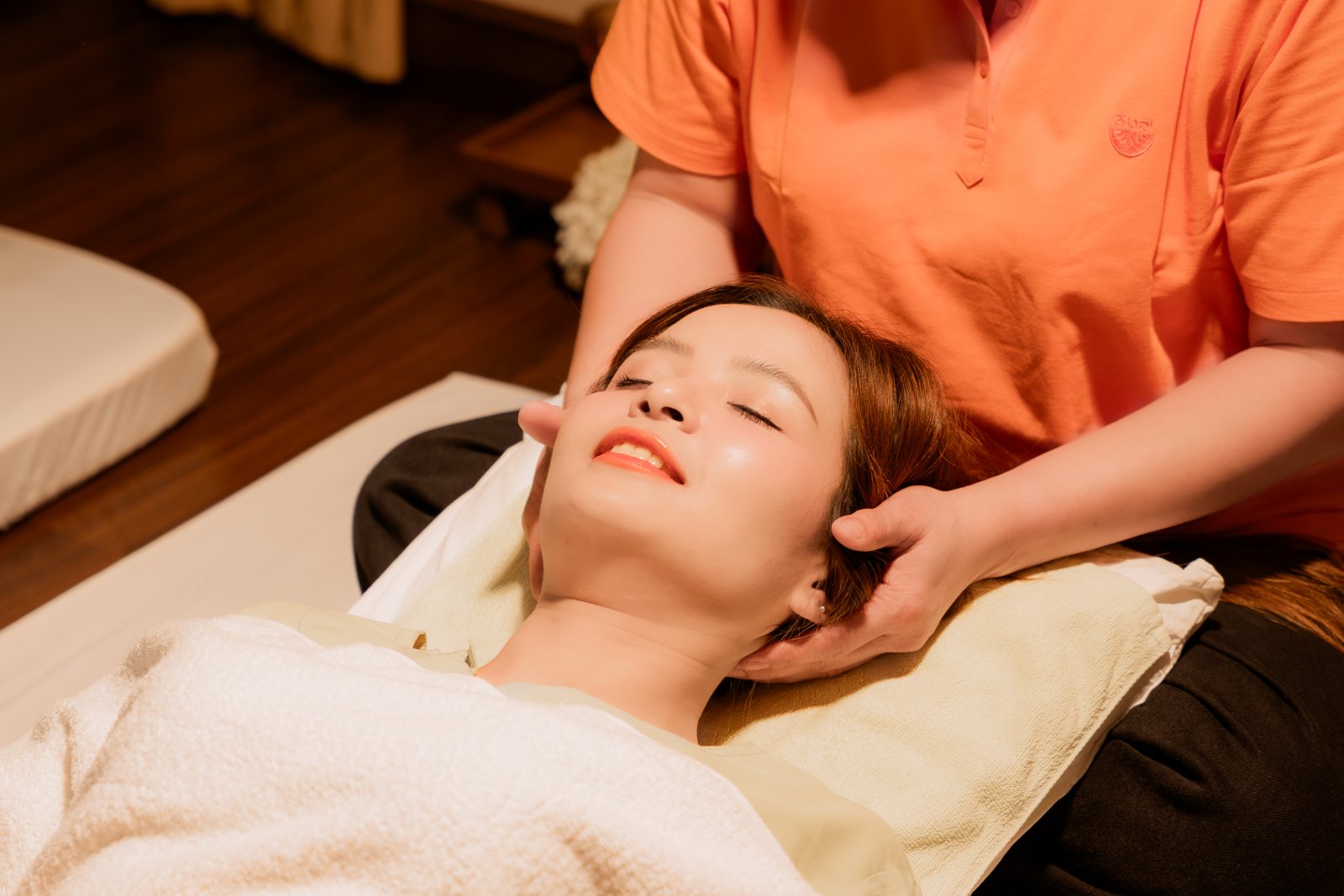

Why Guests Return: What Consistent Care Looks Like at Malatee
Malatee Thai Massage has welcomed guests in Bangkok since 2000, and our name comes from the Malatee jasmine, the most
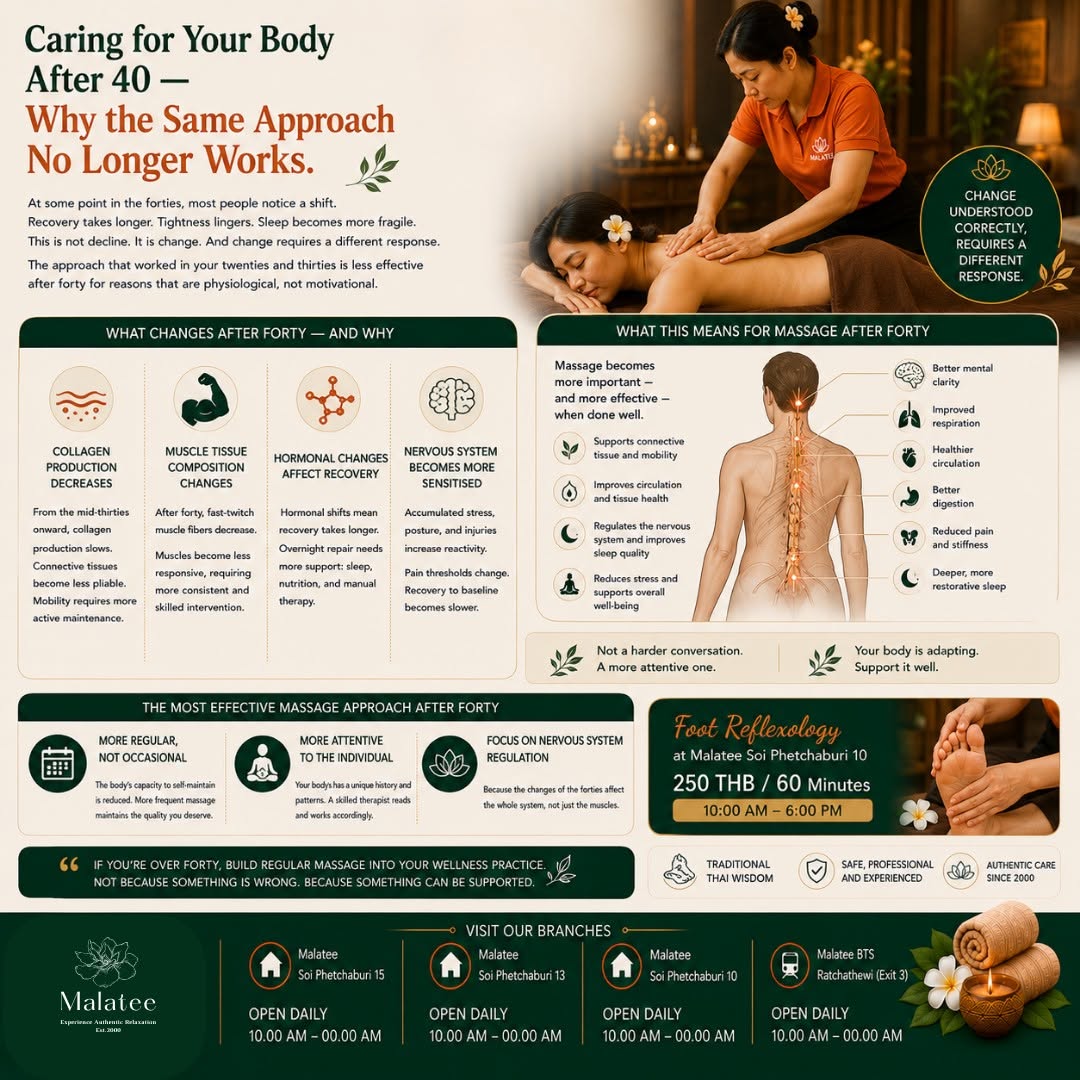
At some point in the forties, most people notice a shift.
Recovery takes longer than it used to. The tightness that once resolved itself over a few days now lingers for a week. Sleep that used to be reliable becomes more fragile. The body that once absorbed the demands of daily life without obvious protest begins to communicate — more frequently, and more clearly — that something needs to change.
This is not decline. It is change. And change, understood correctly, requires a different response.
The approach that worked in your twenties and thirties — doing more, pushing through, relying on the body’s resilience to manage the accumulation — is less effective after forty for reasons that are physiological, not motivational. Understanding those reasons is the first step toward addressing them.
**What changes after forty — and why**
 Collagen production decreases
From the mid-thirties onward, the body produces collagen at a progressively slower rate. Collagen is the primary structural protein of connective tissue — the fascia, tendons, ligaments, and joint capsules that give the body its structural integrity and mobility. As production decreases, these structures become less pliable. Movements that were effortless become slightly more effortful. The range of motion that was once a given requires more active maintenance to preserve.
Muscle tissue composition changes
After forty, the proportion of fast-twitch muscle fibres decreases relative to slow-twitch fibres. The body’s capacity for rapid force generation and explosive movement decreases. More significantly for most people’s daily experience, the muscle tissue itself becomes less responsive to the mechanical input of both exercise and manual therapy — requiring more consistent and more skilled intervention to maintain quality.
Hormonal changes affect recovery
The hormonal environment that supported rapid overnight recovery in younger years — particularly growth hormone and sex hormones — changes significantly after forty. Recovery from physical demand takes longer. The overnight repair that once happened automatically now requires more deliberate support: adequate sleep, adequate nutrition, and — directly relevant here — regular manual therapy that supports the circulatory and tissue maintenance processes that hormonal changes slow.
The nervous system becomes more sensitised
Accumulated life experience — including accumulated physical demand, stress, and the minor injuries and postural compensations of decades — produces a nervous system that is more reactive and less efficiently regulated. Pain thresholds change. Sleep becomes more sensitive to disruption. The body’s ability to return to a resting baseline after activation becomes slower.
**What this means for massage after forty**
These physiological changes don’t mean that massage becomes less effective after forty. In many respects, it becomes more important — and when done well, more effective — because the body has more to benefit from the specific things that massage does.
The connective tissue that has become less pliable responds directly to the myofascial techniques that skilled Thai massage applies. The circulation that hormonal changes slow responds to the mechanical stimulation of massage. The nervous system that has become more sensitised responds to the parasympathetic shift that a good session produces. The sleep quality that has become more fragile improves with the nervous system regulation that regular massage supports.
What changes is not whether massage helps — it is how it needs to be applied.
After forty, the most effective massage approach is:
More regular — not occasional. The body’s capacity to self-maintain between sessions is reduced; more frequent intervention maintains the quality that used to happen more automatically
More attentive to the individual — the body after forty has a specific history, specific accumulated patterns, specific areas that need more attention. A skilled therapist reads this and works accordingly
More focused on nervous system regulation alongside tissue work — because the physiological changes of the forties affect not just the muscles but the whole regulatory system
At Malatee, our therapists work with clients across all ages — and understand that the body at forty, fifty, and beyond requires a different conversation than the body at twenty-five. Not a harder conversation. A more attentive one.
If you’re over forty and you haven’t yet built regular massage into your wellness practice — now is the right time. Not because something is wrong. Because something can be genuinely supported.
Walk-ins welcome at all Malatee branches.
การดูแลร่างกายหลัง 40 — ทำไมแนวทางเดิมถึงใช้ไม่ได้อีกต่อไป
ในช่วงวัยสี่สิบ คนส่วนใหญ่สังเกตเห็นการเปลี่ยนแปลง
การฟื้นตัวใช้เวลานานกว่าที่เคย ความแข็งที่เคยหายเองใน ไม่กี่วันตอนนี้คงอยู่นานขึ้น การนอนหลับที่เคยน่าเชื่อถือกลายเป็นเปราะบางกว่า ร่างกายที่เคยรองรับความต้องการของชีวิตประจำวันโดยไม่ประท้วงชัดๆ เริ่มสื่อสาร — บ่อยขึ้น และชัดขึ้น — ว่ามีบางอย่างต้องเปลี่ยน
นี่ไม่ใช่การเสื่อมถอย แต่คือการเปลี่ยนแปลง และการเปลี่ยนแปลงที่เข้าใจอย่างถูกต้องต้องการการตอบสนองที่ต่างออกไป
สิ่งที่เปลี่ยนหลัง 40 — และทำไม
การผลิตคอลลาเจนลดลง — ตั้งแต่กลางทศวรรษสามสิบ ร่างกายผลิตคอลลาเจนในอัตราที่ช้าลงเรื่อยๆ พังผืด เอ็น เอ็นยึด และแคปซูลข้อต่อมีความยืดหยุ่นน้อยลง
องค์ประกอบของเนื้อเยื่อกล้ามเนื้อเปลี่ยน — หลัง 40 สัดส่วนของเส้นใยกล้ามเนื้อ Fast-twitch ลดลง เนื้อเยื่อกล้ามเนื้อเองตอบสนองต่อการรับสัญญาณทางกลของทั้งการออกกำลังกายและการบำบัดด้วยมือน้อยลง ต้องการการแทรกแซงที่สม่ำเสมอและมีทักษะมากขึ้น
การเปลี่ยนแปลงฮอร์โมนส่งผลต่อการฟื้นตัว — สภาพแวดล้อมฮอร์โมนที่สนับสนุนการฟื้นตัวข้ามคืนที่รวดเร็วในช่วงวัยที่อายุน้อย เปลี่ยนแปลงอย่างมีนัยสำคัญหลัง 40 การฟื้นตัวจากความต้องการทางกายใช้เวลานานขึ้น
ระบบประสาทไวมากขึ้น — ประสบการณ์ชีวิตสะสม รวมถึงความต้องการทางกายสะสม ความเครียด และการบาดเจ็บเล็กน้อยและการชดเชยท่าทางมาหลายทศวรรษ สร้างระบบประสาทที่ตอบสนองมากขึ้นและควบคุมได้น้อยลง
สิ่งนี้หมายความว่าอะไรสำหรับการนวดหลัง 40
การเปลี่ยนแปลงทางสรีรวิทยาเหล่านี้ไม่ได้หมายความว่าการนวดมีประสิทธิภาพน้อยลงหลัง 40 ในหลายแง่มุม มันสำคัญมากขึ้น
หลัง 40 แนวทางการนวดที่มีประสิทธิผลสูงสุดคือ:
สม่ำเสมอมากขึ้น — ไม่ใช่เป็นครั้งคราว
ใส่ใจต่อบุคคลมากขึ้น — ร่างกายหลัง 40 มีประวัติเฉพาะ รูปแบบสะสมเฉพาะ
มุ่งเน้นการควบคุมระบบประสาทควบคู่กับการทำงานเนื้อเยื่อ
ที่มาลาตี หมอนวดทำงานกับลูกค้าทุกอายุ และเข้าใจว่าร่างกายที่สี่สิบ ห้าสิบ ต้องการการสนทนาที่ต่างออกไป ไม่ใช่ยากกว่า แต่ใส่ใจมากขึ้น
ไม่ต้องนัด Walk-in ยินดีต้อนรับทุกสาขา
40岁之后的身体照护——为什么同样的方式不再奏效
四十岁前后,大多数人都会注意到一种转变。
恢复需要的时间比以前更长。曾经几天就能自行消散的僵硬,现在可能持续一周。曾经可靠的睡眠变得更加脆弱。曾经默默承受日常要求的身体,开始更频繁、更清晰地传递信号——有些东西需要改变。
这不是衰退,而是变化。而变化,若能正确理解,需要不同的回应。
40岁后的变化——以及原因
胶原蛋白生成减少——从三十多岁中期开始,身体产生胶原蛋白的速率逐渐放缓。筋膜、肌腱、韧带和关节囊的弹性降低,曾经轻松的动作变得略微费力。
肌肉组织成分改变——四十岁后,快肌纤维比例减少,肌肉组织对运动和手法治疗的机械刺激响应减弱,需要更持续、更有技术的干预来维持质量。
激素变化影响恢复——支持快速夜间恢复的激素环境(尤其是生长激素和性激素)在四十岁后显著改变,从体力需求中恢复所需的时间更长。
神经系统变得更敏感——数十年积累的体力需求、压力和姿态代偿,造就了一个反应更强、调节效率更低的神经系统,疼痛阈值改变,睡眠更易受干扰。
这对40岁后的按摩意味着什么
这些生理变化不意味着按摩在四十岁后效果变差——在很多方面,它变得更加重要。
40岁后效果最好的按摩方式:
更规律——而非偶尔。身体在两次疗程之间自我维护的能力减弱
更注重个体——四十岁后的身体有其特定历史和积累模式
更注重神经系统调节与组织工作并重
在 Malatee,我们的按摩师与各年龄层客人合作,深知四十、五十岁后的身体需要不同的照护方式——不是更难,而是更用心。
欢迎直接前往 Malatee 任意门店,无需预约。
Experience Authentic Relaxation | Est. 2000
Visit Our Branches:
• Malatee Soi Phetchaburi 15
• Malatee Soi Phetchaburi 13
• Malatee Soi Phetchaburi 10
• Malatee BTS Ratchathewi (Exit 3)
#MalateeThaiMassage#มาลาตีนวดไทย#Over40Wellness#ดูแลร่างกายหลัง40#ThaiMassageBangkok#นวดแผนไทย#HealthyAging#ActiveAging#WellnessBangkok#BangkokMassage#นวดเพื่อสุขภาพ#ถนนเพชรบุรี#MassageAfter40#WellnessForAll
Lorem Ipsum is simply dummy text of the printing and typesetting industry