
Why Guests Return: What Consistent Care Looks Like at Malatee
Malatee Thai Massage has welcomed guests in Bangkok since 2000, and our name comes from the Malatee jasmine, the most
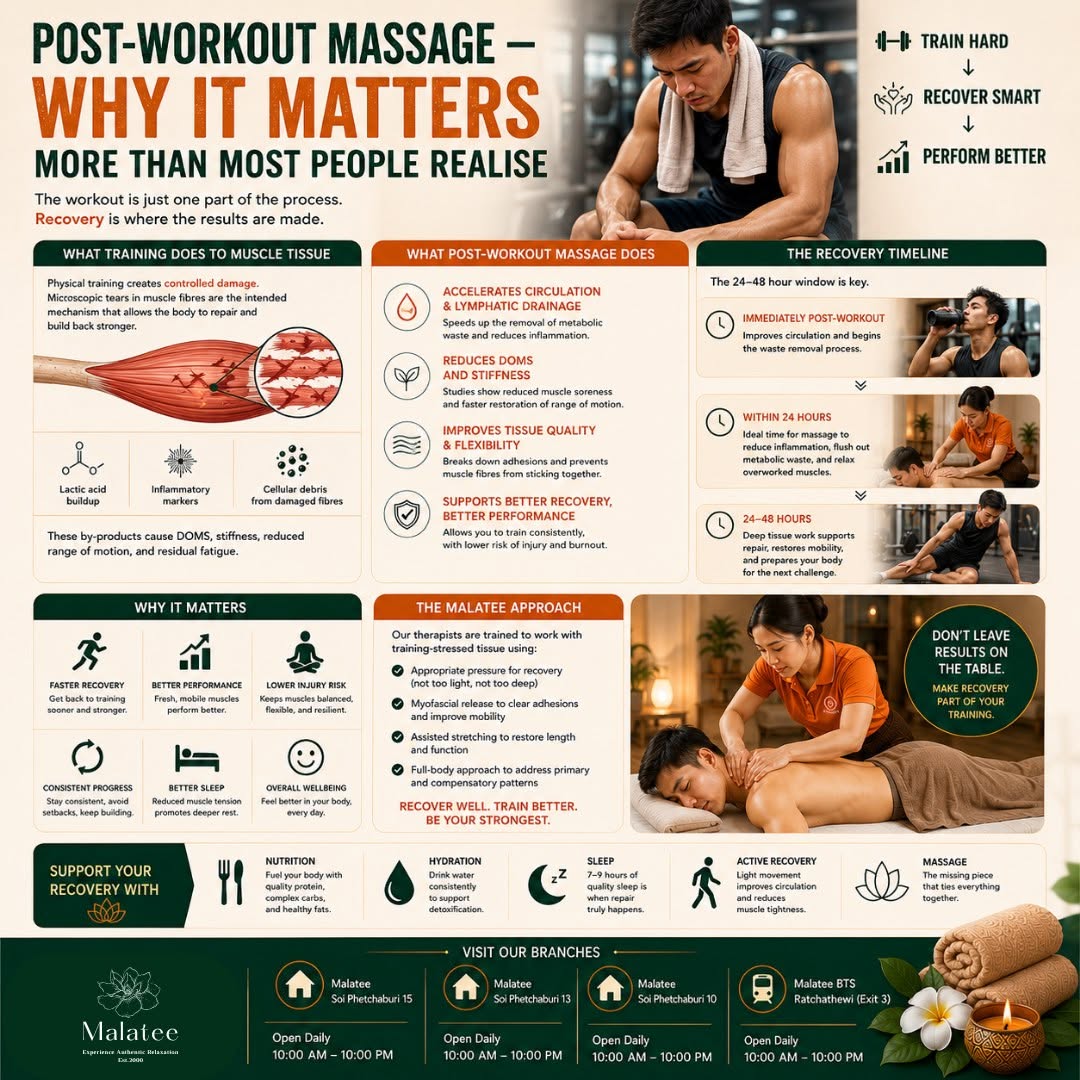
The workout gets all the attention. The warm-up, the session itself, the cool-down if you’re disciplined about it. But there’s a phase of physical training that most people systematically underinvest in — and it’s the phase where the actual results of training are determined.
Recovery.
Not passive recovery — lying on the sofa, sleeping in, taking rest days. Those things matter. But active, targeted recovery that addresses what the training session has actually done to the body.
Here’s what happens during exercise that makes post-workout massage genuinely important.
**What training does to muscle tissue**
Physical training creates controlled damage. When you run, lift, cycle, or play sport, the muscle fibres are subjected to mechanical stress that causes microscopic tears. This is the intended mechanism — the body repairs these fibres stronger and denser than before, which is how fitness and strength develop.
But the repair process is not automatic or guaranteed. It depends entirely on the conditions the body is given to work with. Adequate nutrition, adequate sleep, and — critically — the removal of the metabolic waste products that accumulate in muscle tissue during intense exercise.
Lactic acid, inflammatory markers, cellular debris from damaged fibres — these are the by-products of training. Left to clear on their own, they are responsible for the delayed onset muscle soreness (DOMS) that peaks 24-48 hours after exercise, the stiffness that reduces range of motion in the days following a hard session, and the residual fatigue that carries into the next training day.
**What post-workout massage does**
Massage immediately or shortly after exercise — or within the recovery window — addresses these by-products directly.
The mechanical pressure of massage accelerates lymphatic drainage and venous return — essentially speeding up the removal of metabolic waste from the tissues. Studies on post-exercise massage consistently show reduced DOMS, faster restoration of range of motion, and lower inflammatory markers in the days following massaged muscles compared to unmanipulated ones.
But the benefits go beyond the purely metabolic.
The fascial system — the connective tissue web that surrounds every muscle and links them together — responds to intense training by becoming more adhesive. Muscle fibres that have been working hard tend to stick to adjacent structures. Left unaddressed, these micro-adhesions accumulate over weeks of training into the kind of chronic tightness that reduces performance and increases injury risk.
Massage — particularly the myofascial release techniques and assisted stretching that form part of Traditional Thai Massage — prevents this accumulation. It keeps the tissue quality high. It maintains the length and mobility of muscles that training would otherwise progressively shorten.
**The timing question**
The most effective window for post-workout massage is typically within 24-48 hours of the training session. Immediately post-workout is beneficial for circulation and waste removal. The following day is often the best time to address the deeper tissue work — when the initial inflammatory response has settled but the muscles are still in the active phase of repair.
At Malatee, our therapists understand how to work with training-stressed tissue — the appropriate pressure, the techniques that support recovery rather than adding to the load, and the full-body approach that addresses not just the primary muscles worked but the compensatory patterns that develop throughout the rest of the body.
If you train regularly and you’re not building post-workout massage into your recovery practice — you’re leaving a significant part of your training’s potential on the table.
 Walk-ins welcome at all Malatee branches.
การนวดหลังออกกำลังกาย — ทำไมถึงสำคัญกว่าที่คนส่วนใหญ่ตระหนัก
การออกกำลังกายได้รับความสนใจทั้งหมด การอบอุ่นร่างกาย การออกกำลังกายเอง การคูลดาวน์ถ้าคุณมีวินัยพอ แต่มีช่วงหนึ่งของการฝึกทางกายที่คนส่วนใหญ่ลงทุนไม่เพียงพออย่างเป็นระบบ — และมันคือช่วงที่ผลลัพธ์จริงๆ ของการฝึกถูกกำหนด
การฟื้นตัว
ไม่ใช่การฟื้นตัวแบบเฉื่อย — การนอนอยู่บนโซฟา นอนตื่นสาย วันพัก สิ่งเหล่านั้นมีความสำคัญ แต่การฟื้นตัวที่กระตือรือร้นและเฉพาะเจาะจงที่จัดการกับสิ่งที่การนวดทำกับร่างกายจริงๆ
นี่คือสิ่งที่เกิดขึ้นระหว่างการออกกำลังกายที่ทำให้การนวดหลังออกกำลังกายมีความสำคัญจริงๆ
 การฝึกทำอะไรกับเนื้อเยื่อกล้ามเนื้อ
การฝึกทางกายสร้างความเสียหายที่ควบคุมได้ เมื่อคุณวิ่ง ยกน้ำหนัก ปั่นจักรยาน หรือเล่นกีฬา เส้นใยกล้ามเนื้อถูกกระทบด้วยความเครียดทางกลที่ทำให้เกิดการฉีกขาดระดับจุลภาค นี่คือกลไกที่ตั้งใจไว้ — ร่างกายซ่อมแซมเส้นใยเหล่านี้ให้แข็งแรงและหนาแน่นกว่าเดิม ซึ่งเป็นวิธีที่ความฟิตและความแข็งแรงพัฒนา
แต่กระบวนการซ่อมแซมไม่ได้เป็นไปโดยอัตโนมัติหรือรับประกัน มันขึ้นอยู่กับเงื่อนไขที่ร่างกายได้รับทั้งหมด โภชนาการที่เพียงพอ การนอนหลับที่เพียงพอ และ — สำคัญที่สุด — การกำจัดผลิตภัณฑ์ของเสียจากการเผาผลาญที่สะสมในเนื้อเยื่อกล้ามเนื้อระหว่างการออกกำลังกายอย่างหนัก
กรดแลคติก ตัวชี้วัดการอักเสบ เศษซากเซลล์จากเส้นใยที่เสียหาย — สิ่งเหล่านี้คือผลพลอยได้ของการฝึก ถ้าปล่อยให้ค่อยๆ หายเอง พวกมันรับผิดชอบต่ออาการปวดกล้ามเนื้อที่เริ่มช้า (DOMS) ที่ถึงจุดสูงสุด 24-48 ชั่วโมงหลังออกกำลังกาย ความแข็งที่ลดช่วงการเคลื่อนไหวในวันหลังจากเซสชั่นที่หนัก และความล้าที่เหลืออยู่ที่พาไปสู่วันฝึกถัดไป
การนวดหลังออกกำลังกายทำอะไร
การนวดทันทีหรือไม่นานหลังออกกำลังกาย — หรือภายในหน้าต่างการฟื้นตัว — จัดการกับผลพลอยได้เหล่านี้โดยตรง
แรงกดทางกลของการนวดเร่งการระบายน้ำเหลืองและการกลับของหลอดเลือดดำ — โดยพื้นฐานคือเร่งการกำจัดของเสียจากการเผาผลาญออกจากเนื้อเยื่อ การศึกษาเกี่ยวกับการนวดหลังออกกำลังกายอย่างสม่ำเสมอแสดงให้เห็น DOMS ที่ลดลง การคืนช่วงการเคลื่อนไหวที่เร็วขึ้น และตัวชี้วัดการอักเสบที่ต่ำกว่าในวันหลังจากกล้ามเนื้อที่ได้รับการนวดเทียบกับกล้ามเนื้อที่ไม่ได้รับการนวด
แต่ประโยชน์ไปไกลกว่าเมตาบอลิกล้วนๆ
ระบบพังผืด — เว็บเนื้อเยื่อเกี่ยวพันที่ล้อมรอบกล้ามเนื้อทุกมัดและเชื่อมต่อพวกมัน — ตอบสนองต่อการฝึกอย่างหนักโดยกลายเป็นกาวมากขึ้น เส้นใยกล้ามเนื้อที่ทำงานหนักมักจะติดกับโครงสร้างที่อยู่ติดกัน ถ้าไม่ได้รับการจัดการ การยึดติดระดับจุลภาคเหล่านี้สะสมตลอดหลายสัปดาห์ของการฝึกซ้อมเป็นความตึงเรื้อรังที่ลดสมรรถภาพและเพิ่มความเสี่ยงต่อการบาดเจ็บ
การนวด — โดยเฉพาะเทคนิคการคลายพังผืดและการยืดแบบช่วยเหลือที่เป็นส่วนหนึ่งของการนวดแผนไทย — ป้องกันการสะสมนี้ มันรักษาคุณภาพของเนื้อเยื่อให้สูง รักษาความยาวและความคล่องตัวของกล้ามเนื้อที่การฝึกซ้อมจะค่อยๆ ทำให้สั้นลงในทางอื่น
คำถามเรื่องเวลา
หน้าต่างที่มีประสิทธิผลสูงสุดสำหรับการนวดหลังออกกำลังกายโดยทั่วไปอยู่ภายใน 24-48 ชั่วโมงหลังเซสชั่นการฝึก ทันทีหลังออกกำลังกายมีประโยชน์สำหรับการไหลเวียนและการกำจัดของเสีย วันถัดไปมักเป็นเวลาที่ดีที่สุดสำหรับการทำงานเนื้อเยื่อลึกกว่า — เมื่อการตอบสนองการอักเสบเริ่มต้นสงบลงแต่กล้ามเนื้อยังอยู่ในระยะการซ่อมแซมที่กระตือรือร้น
ที่มาลาตี หมอนวดของเราเข้าใจวิธีการทำงานกับเนื้อเยื่อที่เครียดจากการฝึก — แรงกดที่เหมาะสม เทคนิคที่สนับสนุนการฟื้นตัวแทนที่จะเพิ่มภาระ และแนวทางทั้งร่างกายที่จัดการไม่ใช่แค่กล้ามเนื้อหลักที่ทำงานแต่รูปแบบการชดเชยที่พัฒนาขึ้นทั่วร่างกายที่เหลือ
ถ้าคุณฝึกสม่ำเสมอและไม่ได้สร้างการนวดหลังออกกำลังกายเข้าไปในการฝึกการฟื้นตัวของคุณ — คุณกำลังทิ้งส่วนสำคัญของศักยภาพการฝึกไว้
ไม่ต้องนัด Walk-in ยินดีต้อนรับทุกสาขา
运动后按摩——为什么它比大多数人意识到的更重要
训练本身得到了所有的关注。热身、正式训练、如果你足够自律还有放松整理。但大多数人系统性地低投入了体能训练的某个阶段——而这个阶段恰恰决定了训练成果能否真正实现。
恢复。
不是被动恢复——躺在沙发上、睡个懒觉、安排休息日。这些都重要。而是主动、有针对性的恢复,真正处理训练对身体造成的影响。
以下是训练过程中发生的事情,也是运动后按摩真正重要的原因。
训练对肌肉组织的影响
体能训练制造受控的损伤。当你跑步、举重、骑车或运动时,肌纤维承受机械压力,产生微观撕裂。这是有意为之的机制——身体会将这些纤维修复得比之前更强壮、更致密,这就是体能和力量提升的原理。
但修复过程并非自动进行或有所保证,它完全取决于身体所处的条件:充足的营养、充足的睡眠,以及——至关重要的——清除在高强度运动中积累于肌肉组织中的代谢废物。
乳酸、炎症标志物、受损纤维的细胞碎片——这些都是训练的副产品。任其自然清除,它们是导致延迟性肌肉酸痛(DOMS)的原因,在运动后24-48小时达到峰值,在大强度训练后数天内限制活动范围,并将残余疲劳带入下一个训练日。
运动后按摩的作用
训练后立即或不久后进行按摩——或在恢复窗口期内——直接处理这些副产品。
按摩的机械压力加速淋巴引流和静脉回流——本质上是加速代谢废物从组织中排出。关于运动后按摩的研究持续表明:与未经按摩的肌肉相比,接受按摩的肌肉在随后数天内DOMS更低、活动范围恢复更快、炎症标志物更少。
但好处不仅限于代谢层面。
筋膜系统——包裹每一块肌肉并将它们相互连接的结缔组织网络——在高强度训练后会变得更具粘附性。努力工作的肌纤维往往会粘附在相邻结构上。如果不加处理,这些微粘连在数周训练中逐渐积累,形成降低运动表现、增加受伤风险的慢性紧绷。
按摩——尤其是泰式传统按摩中的筋膜松解技法和辅助拉伸——能防止这种积累,维持高质量的组织状态,保持肌肉的长度和灵活性,而训练在其他情况下会使其逐渐缩短。
时机问题
运动后按摩效果最好的窗口期通常在训练后24-48小时内。训练后立即按摩有助于促进循环和废物清除。第二天往往是进行深层组织工作的最佳时机——此时初始炎症反应已趋于平稳,但肌肉仍处于活跃的修复阶段。
在 Malatee,我们的按摩师了解如何处理训练后的疲劳组织——适当的力度、支持恢复而非增加负荷的技法,以及处理不只是主要训练肌群、更涵盖全身代偿模式的整体方式。
如果你坚持训练,却没有将运动后按摩纳入恢复计划——你正在让训练潜力的相当一部分白白流失。
欢迎直接前往 Malatee 任意门店,无需预约。
Experience Authentic Relaxation | Est. 2000
 Visit Our Branches:
• Malatee Soi Phetchaburi 15
• Malatee Soi Phetchaburi 13
• Malatee Soi Phetchaburi 10
• Malatee BTS Ratchathewi (Exit 3)
#MalateeThaiMassage#มาลาตีนวดไทย#PostWorkoutMassage#นวดหลังออกกำลังกาย#ThaiMassageBangkok#นวดแผนไทย#ActiveRecovery#MuscleRecovery#WellnessBangkok#BangkokMassage#นวดเพื่อสุขภาพ#ถนนเพชรบุรี#FitnessRecovery#SportsMassage
Lorem Ipsum is simply dummy text of the printing and typesetting industry