
Why Guests Return: What Consistent Care Looks Like at Malatee
Malatee Thai Massage has welcomed guests in Bangkok since 2000, and our name comes from the Malatee jasmine, the most
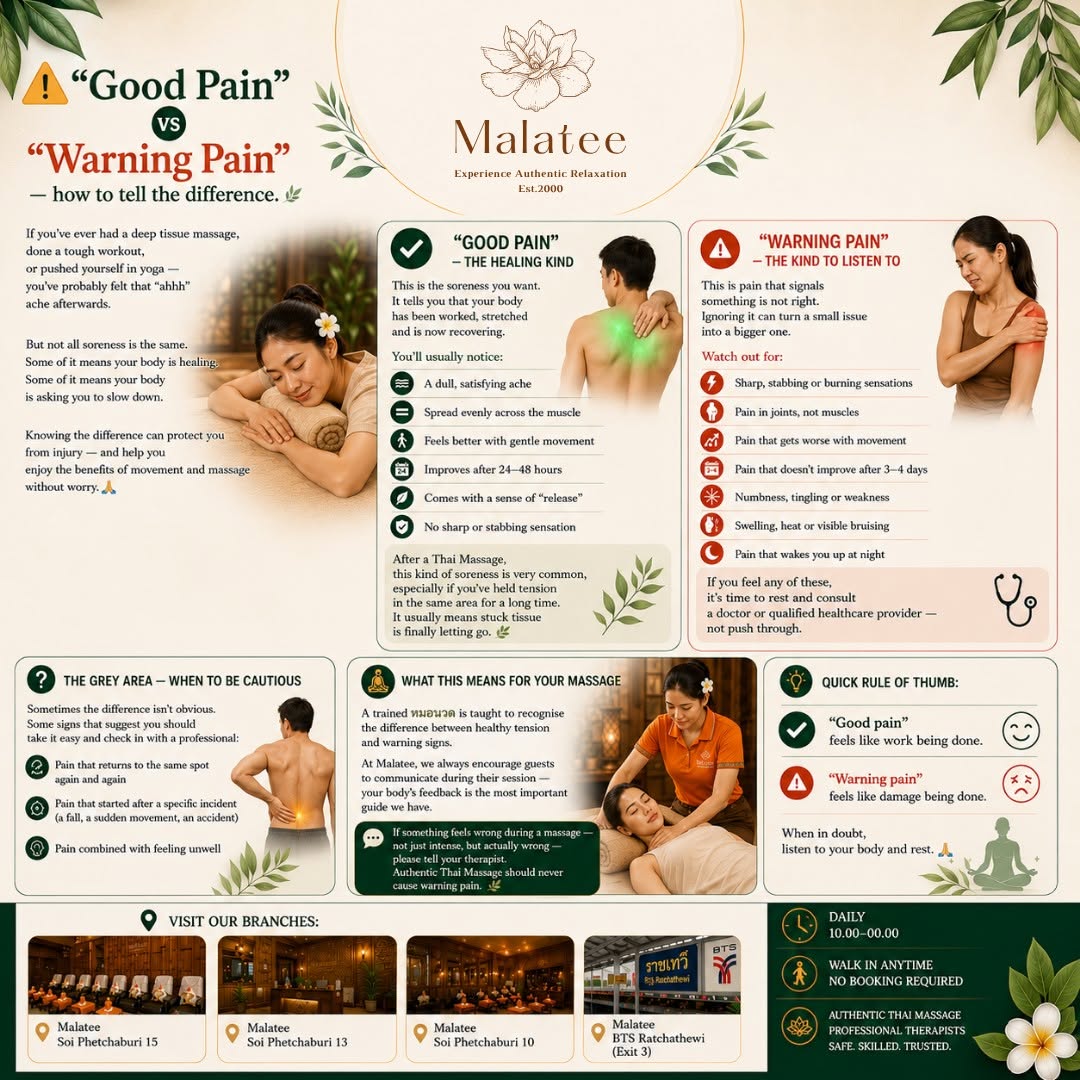
how to tell the difference. 
If you’ve ever had a deep tissue massage,
done a tough workout,
or pushed yourself in yoga —
you’ve probably felt that “ahhh”
ache afterwards.
But not all soreness is the same.
Some of it means your body is healing.
Some of it means your body
is asking you to slow down.
Knowing the difference can protect you
from injury — and help you
enjoy the benefits of movement and massage
without worry. 
 “Good Pain” — the healing kind
This is the soreness you want.
It tells you that your body
has been worked, stretched
and is now recovering.
You’ll usually notice:
→ A dull, satisfying ache
→ Spread evenly across the muscle
→ Feels better with gentle movement
→ Improves after 24–48 hours
→ Comes with a sense of “release”
→ No sharp or stabbing sensation
After a Thai Massage,
this kind of soreness is very common,
especially if you’ve held tension
in the same area for a long time.
It usually means stuck tissue
is finally letting go.
 “Warning Pain” — the kind to listen to
This is pain that signals
something is not right.
Ignoring it can turn a small issue
into a bigger one.
Watch out for:
→ Sharp, stabbing or burning sensations
→ Pain in joints, not muscles
→ Pain that gets worse with movement
→ Pain that doesn’t improve after 3–4 days
→ Numbness, tingling or weakness
→ Swelling, heat or visible bruising
→ Pain that wakes you up at night
If you feel any of these,
it’s time to rest and consult
a doctor or qualified healthcare provider —
not push through.
 The grey area — when to be cautious
Sometimes the difference isn’t obvious.
Some signs that suggest you should
take it easy and check in with a professional:
→ Pain that returns to the same spot
again and again
→ Pain that started after a specific incident
(a fall, a sudden movement, an accident)
→ Pain combined with feeling unwell
What this means for your massage
A trained หมอนวด is taught to recognise
the difference between healthy tension
and warning signs.
At Malatee, we always encourage guests
to communicate during their session —
your body’s feedback is the most important
guide we have.
If something feels wrong during a massage —
not just intense, but actually wrong —
please tell your therapist.
Authentic Thai Massage should never
cause warning pain.
 Quick rule of thumb:
“Good pain” feels like work being done.
“Warning pain” feels like damage being done.
When in doubt, listen to your body
and rest.
 Experience Authentic Relaxation | Est. 2000
 Visit Our Branches:
• Malatee Soi Phetchaburi 15
• Malatee Soi Phetchaburi 13
• Malatee Soi Phetchaburi 10
• Malatee BTS Ratchathewi (Exit 3)
─ ─ ─ ─ ─ ─ ─ ─ ─ ─ ─ ─ ─ ─ ─ ─ ─ ─ ─ ─ ─ ─ ─ ─ ─
“好的疼痛”vs”警告性疼痛”——
如何分辨它们的区别。
如果您曾做过深层组织按摩、
进行过艰苦的锻炼,
或在瑜伽中挑战自己——
您可能在之后感受过那种
“啊~”的酸胀感。
但不是所有酸痛都一样。
有些意味着您的身体在愈合。
有些则意味着您的身体
在请求您慢下来。
知道两者的区别可以保护您
免受伤害——并帮助您
享受运动和按摩的益处
而无需担忧。
“好的疼痛”——愈合型
这是您想要的酸痛。
它告诉您身体
已经经过锻炼、伸展
现在正在恢复。
您通常会注意到:
→ 钝钝的、令人满足的酸感
→ 均匀分布在肌肉上
→ 轻柔运动后感觉更好
→ 24–48 小时后改善
→ 伴随”释放感”
→ 没有尖锐或刺痛感
在泰式按摩之后,
这种酸痛非常常见,
特别是如果您长时间
在同一部位积压紧张。
通常意味着卡住的组织
终于释放了。
“警告性疼痛”——需要倾听的那种
这是身体信号
表示有什么不对劲。
忽视它可能将小问题
变成大问题。
注意:
→ 尖锐、刺痛或灼热感
→ 关节疼痛,而非肌肉
→ 运动时加剧的疼痛
→ 3–4 天后没有改善的疼痛
→ 麻木、刺痛或无力
→ 肿胀、发热或可见瘀伤
→ 夜晚痛醒
如果您感到这些任何一种,
是时候休息并咨询
医生或合格的医疗专业人员——
不要硬撑。
灰色地带——何时小心
有时区别并不明显。
一些建议您应该
放慢并咨询专业人士的迹象:
→ 反复回到同一部位的疼痛
→ 在特定事件后开始的疼痛
(跌倒、突然动作、事故)
→ 伴随身体不适的疼痛
这对您的按摩意味着什么
受过训练的หมอนวด被教导识别
健康紧张与警告信号之间的区别。
在玛拉蒂,我们始终鼓励客人
在按摩过程中沟通——
您身体的反馈是我们拥有的
最重要的指南。
如果按摩中感觉不对——
不仅仅是强烈,而是真的不对——
请告诉您的治疗师。
正宗泰式按摩绝不应该
引起警告性疼痛。
简单经验法则:
“好的疼痛”感觉像是工作在进行。
“警告性疼痛”感觉像是伤害在发生。
当犹豫不决时,倾听身体
并休息。
Experience Authentic Relaxation | Est. 2000
Visit Our Branches:
• Malatee Soi Phetchaburi 15
• Malatee Soi Phetchaburi 13
• Malatee Soi Phetchaburi 10
• Malatee BTS Ratchathewi (Exit 3)
─ ─ ─ ─ ─ ─ ─ ─ ─ ─ ─ ─ ─ ─ ─ ─ ─ ─ ─ ─ ─ ─ ─ ─ ─
“ปวดดี” vs “ปวดที่ควรระวัง” —
ดูยังไงให้รู้ความแตกต่าง
ถ้าคุณเคยนวดแบบ Deep Tissue
ออกกำลังกายหนักๆ
หรือฝืนตัวเองในโยคะ —
คุณคงเคยรู้สึก “อ๊า~”
แบบเมื่อยๆ หลังจากนั้น
แต่ความเมื่อยไม่ได้เหมือนกันทั้งหมด
บางอย่างหมายถึงร่างกายของคุณกำลังฟื้นฟู
บางอย่างหมายถึงร่างกายของคุณ
กำลังขอให้คุณช้าลง
การรู้ความแตกต่างจะปกป้องคุณ
จากการบาดเจ็บ — และช่วยให้คุณ
สนุกกับประโยชน์ของการเคลื่อนไหวและการนวด
อย่างไม่ต้องกังวล
“ปวดดี” — แบบที่กำลังเยียวยา
นี่คือความเมื่อยที่คุณต้องการ
มันบอกคุณว่าร่างกายของคุณ
ได้ทำงาน ยืด
และตอนนี้กำลังฟื้นฟู
คุณมักจะสังเกตเห็น:
→ ความเมื่อยตื้อๆ ที่รู้สึกดี
→ กระจายสม่ำเสมอทั่วกล้ามเนื้อ
→ รู้สึกดีขึ้นเมื่อขยับเบาๆ
→ ดีขึ้นภายใน 24–48 ชั่วโมง
→ มาพร้อมกับความรู้สึก “ปลดปล่อย”
→ ไม่มีความรู้สึกแหลมหรือแทง
หลังการนวดแผนไทย
ความเมื่อยแบบนี้พบได้บ่อยมาก
โดยเฉพาะถ้าคุณเก็บความตึง
ในจุดเดียวกันมานาน
มันมักหมายถึงเนื้อเยื่อที่ติดขัด
กำลังคลายตัวในที่สุด
“ปวดที่ควรระวัง” — แบบที่ต้องฟัง
นี่คือความปวดที่ส่งสัญญาณ
ว่ามีบางอย่างไม่ปกติ
การเพิกเฉยอาจเปลี่ยนปัญหาเล็กๆ
ให้กลายเป็นปัญหาใหญ่
ระวัง:
→ ความรู้สึกแหลม แทง หรือแสบร้อน
→ ปวดที่ข้อต่อ ไม่ใช่กล้ามเนื้อ
→ ปวดที่แย่ลงเมื่อเคลื่อนไหว
→ ปวดที่ไม่ดีขึ้นหลัง 3–4 วัน
→ ชา เสียวซ่า หรืออ่อนแรง
→ บวม ร้อน หรือมีรอยช้ำให้เห็น
→ ปวดที่ทำให้ตื่นกลางคืน
ถ้าคุณรู้สึกอาการเหล่านี้
ถึงเวลาพักและปรึกษา
แพทย์หรือผู้เชี่ยวชาญด้านสุขภาพ —
ไม่ใช่ฝืนต่อ
จุดสีเทา — เมื่อไรควรระมัดระวัง
บางครั้งความแตกต่างไม่ชัดเจน
สัญญาณบางอย่างที่บอกว่าคุณควร
ผ่อนและปรึกษาผู้เชี่ยวชาญ:
→ ปวดที่กลับมาที่จุดเดิม
ซ้ำแล้วซ้ำอีก
→ ปวดที่เริ่มหลังเหตุการณ์เฉพาะ
(ล้ม เคลื่อนไหวกะทันหัน อุบัติเหตุ)
→ ปวดร่วมกับความรู้สึกไม่สบาย
สิ่งนี้หมายความว่าอะไรกับการนวดของคุณ
หมอนวดที่ผ่านการฝึกอบรมถูกสอน
ให้แยกความแตกต่างระหว่างความตึงปกติ
กับสัญญาณเตือน
ที่มาลาตี เราสนับสนุนให้ลูกค้า
สื่อสารระหว่างเซสชันเสมอ —
ฟีดแบ็กจากร่างกายของคุณ
คือไกด์ที่สำคัญที่สุดที่เรามี
ถ้ามีอะไรรู้สึกผิดในระหว่างการนวด —
ไม่ใช่แค่หนัก แต่รู้สึก “ผิด” จริงๆ —
โปรดบอกหมอนวดของคุณ
การนวดแผนไทยแท้จริงไม่ควร
ทำให้เกิดปวดที่ควรระวัง
หลักการง่ายๆ:
“ปวดดี” รู้สึกเหมือนงานกำลังถูกทำ
“ปวดที่ควรระวัง” รู้สึกเหมือนความเสียหายกำลังเกิด
เมื่อไม่แน่ใจ ฟังร่างกายของคุณ
และพักผ่อน
Experience Authentic Relaxation | Est. 2000
Visit Our Branches:
• Malatee Soi Phetchaburi 15
• Malatee Soi Phetchaburi 13
• Malatee Soi Phetchaburi 10
• Malatee BTS Ratchathewi (Exit 3)
#GoodPainBadPain#ปวดดีปวดร้าย#疼痛识别#BodyAwareness#MassageEducation#ThaiMassageScience#MalateeThaiMassage#BangkokWellness#ThaiMassage#ThursdayWellness#ListenToYourBody
Lorem Ipsum is simply dummy text of the printing and typesetting industry